Play Fantasy Grand Slam of Darts 2026: Compete for $380 / €350 / £295 in guaranteed prizes
Fantasy Darts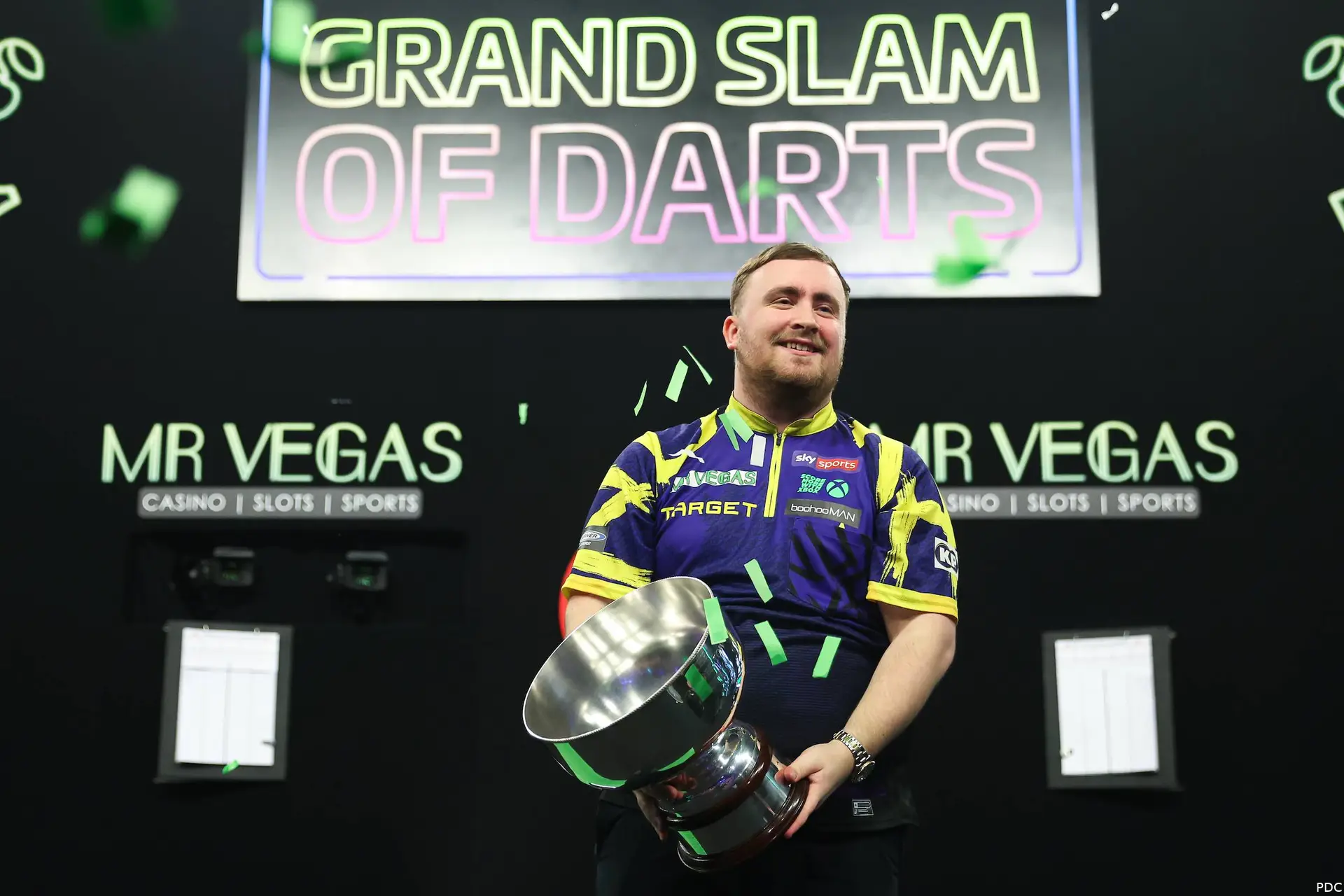
The Grand Slam of Darts returns to Wolverhampton on Saturday, 14 November, with a bigger field, a new tournament format and some fascinating clashes awaiting the world's best players. Luke Littler, Luke Humphries, Michael van Gerwen and 45 other competitors will battle for the prestigious Eric Bristow Trophy, while darts fans can add another dimension to the tournament by taking part in the Fantasy Grand Slam of Darts 2026.
ADVERTISEMENT
With $380 / €350 / £295 in guaranteed prizes, the fantasy competition challenges participants to select 11 players within a €103 million budget. Every match, every 180 and every important checkout could make the difference between winning a prize and finishing outside the top positions.
The Fantasy Grand Slam of Darts starts on Saturday, 14 November, at 14:15 CET (13:15 GMT), giving fans the opportunity to put their darts knowledge to the test throughout one of the biggest tournaments of the PDC season.
Enter here to play Fantasy Grand Slam of Darts 2026
Enter here to play Fantasy Grand Slam of Darts 2026

Grand Slam of Darts 2026: A bigger field and a completely new format
The Grand Slam of Darts has always occupied a special place on the PDC calendar. Unlike most major tournaments, qualification is not determined solely by world rankings or performances on the ProTour.
Instead, the event brings together champions and finalists from televised tournaments, alongside players who have secured their places through other qualifying routes, including the World Youth Championship and various seasonal rankings.
The result is a field combining established champions, emerging talents and dangerous outsiders who might not regularly feature in the latter stages of major televised events.
ADVERTISEMENT
The 2026 edition introduces the biggest change to the tournament in years.
For the first time, 48 players will compete at WV Active Aldersley in Wolverhampton, with the tournament running from 14 to 22 November.
Instead of the traditional eight groups of four players, the competitors have been divided into 16 groups of three.
Each player faces their two group opponents in matches played over the best of nine legs. The first player to win five legs claims the victory.
Crucially, only the winner of each group progresses to the last 16.
ADVERTISEMENT
That makes the group stage particularly unforgiving. One poor performance could be enough to end a player's hopes of reaching the knockout rounds, while leg difference and scoring consistency could prove decisive in determining who advances.
From the last 16 onwards, the tournament switches to a straight knockout format. Second-round matches are played over the best of 19 legs, with the quarter-finals, semi-finals and final contested over the best of 31 legs.
For Fantasy Darts participants, the new format creates an additional challenge. With fewer group matches and only 16 players advancing, identifying those capable of reaching the knockout stages becomes even more important.
Luke Littler, Luke Humphries and Michael van Gerwen headline the Grand Slam of Darts
Defending champion Luke Littler arrives in Wolverhampton looking to secure a third consecutive Grand Slam of Darts title.
ADVERTISEMENT
The 19-year-old has been drawn into Group A alongside Beau Greaves and Niels Zonneveld, setting up one of the most intriguing opening matches of the tournament.
Littler and Greaves will meet on Saturday evening, with their encounter attracting considerable attention following Greaves' victory over Littler at the 2025 World Youth Championship.
Elsewhere, Luke Humphries faces Joe Cullen and Paolo Nebrida in Group I, while three-time Grand Slam champion Michael van Gerwen has been drawn alongside Jeffrey de Graaf and Henry Coates in Group L.
Gian van Veen, Gerwyn Price, Stephen Bunting, Josh Rock and Jonny Clayton are among the other leading names hoping to make an impact.
The draw also features several interesting match-ups that could influence fantasy team selections.
ADVERTISEMENT
Jonny Clayton shares Group G with Rob Cross and Anton Östlund, while Wessel Nijman faces Niko Springer and Adam Sevada in Group H.
Martin Schindler, meanwhile, must overcome Chris Dobey and Jan Schmidt if he wants to reach the knockout stage.
With only one player advancing from each group, even the biggest favourites face a demanding route through the opening rounds.
How to play Fantasy Grand Slam of Darts 2026
The Fantasy Grand Slam of Darts gives participants the opportunity to create their own team and compete against other darts fans throughout the tournament.
ADVERTISEMENT
Each participant receives a virtual budget of €103 million to select 11 players from the tournament field.
Every player has an assigned price, meaning it is impossible to simply select all the biggest stars without considering the budget.
The challenge is to find the right balance between expensive tournament favourites and lower-priced players who could deliver strong performances.
Selecting players capable of progressing deep into the competition is important, but the fantasy scoring system also rewards individual statistics.
That means a player does not necessarily need to win the tournament to become a valuable member of your fantasy team.
ADVERTISEMENT
A consistent performer who regularly hits 180s, produces high averages and wins plenty of legs can accumulate a substantial number of points.
Likewise, a relatively inexpensive player who unexpectedly reaches the quarter-finals or semi-finals could prove to be one of the most valuable selections in the competition.
How does the Fantasy Grand Slam of Darts scoring system work?
The Fantasy Grand Slam of Darts rewards both match results and individual performances.
Players can earn points in several different categories:
ADVERTISEMENT
- Match victories
- Total legs won
- Leg difference
- 100+ scores
- 140+ scores
- 180s
- High checkouts
- Checkout percentage
- Three-dart averages
The scoring system means every leg matters, even when a player is involved in a losing effort.
For example, a player who wins a match 5-2 receives points for the victory, the five legs won and the positive leg difference.
Additional points are awarded for scoring statistics, including 100+ scores, 140+ scores, 180s and checkout performances.
A player producing an outstanding average and several maximum scores can therefore earn significantly more points than someone who wins a match with less impressive statistics.
This adds another layer of strategy to team selection.
Rather than focusing exclusively on tournament favourites, participants should also consider players who regularly produce strong scoring numbers.
With the group stage featuring relatively short matches, one exceptional performance could make a significant difference to the fantasy standings.
The same scoring categories apply throughout the tournament, from the opening group matches to the final.
Fantasy Grand Slam of Darts 2026: $380 / €350 / £295 in guaranteed prizes
There is more than just fantasy bragging rights at stake.
The Fantasy Grand Slam of Darts 2026 offers a guaranteed prize pool of $380 / €350 / £295, giving participants the chance to compete for cash prizes while following the action in Wolverhampton.
The entry fee is approximately $7.75 / €7 / £5.85 per team, while the first prize is worth approximately $87 / €78.40 / £65.50.
There are also 10 GC prizes available.
The prize pool is guaranteed, meaning participants know the minimum amount available before the competition begins.
With 11 players to select and a budget of €103 million, the challenge is to assemble a team capable of collecting points consistently across all nine days of the tournament.
Whether you build your team around established champions or take a chance on a few outsiders, every match can influence your final position.
Fantasy Grand Slam of Darts 2026 strategy: How to build a competitive team
Choosing the right 11 players is not simply a matter of selecting the biggest names in the tournament.
The new Grand Slam format means the group-stage draw could play an important role in determining which players offer the best value.
With only one player progressing from each group, selecting two or three players from the same group carries an obvious risk. At most, one of them can reach the knockout stages.
That makes it worth examining the draw before finalising your team.
Luke Littler may be one of the leading contenders for the title, but his group includes Beau Greaves and Niels Zonneveld. Similarly, Jonny Clayton and Rob Cross cannot both progress from Group G.
Participants should also pay attention to the prices assigned to individual players.
An expensive favourite may offer considerable potential if they reach the final, but selecting too many high-priced players could leave insufficient funds to complete a balanced squad.
Lower-priced players with strong scoring statistics could therefore prove particularly valuable.
Another factor to consider is the length of the matches.
The opening group games are played over a maximum of nine legs, while the knockout matches become considerably longer.
Players who progress beyond the group stage will have more opportunities to collect points through 180s, legs won, high checkouts and other statistics.
A player reaching the semi-finals or final could therefore become a major contributor to your fantasy team's overall score.
Ultimately, the key is finding the right combination of players who can win matches, progress through the draw and consistently produce strong individual statistics.
When is the Fantasy Grand Slam of Darts 2026 deadline?
The Fantasy Grand Slam of Darts 2026 begins on Saturday, 14 November, at 14:15 CET (13:15 GMT).
Participants must submit their teams before the competition starts.
The Grand Slam itself begins earlier that afternoon, with the opening session scheduled for 13:00 GMT, followed by an evening session featuring several of the tournament's biggest names.
Once the fantasy competition is underway, participants can follow their selected players' performances and see how their team compares with others in the standings.
With nine days of darts ahead, there will be plenty of opportunities for the rankings to change as players progress through the tournament.
Enter the Fantasy Grand Slam of Darts 2026 and compete for prizes
The expanded Grand Slam of Darts promises nine days of top-level action in Wolverhampton, with Luke Littler chasing a third successive title and 47 other players hoping to stop him.
For darts fans who enjoy analysing the draw, comparing player statistics and predicting tournament results, the Fantasy Grand Slam of Darts offers an additional way to follow the competition.
With a virtual budget of €103 million, participants must select 11 players and try to accumulate as many points as possible through match victories, scoring statistics and checkout performances.
The competition offers $380 / €350 / £295 in guaranteed prizes, with an entry fee of approximately $7.75 / €7 / £5.85 per team.
The first prize is approximately $87 / €78.40 / £65.50.
The Fantasy Grand Slam of Darts 2026 starts on Saturday, 14 November, at 14:15 CET (13:15 GMT).
Think you can select the winning team?

Samuel GillChief Content Officer
Samuel Gill is the Chief Content Officer (CCO) of DartsNews.com, a role he has held since 2020. He is responsible for editorial governance across the platform, including setting content standards, overseeing accuracy and consistency, and guiding long-term editorial strategy across professional darts coverage. Since joining, he has contributed more than 10,000 articles and editorial pieces, playing a central role in the development and daily operation of the site.
Based in Leicester, Samuel has extensive experience in darts media and has been closely involved in coverage of the professional darts circuit for several years. Within the UK darts community, he is a recognised figure known for his consistent editorial output and ongoing reporting on major tournaments and developments across the PDC calendar.
In his current role, Samuel works closely with editors and writers to ensure content meets clear journalistic standards, with a focus on source verification, editorial consistency, and timely updates when new, confirmed information becomes available.
claps 0visitors 0
Just in



Popular news
Latest comments
- He produced some impressive numbers in that qualifying campaign. I'm excited to see him compete at the World Championship once again, even if it will be difficult to replicate last year's success even with an improved performance, with the draw playing a huge role in determining his fortunes.Deduce635811-11-2026
- I often think about this very question. I think they should revive the format. They could even invite representatives from MODUS Super Series, with four series winners from the past year, and the ADC, with finalists from the Global Championship and perhaps other events. Why not throw in eligible representatives from the JDC and even the soft-tip game too?Deduce635811-11-2026
- So what if littler missed out, he doesnt have to enter everythingant10-11-2026
- Good, absolutely no loss if we never see this dancing goof ever again......no that is not fair. He absolutely cannot and has never been remotely able to dance!richieburnettrocks10-11-2026
- Yes Phil,now the money in the game is bigger than ever,you'd play littler. Well so would I! Retire on your memory Phil,and your successful careerrick6709-11-2026
- And why should he listen to you?Deduce635807-11-2026
- Ultimately it is a bye for whoever draws Barney. It will be another stroppy and sulky performance once he goes behind. Barney was excellent but really must completely call it a day now.richieburnettrocks07-11-2026
- I'm disappointed he was not able to secure a spot at the Grand Slam. With Carl Sneyd taking care of Daryl Gurney, he would have had to beat Andy Boulton before facing the winner of Sneyd vs Mensur Suljović for a Grand Slam spot. Unfortunately, after beating Filip Bereza comfortably, he succumbed to Boulton, and the board would ultimately be won by the highly inconsistent Carl Sneyd. Since he could instead have been drawn against the likes of Cristo Reyes, Dirk van Duijvenbode and Stephen Bunting, I think once Gurney was out of the picture he would have been favourite to win his board, and it seems like a massive missed opportunity to put 5 grand on his ranking and seal another major TV appearance ahead of the Worlds. The highs and lows of following Raymond van Barneveld!Deduce635806-11-2026
- Probably i will receive a lot of backlash and hate for this reaction, but well, so be it. I am more than sick and tired of those lies of you Barry Hearn. How dare you defend yourself over the back of Fallon’s son! He has a disability and not an illness, so let me correct that for you! I know because I have the exact same disability. I have tried to reach out to Fallon in the past, and offered her to help her and her son, because I was struggling with the same problems, and I understood the boy. I wanted him to have finally someone who understood him. However she told me that she did not want my help, and I have respected Fallon’s choice. I have never asked Fallon for money. They don’t need money in that case. I only ever wanted the best for Fallon and Rory, but I have to be honest about the situation. Fallon should tell the true story and not be forced to tell lies. I don’t hate Fallon, and I don’t begrudge or envy a single penny that she gets, but this situation/case is just not fair. I hate the lies and the dishonesty and injustice. I don’t want Fallon to be hated because there is an unfair disadvantage created. Don’t proclaim your false lies over the back of Rory! I only stand for integrity and justice. I am precisely the one who always sticks up for Fallon. And you don't, you don't give a damn about them. You were never there for them, and now you only want to save your own position! You are just trying to talk your way out of your own bad behavior at the expense of someone with a disability. And to Fallon, I don’t know if this may ever reach you, and you read it, but I want you to know I love you and I love your son Rory very much, I am sorry how things developed and went. I hope you and Harriet are still friends. I am sorry if I were too persistent to you, or you experienced it that way, but it was never my intention. Please understand I have autism as well. As Barry Hearn would say, I am only just a human being too, and I also make mistakes and misjudge things sometimes. I promise you I did everything out of the deepest love and care for you and Rory. If I were you, I should just keep all the money, only please never be dishonest or tell lies anymore for Barry Hearn, or anyone else. I hope you have the best life, and I wish nothing more than the best for you. I have always loved the two of you. Farewell.Hiddo05-11-2026
- She is a professional. If darts is her income, she is a professional. Same as Adrian Lewis, Martin Adams. A tour card just means someone can play on the PDC tour. You could even make a case that Clayton wasn't a professional (until recently I believe) because he had employment elsewhere.BandB04-11-2026