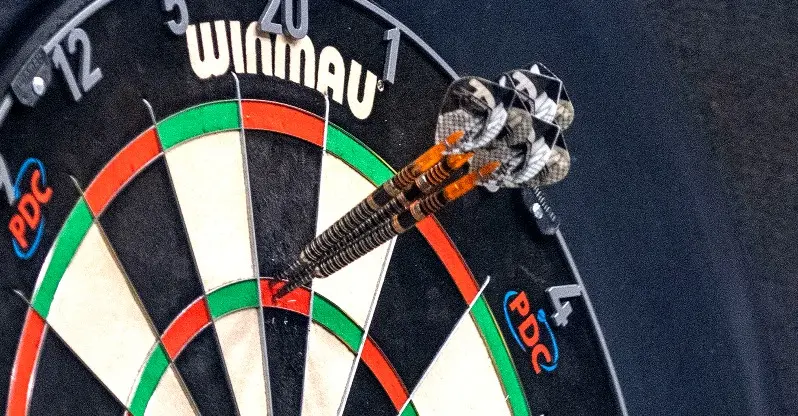
Darts does not just stage a match. It stages a
mood.
ADVERTISEMENT
You can see it in the fancy dress, hear it in
the chants, and, if you have ever watched the World Championship through a
broadcast break, feel it in the tune that resets the room. Asked what song is
played between sets at the Worlds, Sky Sports answers with the kind of clarity
usually reserved for rules explainers: it’s “Chase the Sun” by Planet Funk, and “you
just have to join in when it comes on.”
That small detail helps explain something
bigger. Darts has developed a set of instantly recognisable cues, numbers,
sounds, and shared references, that travel beyond the oche. And when a sport
becomes that compressible as entertainment, other industries start to treat its
atmosphere as reusable material.
Social roots: from pubs to global arenas
In its modern British form, darts is rooted in
social spaces: Encyclopaedia Britannica notes it is “ordinarily played in the
public house… or in a club, rather than in the home.” That origin story matters
here because it puts darts in the same cultural neighbourhood as leisure
industries that have long mixed competition, socialising and, for adults,
gambling.
The World Championship then amplifies those
roots into spectacle, place and ritual as much as performance. DartsNews’ own
reporting on “Chase the Sun” captures how the band members behind the track
have become “darts fans for life,” describing the surreal longevity of hearing
their song echo through an arena atmosphere that is now global.
Why darts symbolism translates easily into gaming
A sport built on simple, recognisable cues
ADVERTISEMENT
So what does that have to do with casino and
gaming products?
The simplest answer is that darts has become
unusually “legible” to non-fans. Even casual viewers understand what a 180
means. “Bullseye” already carries wider cultural meaning. “Double top” is both
a darts finish and a phrase that feels like a win condition. Those are exactly
the kinds of symbols game designers look for: short, meaningful cues that can
be turned into mechanics.
That is why the crossover is no longer
hypothetical. It is on the record as a business decision.
Licensed products: when darts becomes intellectual property
In February 2021, trade press reported that
Blueprint Gaming partnered with the Professional Darts Corporation (PDC) to
launch a World Darts Championship-themed online slot,
officially licensed from the PDC. In the same announcement, Blueprint’s
marketing director Jo Purvis framed the game around recognizability, “the
sport’s biggest and most recognisable characters”, and promised an experience
that would “resonate with a large audience.”
ADVERTISEMENT
The PDC’s side of the story was equally
explicit. Chairman Barry Hearn described the partnership as “another important
step to broaden the appeal of the sport to more people across the globe,”
positioning the slot not as a novelty, but as a deliberate extension of darts’
reach into other entertainment channels.
Note what is happening in that framing. A
darts tournament is being treated as licensable intellectual property: star
names, visual trophies, and a set of familiar cues that can be placed into a
“proven casino format.” Once developed, these titles typically appear across
regulated online platforms, including casino brands such as AdmiralCasino,
where themed releases sit alongside broader interactive entertainment content.
Whether you like that direction or not, it is evidence that darts’ symbols have
become valuable outside the match itself.
Character-driven adaptations and broader audiences
Other developers have approached the same idea
through character-led formats rather than direct licensing. Titles built around
recognisable “heroes” or stylised player figures have been introduced across
major European operator networks, often positioned as entertainment capable of
reaching audiences beyond dedicated darts fans. Product teams have frequently
highlighted how familiar iconography can act as an accessible entry point,
suggesting that darts themes work not only for enthusiasts, but also for players
encountering the sport through interactive entertainment for the first time.
Virtual darts and the rise of interactive formats
ADVERTISEMENT
Virtual sports illustrate the same logic in a
different form, darts rendered as an on-demand digital event. Industry
announcements around new virtual darts products have emphasised selectable
match-ups, recognisable scoring moments and betting markets such as “Match
Winner” or “Winning Checkout.” Rather than replicating traditional broadcasts,
these formats repackage the rhythm of darts into short, repeatable experiences
designed for online environments, showing how the sport’s structure translates
naturally into interactive scheduling.
Gamification around the World Championship
The same pattern appears in tournament-driven
gamification, where darts-themed mini-games and interactive formats become part
of the wider event ecosystem. These experiences often revolve around simple
mechanics — quick challenges, leaderboard races or digital rewards, designed to
accompany the surge of attention that surrounds the competitive calendar.
During major tournaments such as the World Championship, darts extends beyond
the arena into regulated sportsbook environments, with betting markets sometimes
appearing on platforms like AdmiralCasino, reflecting how the sport’s
calendar now intersects with broader interactive entertainment formats.
If darts is the “Christmas sport,” these products are attempting to live inside
the same seasonal attention spike.
Regulation and responsibility in the modern landscape
None of this means darts has “become
gambling,” and it would be misleading to write as if the sport’s identity is
reducible to sponsorship or betting-market adjacency. Darts remains a craft:
repetition under pressure, the psychology of doubling, the pacing of sets. But
it does mean that modern darts has built an exportable package, symbols and
rituals that can be translated into interactive formats with minimal
explanation.
ADVERTISEMENT
There is also a practical, structural reason
this matters for coverage: gambling is a sensitive topic in UK sport, and
regulation has increasingly emphasised harm reduction and safer design. The UK
government’s gambling reform white paper describes measures aimed at making
online gambling safer and limiting features linked to higher risk.
Any darts-to-gaming story
should acknowledge that context without turning into a campaign slogan or a
shopping guide.

Samuel GillChief Content Officer
Samuel Gill is the Chief Content Officer (CCO) of DartsNews.com, a role he has held since 2020. He is responsible for editorial governance across the platform, including setting content standards, overseeing accuracy and consistency, and guiding long-term editorial strategy across professional darts coverage. Since joining, he has contributed more than 10,000 articles and editorial pieces, playing a central role in the development and daily operation of the site.
Based in Leicester, Samuel has extensive experience in darts media and has been closely involved in coverage of the professional darts circuit for several years. Within the UK darts community, he is a recognised figure known for his consistent editorial output and ongoing reporting on major tournaments and developments across the PDC calendar.
In his current role, Samuel works closely with editors and writers to ensure content meets clear journalistic standards, with a focus on source verification, editorial consistency, and timely updates when new, confirmed information becomes available.
claps 0visitors 0
Just in
Popular news

Latest comments
- I agree,I can't believe the lack of coverage of this sad loss. Always enjoyed watching him,but I guess now it's all about littler,well it seems that way. Darts has sadly lost a good manrick6717-10-2026
- In the absence of a report regarding the death of Stefan Lord, I'll assist. An excellent player in the late 70s and early 80s, he actually won the now defunct 3rd place match at two World Championships and a couple of the News of the World Championships. A fabulous player and easily the best Swedish player ever. Rest peacefully Stefan.richieburnettrocks16-10-2026
- Joking aside, it is the second most watched sport on sky (more than golf, F1 etc) behind football only, and in participation is second to only football and swimming. It doesn't get the attention or sponsorship of "bigger" sports because it's not as sexy, but it's right up there.BandB13-10-2026
- i love darts but you can't seriously believe it's the second most popular sport in the uk. even top five is pushing it. it may be the fastest growing, though.colt13-10-2026
- I'm a big Clayton fan, but he's got this completely wrong. Qualification criteria exists for a reason - so just as failing to make the top 32/64 for the Euro championships/PT Finals means you miss out, so does not lifting a title for this one.26sForFun12-10-2026
- The players who deliberately slow the game down are usually boring and win very little in the way of silverware. Horrible to watch.MrYnyslas197112-10-2026
- [“The Gentle” then used a sweeping and questionable phrase...] You anglocucks are hilariously finished in every sense of the word.Critical99911-10-2026
- I love Jonny but I disagree. The Grand Slam was always supposed to be "champion of champions" type competition. If the top 16 are guaranteed participation in everything there will be so much less jeopardy involved in qualifying and each major tournament will lose its unique flavour which the PDC has worked hard trying to develop. I enjoy following the qualification races towards the end of the year, and while consistency should have its rewards, the truth is Jonny hasn't reached a major final all year or won a single event on the Pro Tour. Being consistent is one thing, but that alone should have consequences as the sport's elite should not be prepared to accept consistently strong performances, their foremost motivation should be to win and this should be what separates them from the rest, not the consistency of their performances. Jonny is expecting that losing should be enough; it shouldn't be, at least not as far as the Grand Slam is concerned.Deduce635811-10-2026
- Well being honest,it doesn't matter what level you play at, there's always someone who slows it down to suit themselves,and extra swig of water, replacing flights, asking the ref what the score is. It happens wherever. I'm not saying it's professional,but I'm sure we've all seen it beforerick6711-10-2026
- Agree completely. Not sure how a ranking event can have a criteria not based on rankings. And he right on popularity. In the UK second only to football.BandB11-10-2026
Loading