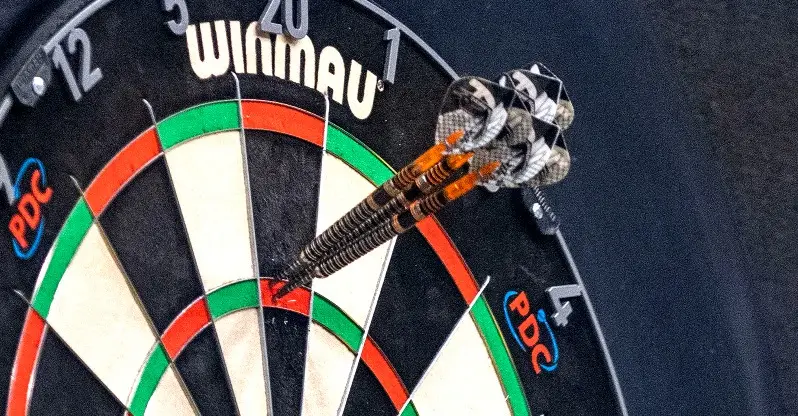
Luke Littler’s 6–5 victory over Luke Humphries in the 2026 World Masters final required all 11 available sets. His opening win against Mike De Decker finished 3–2. Both reached a deciding set, yet the winning totals were different. The distinction becomes clearer when the score is read alongside the match format: it identifies what is being counted and how many units a competitor must win.
ADVERTISEMENT
At the World Masters, those units operate on two levels. The tournament’s results and format show that every set was best of three legs, while matches required different numbers of sets as the main draw progressed. Winning a leg advanced the set; winning a set advanced the match. The winning margin within a set did not change its value in the match score.
How legs, sets, and maps fit into a match
Counter-Strike 2 has a comparable distinction between winning part of a match and completing it. At the IEM Beijing 2026 tournament in November, teams will contest a series of maps. A map is one game within that series, and the match score counts maps won. Its place in the overall score resembles a darts set, although the two are different competitive units.
ESL’s 2026 tournament details specify best-of-three matches before a best-of-five final. In each case, the series brings map results together into one match result. The number following “best of” refers to maps, whereas the equivalent number in a Masters match description refers to sets.
In the Masters, a set ended when a player won two legs. Each new set had its own leg score, while completed sets remained on the match score. Leg victories were counted within their sets, rather than added to one continuous race across the whole match. The scoring structure grouped them into separate contests, each contributing one set towards victory.
Longer finals raise the winning target
The World Masters increased that target through its main draw. First-round matches were best of five sets, requiring three to win. The second round and quarter-finals moved to best of seven, requiring four. In the semi-finals, best of nine meant five sets to win; the best-of-11 final required six. Each individual set still ended when a player won two legs.
ADVERTISEMENT
A longer match can still consist of short sets. The final required six set wins, twice the opening round’s target, but each set remained short. A player still had to secure it within the same limited number of legs. Extending the match did not turn each set into a longer contest; it increased the number of successful sets required.
Beijing changes the target at its final. Before that stage, a team must collect two maps; the finalists need three. The comparison concerns the number of completed units needed for victory. It does not establish that a map takes as long as a set, or that the two sports impose equivalent demands.
Nor does “best of” specify a fixed duration. It describes the permitted length in sets or maps, with the actual number played depending on the result. A longer winning distance and a longer running time are different measurements, so the format alone cannot supply a finishing time.
Qualification decides the field
Qualification operates separately from those match rules. The 32-player World Masters main draw combined 24 automatic entrants with eight preliminary qualifiers. Beijing’s allocation combines 13 ranking invitations with three qualifying places. These routes determine who reaches the event; the published match format determines what those entrants must win once competing at a particular stage. Entry through a qualifier does not create a different winning target in the same round.
ADVERTISEMENT
Beijing’s ranking places include 10 global invitations and one each from North America, South America, and Asia. Its qualifying places comprise two from the global qualifier and one from the Asian qualifier. The regional allocation means the invitation list is not simply the first 13 teams in one global ranking.
The event also separates admission from seeding, which determines placement in the draw. ESL’s published plan uses the first available monthly ranking publication in August 2026 for invitations and the October 2026 publication for seeding. Those snapshots serve different decisions: the earlier one governs ranking-based entry, while the later one is used to arrange the entrants. A team’s position in October therefore cannot be read as the position that originally determined its invitation.

Samuel GillChief Content Officer
Samuel Gill is the Chief Content Officer (CCO) of DartsNews.com, a role he has held since 2020. He is responsible for editorial governance across the platform, including setting content standards, overseeing accuracy and consistency, and guiding long-term editorial strategy across professional darts coverage. Since joining, he has contributed more than 10,000 articles and editorial pieces, playing a central role in the development and daily operation of the site.
Based in Leicester, Samuel has extensive experience in darts media and has been closely involved in coverage of the professional darts circuit for several years. Within the UK darts community, he is a recognised figure known for his consistent editorial output and ongoing reporting on major tournaments and developments across the PDC calendar.
In his current role, Samuel works closely with editors and writers to ensure content meets clear journalistic standards, with a focus on source verification, editorial consistency, and timely updates when new, confirmed information becomes available.
claps 0visitors 0
Just in



Popular news

Latest comments
- Everyone knows what a fantastic champion Taylor was,but his performances in the seniors were poor. He wouldn't throw littler off stage,as he'd miss these days!!rick6712-11-2026
- He produced some impressive numbers in that qualifying campaign. I'm excited to see him compete at the World Championship once again, even if it will be difficult to replicate last year's success even with an improved performance, with the draw playing a huge role in determining his fortunes.Deduce635811-11-2026
- I often think about this very question. I think they should revive the format. They could even invite representatives from MODUS Super Series, with four series winners from the past year, and the ADC, with finalists from the Global Championship and perhaps other events. Why not throw in eligible representatives from the JDC and even the soft-tip game too?Deduce635811-11-2026
- So what if littler missed out, he doesnt have to enter everythingant10-11-2026
- Good, absolutely no loss if we never see this dancing goof ever again......no that is not fair. He absolutely cannot and has never been remotely able to dance!richieburnettrocks10-11-2026
- Yes Phil,now the money in the game is bigger than ever,you'd play littler. Well so would I! Retire on your memory Phil,and your successful careerrick6709-11-2026
- And why should he listen to you?Deduce635807-11-2026
- Ultimately it is a bye for whoever draws Barney. It will be another stroppy and sulky performance once he goes behind. Barney was excellent but really must completely call it a day now.richieburnettrocks07-11-2026
- I'm disappointed he was not able to secure a spot at the Grand Slam. With Carl Sneyd taking care of Daryl Gurney, he would have had to beat Andy Boulton before facing the winner of Sneyd vs Mensur Suljović for a Grand Slam spot. Unfortunately, after beating Filip Bereza comfortably, he succumbed to Boulton, and the board would ultimately be won by the highly inconsistent Carl Sneyd. Since he could instead have been drawn against the likes of Cristo Reyes, Dirk van Duijvenbode and Stephen Bunting, I think once Gurney was out of the picture he would have been favourite to win his board, and it seems like a massive missed opportunity to put 5 grand on his ranking and seal another major TV appearance ahead of the Worlds. The highs and lows of following Raymond van Barneveld!Deduce635806-11-2026
- Probably i will receive a lot of backlash and hate for this reaction, but well, so be it. I am more than sick and tired of those lies of you Barry Hearn. How dare you defend yourself over the back of Fallon’s son! He has a disability and not an illness, so let me correct that for you! I know because I have the exact same disability. I have tried to reach out to Fallon in the past, and offered her to help her and her son, because I was struggling with the same problems, and I understood the boy. I wanted him to have finally someone who understood him. However she told me that she did not want my help, and I have respected Fallon’s choice. I have never asked Fallon for money. They don’t need money in that case. I only ever wanted the best for Fallon and Rory, but I have to be honest about the situation. Fallon should tell the true story and not be forced to tell lies. I don’t hate Fallon, and I don’t begrudge or envy a single penny that she gets, but this situation/case is just not fair. I hate the lies and the dishonesty and injustice. I don’t want Fallon to be hated because there is an unfair disadvantage created. Don’t proclaim your false lies over the back of Rory! I only stand for integrity and justice. I am precisely the one who always sticks up for Fallon. And you don't, you don't give a damn about them. You were never there for them, and now you only want to save your own position! You are just trying to talk your way out of your own bad behavior at the expense of someone with a disability. And to Fallon, I don’t know if this may ever reach you, and you read it, but I want you to know I love you and I love your son Rory very much, I am sorry how things developed and went. I hope you and Harriet are still friends. I am sorry if I were too persistent to you, or you experienced it that way, but it was never my intention. Please understand I have autism as well. As Barry Hearn would say, I am only just a human being too, and I also make mistakes and misjudge things sometimes. I promise you I did everything out of the deepest love and care for you and Rory. If I were you, I should just keep all the money, only please never be dishonest or tell lies anymore for Barry Hearn, or anyone else. I hope you have the best life, and I wish nothing more than the best for you. I have always loved the two of you. Farewell.Hiddo05-11-2026