“I just think it's going to be almost impossible” – Simon and son Mason Whitlock can't agree over darts most prominent subjects
MODUS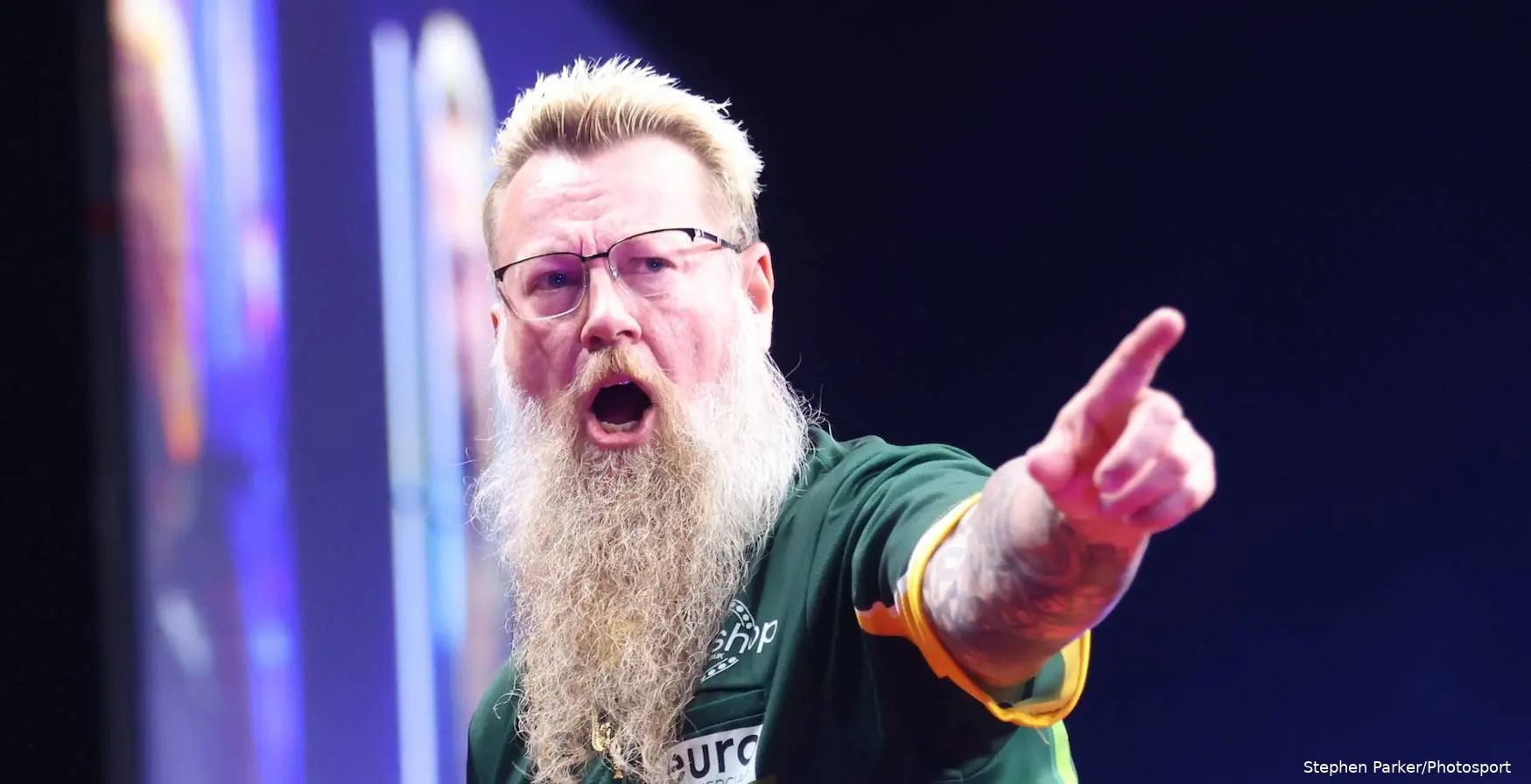
Simon Whitlock and his son Mason Whitlock don’t see eye to eye on everything in the darts world. In a striking conversation, father and son were put opposite each other with various statements about the sport. While they agreed on some points, clear differences emerged too. From the current ranking system to the sport’s future and Australia’s much-debated defeat at the 2012 World Cup of Darts, the Whitlocks refused to be boxed into one camp.
ADVERTISEMENT
Speaking on the MODUS Super Series, One of the first statements addressed how the darts world ranking is compiled. The claim that the ranking system should not be based on prize money met little support from Simon Whitlock — who will be in action soon at the World Series of Darts Finals.
“I think what they've done in the past 20 years has been correct,” the Australian replied. Mason initially disagreed, but then said he actually believes the ranking system should be based on earnings. In the end, father and son aligned on the current method.
The system in which players are ranked by prize money earned at ranking tournaments has been a key pillar of professional darts for years. The Whitlocks believe that makes sense. Those who stack up big sums over a longer period deserve to sit high on the ladder.
“I don’t think anyone will ever do that again”
The conversation also turned to the future at the very top. That inevitably brought up the exceptional dominance of players like Phil Taylor and Michael van Gerwen. Simon Whitlock sees how hard it is nowadays to rule the sport for years on end.
Read also

“I just think it's going to be almost impossible with the quality of players to win, especially 16 world titles. I just don't think anyone will ever do that again,” said Whitlock.
ADVERTISEMENT
Mason was a touch more optimistic. He pointed out that age can be a decisive factor when an extraordinary tally is in play. “I think Littler will do it, precisely because of his age,” he said. At the same time, he stressed talent alone won’t be enough. “No, he's definitely got the ability. After so many years, he's got to play,” Simon added.
The discussion underlines how extraordinary the achievements of the sport’s greatest names are. In an era where darts is broader and stronger, the Whitlocks say it’s harder than ever to stay unbeaten at the top for years. The field is deeper, there are more strong players, and young talents are constantly emerging.

Mason Whitlock wants to follow in his father’s footsteps
Australian darts has more potential, says Whitlock
When the focus shifted to Australia, father and son were again critical but positive about their homeland’s possibilities. According to Mason, Australian darts is sometimes underrated, mainly because the country has fewer big tournaments and leagues than, for example, Germany and other European nations. “II think it's a bit underrated, just because we haven't got a lot of players coming through like a lot of other countries, like Germany and a lot of the European countries,” said Mason.
ADVERTISEMENT
He believes that’s largely down to infrastructure. In Europe, young players can compete far more often and develop against strong opposition. Australians, by contrast, must travel long distances more frequently to take part in competitions. “Probably because we don't have as many competitions, and you don't get as many people travelling to the competitions,” Mason explained.
Simon mainly looked at the gap between the absolute elite and the rest of the Australian field. “I just think the top Australians compared to, I'd say, there's about 20 great Australian players right now. Compare them to the mid-ranked and lower-ranked Australians, I think the gap is so high,” said Simon. “So I just think, yeah, without those top 20, I think it'd be really hard to judge them.”
The Whitlocks thus point to a key problem and, at the same time, a major opportunity. Australia has enough talent, but needs more events and pathways to develop the depth of its player base.
Who hits a nine-darter first?
ADVERTISEMENT
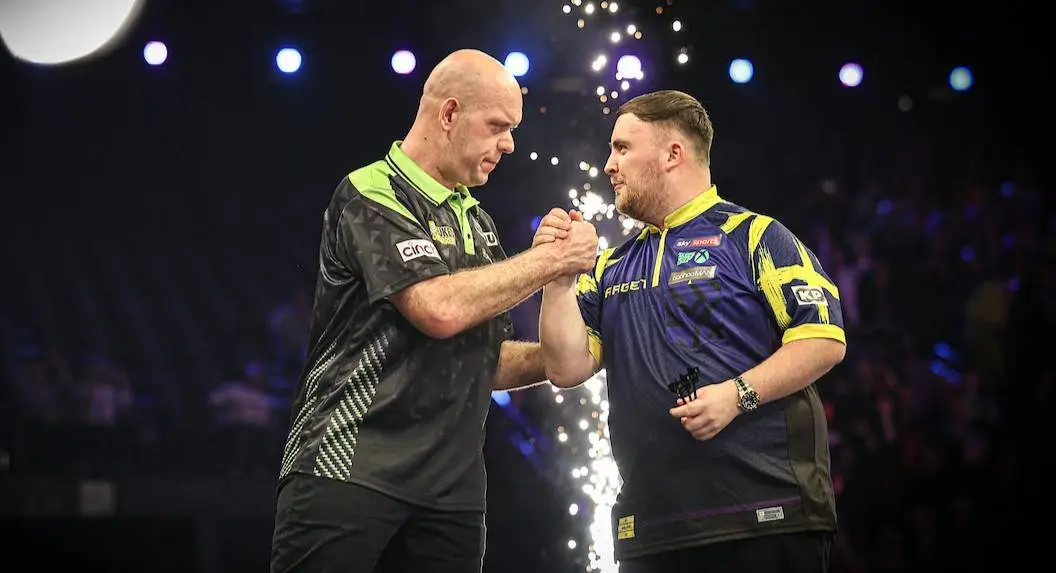
Naturally, a lighter question had to feature too. The Whitlocks were asked whether Mason would throw a nine-darter in the MODUS Super Series before his father Simon. Mason could laugh at that. “I'm just going to say I feel like I'm trying a bit better. I might get one before him, but you never know, he might go and sneak one.”
Simon could agree with that. “I'm agreeing. I just think, yeah, you could pull one any time. It's just one leg.”
Mason then made clear he was mainly trying to test his dad psychologically. “I'm just getting in his head, really..” For now, the tally was still at zero, Mason said. “I haven't got any yet,” he admitted with a laugh.
The rivalry between father and son is clearly there. While Simon has built an outstanding résumé and was for years one of the most recognisable Australian darters in the world, Mason refuses to be filed away as merely the son of a former finalist. He wants to make his own name on stage.
ADVERTISEMENT
“The Luke Littler effect”
Simon and Mason were strikingly aligned on one topic: the huge impact Luke Littler has had on darts. According to the Whitlocks, the rise of the young Englishman has not only delivered exceptional viewing figures, but also inspired a new generation of players. “What Luke Littler has done in the past few years and how he's boosted the sport, and all these new kids coming in, it's ridiculous how good,” said Mason.
Simon fully agreed. The surge in interest among young fans stands out to him. “The viewership as well, it's massive,” he noted. Mason summed it up neatly: “Just the Luke Littler effect.”
The Whitlocks believe darts is currently in a particularly strong period. “You've got all the young kids coming into darts, and darts is extremely strong right now. Everybody's watching it, talking about it. It's just a great spectacle at the moment,” said Mason.
Their words reflect a trend that has become increasingly clear in recent years. Littler has not only developed at breakneck speed on the oche, he has also become a face that attracts new fans to the sport.
ADVERTISEMENT

Simon Whitlock played two World Championship finals
The painful memory of the 2012 World Cup
The most striking statement in the conversation concerned the 2012 World Cup of Darts. It was suggested that Paul Nicholson was to blame for Australia’s elimination. The Whitlocks reacted instantly. “Oh my God,” came the response.
Even so, Mason did not want to hold Nicholson fully responsible for the defeat. He pointed out that the pressure must have been immense, especially as Nicholson had the first three match darts. “I didn't put strongly disagree because of the pressure he must have been under, especially having the first three match darts.” Mason explained.
Then came an important caveat. His father Simon also had chances to close it out. “But, of course, Dad also missed three match darts,” Mason noted. Simon could hardly claim Nicholson was the sole culprit. “I can’t help but disagree,” he said.
ADVERTISEMENT

His reasoning was simple. “I'm just agreeing because he had first shot and he missed. I didn't expect to get another shot, and I probably shouldn't have got another shot.”
The painful memory of that match still lingers for the Whitlock family. At the same time, the story shows Simon’s sporting honesty. Despite the disappointment, he was unwilling to place all the responsibility on his former compatriot. “Sorry, Paul,” Simon concluded with a wink.
The conversation between Simon and Mason Whitlock offered an engaging look at Australia’s darts family. Father and son often disagree, but they share the same passion for the sport. They see the challenges facing Australian darts, yet they are equally excited about the sport’s rapid global growth.
Above all, the Whitlocks have no doubt about Luke Littler’s influence. The young Englishman, they say, has brought a new generation into darts and helped make the sport more popular than ever. For Mason Whitlock, that development also means more and more opportunities for young players to prove themselves at the highest level.
ADVERTISEMENT
Lucas MichaelDarts Journalist
Lucas Michael is a darts journalist and reporter based in Cambridge, UK, and has been part of the DartsNews team since 2025. He covers professional darts through reports, analysis, round-ups, and live coverage, with a focus on clear context and accurate reporting across the PDC calendar.
A key part of his work is liveblogging major tournaments throughout the year, providing real-time updates, match coverage, and contextual reporting across the professional circuit. He also reports regularly from events on site and has covered the PDC World Darts Championship from the venue, delivering first-hand insight throughout the tournament.
Within the newsroom, Lucas works closely with the editorial team and supports coverage alongside Chief Content Officer Samuel Gill and reporter Kieran Wood.
Lucas holds a BA (Hons) in Sports Journalism. In his work, he places strong emphasis on careful sourcing, editorial accuracy, and updating content promptly when new, verified information becomes available.
claps 0visitors 0
Just in

Popular news
Latest comments
- I agree,I can't believe the lack of coverage of this sad loss. Always enjoyed watching him,but I guess now it's all about littler,well it seems that way. Darts has sadly lost a good manrick6717-10-2026
- In the absence of a report regarding the death of Stefan Lord, I'll assist. An excellent player in the late 70s and early 80s, he actually won the now defunct 3rd place match at two World Championships and a couple of the News of the World Championships. A fabulous player and easily the best Swedish player ever. Rest peacefully Stefan.richieburnettrocks16-10-2026
- Joking aside, it is the second most watched sport on sky (more than golf, F1 etc) behind football only, and in participation is second to only football and swimming. It doesn't get the attention or sponsorship of "bigger" sports because it's not as sexy, but it's right up there.BandB13-10-2026
- i love darts but you can't seriously believe it's the second most popular sport in the uk. even top five is pushing it. it may be the fastest growing, though.colt13-10-2026
- I'm a big Clayton fan, but he's got this completely wrong. Qualification criteria exists for a reason - so just as failing to make the top 32/64 for the Euro championships/PT Finals means you miss out, so does not lifting a title for this one.26sForFun12-10-2026
- The players who deliberately slow the game down are usually boring and win very little in the way of silverware. Horrible to watch.MrYnyslas197112-10-2026
- [“The Gentle” then used a sweeping and questionable phrase...] You anglocucks are hilariously finished in every sense of the word.Critical99911-10-2026
- I love Jonny but I disagree. The Grand Slam was always supposed to be "champion of champions" type competition. If the top 16 are guaranteed participation in everything there will be so much less jeopardy involved in qualifying and each major tournament will lose its unique flavour which the PDC has worked hard trying to develop. I enjoy following the qualification races towards the end of the year, and while consistency should have its rewards, the truth is Jonny hasn't reached a major final all year or won a single event on the Pro Tour. Being consistent is one thing, but that alone should have consequences as the sport's elite should not be prepared to accept consistently strong performances, their foremost motivation should be to win and this should be what separates them from the rest, not the consistency of their performances. Jonny is expecting that losing should be enough; it shouldn't be, at least not as far as the Grand Slam is concerned.Deduce635811-10-2026
- Well being honest,it doesn't matter what level you play at, there's always someone who slows it down to suit themselves,and extra swig of water, replacing flights, asking the ref what the score is. It happens wherever. I'm not saying it's professional,but I'm sure we've all seen it beforerick6711-10-2026
- Agree completely. Not sure how a ranking event can have a criteria not based on rankings. And he right on popularity. In the UK second only to football.BandB11-10-2026
Loading