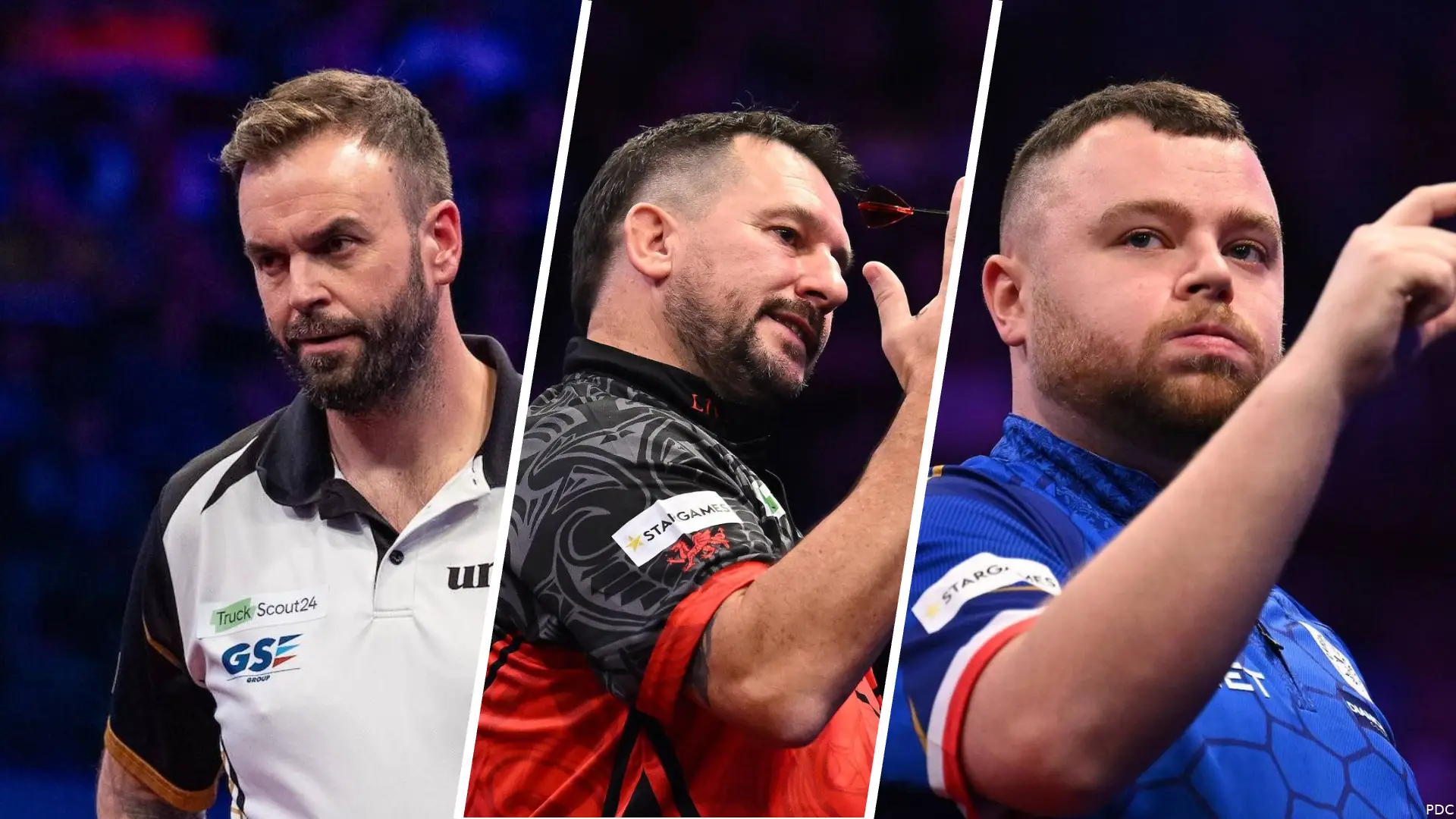
The 2026 Grand Slam of Darts is the 20th staging of the competition and is the first staging of the new format introduced. Expanding from 32 to 48 players and 16 groups of three, this change now means only group winners can advance into the knockout stages of the competition. Seven of the tournament's sixteen seeds failed to survive the group stage, with several discovering just how unforgiving the new format could be after losing their opening match.
ADVERTISEMENT
Smith, Rock and Clayton are the most noticeable names to suffer this, with their losses to Rodriguez, Morris and Ostlund all ending their 2026 campaign. Despite a prize fund increase to £1,000,000, up from £650,000 in 2025, players have expressed their distaste towards this format, believing there was no need for change, and the pressure of the first game has created a different kind of pressure players aren’t used to.
Humphries expressed this best, stating to Online Darts, “I’m not really a big fan of it… what made the Grand Slam so special was the fact of four players…" I think a lot of pros backstage think the same as well”, meaning if the World No. 2 doesn’t like it, the players don’t like it, and seven seeds exited in the group stage, who is this change for?
Seeds Out in the Groups
| Seed | Player | Group Winner |
| 5 | Jonny Clayton | Rob Cross |
| 6 | Ross Smith | Gabriel Clemens |
| 8 | Josh Rock | Kevin Doets |
| 9 | Stephen Bunting | Cameron Menzies |
| 12 | Wessel Nijman | Niko Springer |
| 14 | Chris Dobey | Martin Schindler |
| 15 | Luke Woodhouse | Tom Sykes |
Why Change The Format?
From 2007 to 2025, the Grand Slam of Darts involved 32 players in eight groups of four, with the top two going through into the knockout rounds. A field built around players who have reached titles and televised finals, the field was prestigious and ruthless, cutting players who hadn’t been good enough in the year. A genuine champion-of-champions event, where winning meant beating the year’s best, the Grand Slam had an aura around it, with the winner beating that year's winners having a coveted reputation, perhaps explaining the confidence it gave players, seeing four of the last four winners of this tournament picking up the World Championships later on in the year.
Although this is a seemingly perfect format, the old format had a huge problem: the bracket. The well-criticised old bracket paired group winners with runners-up from the neighbouring group, for example, A1 vs B2, B1 vs A2, meaning two players from the same group met again in the quarter-finals if both won their last 16 matches. This strange bracket system is a genuine flaw and was such a distinct issue attached to the Grand Slam. From 40 quarter-finals from 2016-2025, 22 of them were rematches of group matches, including three from four in 2025: Humphries v Michael Smith, Price v Evans and Noppert v Wenig.
ADVERTISEMENT
Humphries, who won the World Grand Prix, now faces a completely different battle.
Despite at times creating fascination to watch how results differ depending on the leg format, as seen with De Sousa losing 5-2 to Michael Smith in 2020 and beating him 16-14 in the quarter-finals, and most recently Price losing 5-4 to Evans before beating him 16-9 in the quarter-finals last year, it was a genuine flaw. Therefore, a change in the format should tackle this problem. The Grand Slam had very few critiques apart from this bracket system, but instead, the PDC changed the field size and the group format and kept the problem of groupmates meeting again in a different form.
The last 16 now ignores seeding, meaning although not structurally built now, this quarter-final issue can still be run into. Expanding a field that was already too big, relying on tour card qualifiers to fill gaps, and expanding the field has only amplified this problem and created a field so diluted. Shifting from a prestigious tournament, this year's event has included 16 players not ranked inside the top 64. So, who is actually in the field?
Old Format vs New Format
| 2025 | 2026 | |
| Players | 32 | 48 |
| Groups | 8 of 4 | 16 of 3 |
| Matches per Player | 3 | 2 |
| Who Advances | Top 2 | Winner only |
| Total Group Matches | 48 | 48 |
| Prize Fund | £650,000 | £1,000,000 |
ADVERTISEMENT
The Field
Televised finals produced 22 qualifying spots, but only nine different players; Littler alone holds eight of them. An issue the PDC have no control over, the 48 places were filled by these nine televised finalists, six European Tour winners not already qualified, 13 Players Championship winners not already qualified, ten from affiliate and secondary tours and ten from Tour Card Holder qualifiers.
Relying on affiliate and secondary tours to fill the field is, although, great representation but doesn’t produce the quality the Grand Slam should: cutthroat winners of titles. Tours such as the Asian Tour, North American Tour, and ANZ create great players and stories, including Leonard Gates and Damon Heta, but mostly lower the quality of the field. The problem is not that emerging players deserve fewer opportunities. It's whether a tournament historically associated with major finalists and title winners is the appropriate place to expand those opportunities.

Does having big names like Bunting needing to qualify help or hinder the sport?
More prominently, qualifiers from the Women’s Tour, Development Tour, and Challenge Tour have always included players not ready for the stage, playing on the stage against serial winners, again filling the field. After this disappointing qualification system lowered the standard, ten Tour Card Holder Qualifier spots reproduced the same result, including players like Carl Sneyd and Maik Kuivenhoven, who are in a different league on stage under the lights than players like Nathan Aspinall and Gian Van Veen.
ADVERTISEMENT
A title-based tournament can’t fill 48 places with title winners, so the expansion has to come from these affiliate tours and qualifiers. As a result, World Number Nine had to qualify, whilst affiliate champions walked in. Does this really serve the sport's best interests, or the best interests of the underfunded and under-represented PDC international tours?
How the 48 Qualified
| Route | Places | Players |
| Televised finalists | 9 | Luke Littler, Luke Humphries, Ross Smith, Gian van Veen, Gerwyn Price, James Wade, Nathan Aspinall, Michael van Gerwen, Martin Schindler |
| European Tour winners | 6 | Wessel Nijman, Jonny Clayton, Josh Rock, Luke Woodhouse, Krzysztof Ratajski, Niels Zonneveld |
| Players Championship winners | 13 | Chris Dobey, Cameron Menzies, Ryan Searle, Jermaine Wattimena, Rob Cross, Kevin Doets, Andrew Gilding, Jeffrey de Graaf, Karel Sedláček, Gabriel Clemens, Henry Coates, Charlie Manby, Tommy Morris |
| Affiliate and secondary tours | 10 | Beau Greaves, Cam Crabtree, Jan Schmidt, Sebastian Białecki, Joe Hunt, Lisa Ashton, Paolo Nebrida, Adam Sevada, Anton Östlund, Raymond Smith |
| Tour Card Holder qualifier | 10 | Stephen Bunting, Maik Kuivenhoven, Tom Sykes, Rusty-Jake Rodriguez, Niko Springer, Ricky Evans, Carl Sneyd, Bradley Brooks, Joe Cullen, Alan Soutar |
Representation in the Wrong Tournament
The PDC gave 20 spots to title-less players on the PDC tour in the 2026 Grand Slam of Darts, directly ripping the DNA of the tournament in front of the 26 winners who could confidently fill a competitive, engaging field. With only Sykes and Springer making it past the group stage from these 20 spots, it raises the question: is this the best place for representation of PDC’s international tours at the Grand Slam?
ADVERTISEMENT
For tournaments like the World Series of Darts Finals and the Winmau World Masters, there is undeniably a bigger opportunity for these affiliate and secondary players to play a bigger role in, as the World Series currently attempts to include affiliate tour qualifiers, and the inclusion of secondary tours rather than more untelevised and monotonous qualifiers could create a real opportunity for these players; playing for prize money that could transform their careers and a title that doesn’t carry the same credibility, it seems strange for the Grand Slam to be chosen. Mostly, this may be due to Sky Sports' undeniably larger pull and sponsorship money over The World Series of Darts on ITV, but this forces the question: does the PDC need to structurally change its affiliate and secondary tours in the best interest of the Grand Slam of Darts?

Rusty-Jake Rodriguez personifies the issue with the criteria.
The Affiliate tour qualifiers didn’t all go through: Ashton averaged below 80 on both occasions, Sevada was beaten twice, and Nebrida and Ostlund won one game, but without impressive averages, especially Ostlund beating Clayton while averaging 85.75. More inspiring, the Challenge Tour and development tour qualifiers made a great account for themselves, with Joe Hunt hitting a 170 against Gerwyn Price and Cam Crabtree picking up five legs, and a 331 in 6 darts sprinkled were mostly more competitive than the affiliate tour qualifiers.
Despite success for Sykes and Springer, the qualifiers were mostly disappointing, personified by Rusty Jake Rodriguez beating Ross Smith whilst averaging 83.43 and winning two tour games all year. These expanded 20 spots given to qualifiers and affiliate tour winners are another place taken from top-ranked players or floor finalists. The individuals aren’t the issue; the routes are.
The Format
ADVERTISEMENT
The main talking point surrounding the new Grand Slam of Darts format is the new group stages. 16 groups of three gave fewer players more matches each, resulting in no more darts than the 2025 version. Not just this; players simply cannot afford to lose, and with a best-of-nine format, the quality gap is shortened, causing upsets. The Grand Slam of Darts has always suffered with implications on final games, with three groups experiencing this in 2026, including Group A, O and I. This is inevitable to happen with group stages, but what isn’t inevitable is the pressure applied to players now. Wade summarised it: “Everyone’s scared to death of losing… as soon as you lose the first game, I think it's pretty much, unless you're very, very fortunate, you’re out," and it shows.
Ross Smith lost his first game to Rusty Jake Rodriguez 5-3, averaging 86.51, almost 10 points below his seasonal average. Although the PDC expects the players to adapt to this pressure as they are professional sportsmen, it doesn’t create engaging viewing. Watching nervous darts in a best-of-nine is a short, anxious viewing experience, waiting for the quality viewers subscribed for. Price explained, “The format is cut-throat. You can’t slip up”, and this hasn’t really worked out the way the PDC wanted.
Viewers aren’t engaged by Woodhouse trying to warm up his hands before he gets a chance to even stay in the tournament, nor by Josh Rock getting knocked out in under 10 minutes. Viewers subscribe to see the best players play each other, and the drama created didn’t have satisfying results.
Tiebreaker games such as Schindler vs Dobey were a great watch, but nothing that couldn’t be seen with the previous format. Second seed, Luke Humphries, best criticised it, suggesting, “I hate the scenario of having to win two, three legs, don’t have to win the game... I’d rather just play against someone like straight shoot, and that’s it.” The numbers don’t tell the story the format’s critics might expect. Across the 48 group matches, the average stood at 93.81, the second-highest group stage since 2018 behind only 2024’s 95.14, and 24 individual performances topped 100, including Rob Cross’s 114.32 against Jonny Clayton, the fifth-highest average in Grand Slam history.
ADVERTISEMENT
The issue isn't that the new Grand Slam has failed to produce quality. It's whether the tournament still offers the same consistently elite competition and distinctive group-stage drama. Ten matches saw both players average below 90, the most of any Grand Slam since 2018, and ten were won by the player with the lower average, meaning a bigger field didn’t just produce more brilliant darts; it produced more forgettable darts that still decided groups. On the other end though, it could be seen that superior finishing, missed doubles or the limitations of three-dart averages as well as the expansion has increased unpredictability and opportunity.
The clearest example came on the final night. With Ross Smith already finished on 1-1, the European Champion’s fate was settled by Gabriel Clemens and Rusty-Jake Rodriguez, who averaged 85.47 and 85.93, while Alan Soutar’s 5-2 win over Lisa Ashton, 84.85 against 74.80, was the lowest-quality game of the group stage and still shaped a group. That is consequence without quality, and for a tournament built on exclusivity, it is exactly what the Grand Slam was designed to avoid. If the format can’t justify itself on the oche, can the direction behind it?
Grand Slam Group-Stage Standard
| Year | Mean Average | Both Under 90 | 100+ Averages | 5-4 Results |
| 2018 | 93.65 | 6 | 21 | 14 |
| 2019 | 92.61 | 7 | 10 | 12 |
| 2020 | 93.72 | 7 | 18 | 12 |
| 2021 | 93.44 | 8 | 18 | 10 |
| 2023 | 92.21 | 8 | 10 | 17 |
| 2024 | 95.14 | 7 | 26 | 7 |
| 2025 | 92.91 | 9 | 16 | 16 |
| 2026 | 93.81 | 10 | 24 | 14 |
Porter’s Direction
ADVERTISEMENT
The Grand Slam isn’t an isolated decision. Under Matt Porter, almost every major on the PDC calendar has grown at the same time: a 128-player World Championship, a 48-player Grand Slam with a £1,000,000 prize fund, and a European Championship becoming a week-long, 48-player event with its prize money doubling to £1,000,000 in 2027.
Add a new European Open in Salzburg next June, an open-draw major styled on the UK Open, and the direction is clear. Explaining that event in September, Porter said, “We’re very conscious of the need to ensure that all tour card holders have an opportunity to play on the big stage”, and that is exactly the problem for the Grand Slam.
If the European Open exists to give every tour card holder a stage, the opportunity argument for expanding the Grand Slam has already been answered elsewhere on the calendar, and what’s left is a commercial one: a bigger headline prize fund, more players and more stories to sell.
The calendar only makes this worse. With 34 Players Championships and 15 European Tour events, 49 floor events now fill the PDC year, and Porter himself has described the European Tour as close to its natural ceiling. A schedule this crowded means players pick and choose, weakening fields, and the expanded Grand Slam then rewards floor wins from those depleted fields with a place at a major.
James Wade admitted to Online Darts during the tournament that “I haven’t felt great for like six to eight weeks”, and he is far from the only player feeling the strain of a season with no real breaks. The PDC built both halves of this problem: a calendar that produces floor winners from weakened fields, and a tournament that turns those wins into major places.
With Porter promising a Premier League review, telling Sky Sports in May that “we don’t want it to get boring” before adding “so watch this space”, the question is whether the same thinking is heading for the PDC’s flagship event next.
Who Is It For?
So who is this change for? Not the players, with Humphries, Wade and Price all criticising the format during the tournament itself, and Stephen Bunting summing up the mood when he said that “they’re the bosses at the end of the day”. Nor is the scepticism confined to the players, with plenty of pundits and supporters voicing similar doubts across the opening weekend. The new Grand Slam is a commercial decision presented as opportunity, and it fails on both counts.
It didn’t fix the old format’s one genuine flaw, a bracket that turned 22 of the last 40 quarter-finals into group-stage rematches, and it replaced it with a last 16 that ignores seeding altogether, pitting Wade against Michael van Gerwen and Gerwyn Price against Ryan Searle while two unseeded players walk into the quarter-finals. It handed 20 places to the affiliate tours and the qualifier rather than to titles, while Danny Noppert, Gary Anderson and Damon Heta, all ranked inside the top 25, watched from home.
Read also


And its sporting justification, giving more players a stage, already exists in a 128-player World Championship and a European Open built for exactly that purpose. The fix is simple: a smaller, title-based field of 32 and a reworked bracket that keeps group-mates apart until the semi-finals at the earliest. The Grand Slam earned its reputation by being hard to get into. Expanding it hasn’t made it bigger, it has made it ordinary, and if the PDC gets the Premier League review wrong in the same way, the cost will be far greater than a week in Wolverhampton.
The PDC has made a clear decision to prioritise expansion, greater playing opportunities and increased prize money. Whether those benefits compensate for the Grand Slam losing part of its traditional identity is far less clear.

Ben James is a darts writer at DartsNews.com, covering professional darts with a focus on analysis, player storylines, and match context. He contributes articles on tournaments, player performances, and developments across the PDC calendar.
Ben is currently completing his A Levels in History, Sociology, and Business, with predicted grades of A, A, and A. He also completed an Extended Project Qualification (EPQ), awarded an A grade, titled “To what extent do psychological factors and equipment specifications determine performance in competitive darts?”, reflecting a strong interest in the analytical and psychological aspects of the sport.
He has published early work on platforms such as Medium, including articles on Joe Cullen and Niels Zonneveld, and is developing his experience in sports journalism. Ben is also set to attend a PDC event, building first-hand insight into the professional darts environment.
His interest in darts spans player narratives, match dynamics, scoring strategy, and the mathematical and psychological elements of performance. In his writing, he focuses on clear structure, contextual analysis, and accurate reporting.
claps 0visitors 0
Just in




Popular news

Latest comments
- correct, but hey, it wouldn't be dartsnews without shamelessly misleading clickbait titles like this.colt17-11-2026
- No it wasn't the greatest checkout ever,who writes this stuff? And more importantly,he lost!!!rick6717-11-2026
- His back wasn't against the wall as he had already guaranteed he would top the group at that point, and it's nowhere near the greatest checkout of all time as there was consequently nothing riding on it. Littler made it clear that once he had achieved the requisite three legs he was no longer even taking the game seriously and was simply showing off with a shot he probably hits all the time in exhibtion play (I wouldn't know, I only watch real darts). Don't get me wrong though, it was still impressive.Deduce635817-11-2026
- Why not just donate £5 per ticket from the world championship? It's a worthy cause,I agree,but currently Taylor can't keep his nose out of anything,as he's cogging on. And he's not even bloody playing!!rick6716-11-2026
- Well,I suppose if you don't play the tournaments ,then why should any player qualify? There are players who enter every tournament,and if they don't win it,they carry on, spending money they haven't won,yet certain players seem to think they should qualify. Winners only I thinkrick6714-11-2026
- Everyone knows what a fantastic champion Taylor was,but his performances in the seniors were poor. He wouldn't throw littler off stage,as he'd miss these days!!rick6712-11-2026
- He produced some impressive numbers in that qualifying campaign. I'm excited to see him compete at the World Championship once again, even if it will be difficult to replicate last year's success even with an improved performance, with the draw playing a huge role in determining his fortunes.Deduce635811-11-2026
- I often think about this very question. I think they should revive the format. They could even invite representatives from MODUS Super Series, with four series winners from the past year, and the ADC, with finalists from the Global Championship and perhaps other events. Why not throw in eligible representatives from the JDC and even the soft-tip game too?Deduce635811-11-2026
- So what if littler missed out, he doesnt have to enter everythingant10-11-2026
- Good, absolutely no loss if we never see this dancing goof ever again......no that is not fair. He absolutely cannot and has never been remotely able to dance!richieburnettrocks10-11-2026