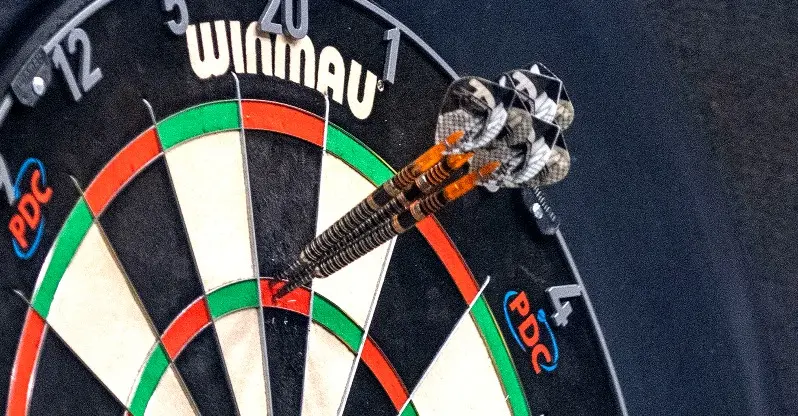
Modern darts has entered a phase where performance is shaped as much by psychological discipline as by technical skill. Precision still matters, but the sport’s most successful players rely on routines, emotional steadiness, and strategic preparation to maintain control in an environment that grows more demanding every year. Professional matches unfold under bright lights, rising audience noise, and the weight of expectation, creating a setting where mental resilience becomes a defining component of success.
ADVERTISEMENT
Pressure, perception and the shifting stage
The professional scene has changed significantly as the sport’s visibility has expanded. Crowded arenas and global broadcasts introduce an atmosphere where concentration must remain firm despite disruptions. Players face long legs where small openings appear unexpectedly, forcing them to reset quickly between throws.
A narrow miss on a double or a sudden scoring surge from an opponent can shift the rhythm of a match, and the ability to manage these swings often separates those who advance from those who struggle to recover.
This environment sits alongside growing interest from wider entertainment audiences, including those who follow the sport through sports betting. Their attention often centres on momentum, composure, and form, placing additional observational pressure on players whose performances are dissected in real time.
Mental routines shaping modern performance
Top players increasingly rely on structured routines that help regulate their focus. These routines are repeated throughout training sessions until they become automatic, giving players a stable foundation when they step to the oche.
Visualisation plays a notable role here. Professionals often rehearse high-pressure scenarios mentally, allowing them to recognise patterns and respond with calm reactions when similar situations arise in competition.
ADVERTISEMENT
Emotional management is another pillar of modern performance. A dip in confidence can affect throwing rhythm, especially during long matches with fluctuating momentum. Players who handle emotional spikes quickly avoid lingering frustration after missed opportunities. They bring their attention back to the immediate task rather than dwelling on previous throws.
Emerging talents have adopted these techniques earlier in their careers, entering the professional circuit with an understanding that mechanical skill alone is no longer enough. Their willingness to combine traditional practice with mental preparation shows how deeply psychological training has been integrated into the sport’s development.
Resilience and adaptation in competitive play
Adaptability defines many of the performances that stand out in modern darts. Players must adjust to changes in pace, crowd intensity, and the emotional tone of the match. Long legs test concentration, while short bursts of scoring require rapid responses.
The best competitors find ways to remain grounded even when the scoreboard creates pressure. They avoid projecting outcomes too far ahead, focusing instead on maintaining a consistent rhythm from throw to throw.
ADVERTISEMENT
Training environments increasingly reflect this reality. Practice sessions simulate match conditions more deliberately than in previous eras, with players introducing small challenges designed to mirror competitive discomfort. Time constraints, scoring targets, and situational drills help strengthen focus under mild stress.
These adjustments create a smoother transition between practice and competition, reducing the gap between controlled conditions and the unpredictability of a live match.

Samuel GillChief Content Officer
Samuel Gill is the Chief Content Officer (CCO) of DartsNews.com, a role he has held since 2020. He is responsible for editorial governance across the platform, including setting content standards, overseeing accuracy and consistency, and guiding long-term editorial strategy across professional darts coverage. Since joining, he has contributed more than 10,000 articles and editorial pieces, playing a central role in the development and daily operation of the site.
Based in Leicester, Samuel has extensive experience in darts media and has been closely involved in coverage of the professional darts circuit for several years. Within the UK darts community, he is a recognised figure known for his consistent editorial output and ongoing reporting on major tournaments and developments across the PDC calendar.
In his current role, Samuel works closely with editors and writers to ensure content meets clear journalistic standards, with a focus on source verification, editorial consistency, and timely updates when new, confirmed information becomes available.
claps 0visitors 0
Just in


Popular news
Latest comments
- I agree,I can't believe the lack of coverage of this sad loss. Always enjoyed watching him,but I guess now it's all about littler,well it seems that way. Darts has sadly lost a good manrick6717-10-2026
- In the absence of a report regarding the death of Stefan Lord, I'll assist. An excellent player in the late 70s and early 80s, he actually won the now defunct 3rd place match at two World Championships and a couple of the News of the World Championships. A fabulous player and easily the best Swedish player ever. Rest peacefully Stefan.richieburnettrocks16-10-2026
- Joking aside, it is the second most watched sport on sky (more than golf, F1 etc) behind football only, and in participation is second to only football and swimming. It doesn't get the attention or sponsorship of "bigger" sports because it's not as sexy, but it's right up there.BandB13-10-2026
- i love darts but you can't seriously believe it's the second most popular sport in the uk. even top five is pushing it. it may be the fastest growing, though.colt13-10-2026
- I'm a big Clayton fan, but he's got this completely wrong. Qualification criteria exists for a reason - so just as failing to make the top 32/64 for the Euro championships/PT Finals means you miss out, so does not lifting a title for this one.26sForFun12-10-2026
- The players who deliberately slow the game down are usually boring and win very little in the way of silverware. Horrible to watch.MrYnyslas197112-10-2026
- [“The Gentle” then used a sweeping and questionable phrase...] You anglocucks are hilariously finished in every sense of the word.Critical99911-10-2026
- I love Jonny but I disagree. The Grand Slam was always supposed to be "champion of champions" type competition. If the top 16 are guaranteed participation in everything there will be so much less jeopardy involved in qualifying and each major tournament will lose its unique flavour which the PDC has worked hard trying to develop. I enjoy following the qualification races towards the end of the year, and while consistency should have its rewards, the truth is Jonny hasn't reached a major final all year or won a single event on the Pro Tour. Being consistent is one thing, but that alone should have consequences as the sport's elite should not be prepared to accept consistently strong performances, their foremost motivation should be to win and this should be what separates them from the rest, not the consistency of their performances. Jonny is expecting that losing should be enough; it shouldn't be, at least not as far as the Grand Slam is concerned.Deduce635811-10-2026
- Well being honest,it doesn't matter what level you play at, there's always someone who slows it down to suit themselves,and extra swig of water, replacing flights, asking the ref what the score is. It happens wherever. I'm not saying it's professional,but I'm sure we've all seen it beforerick6711-10-2026
- Agree completely. Not sure how a ranking event can have a criteria not based on rankings. And he right on popularity. In the UK second only to football.BandB11-10-2026
Loading