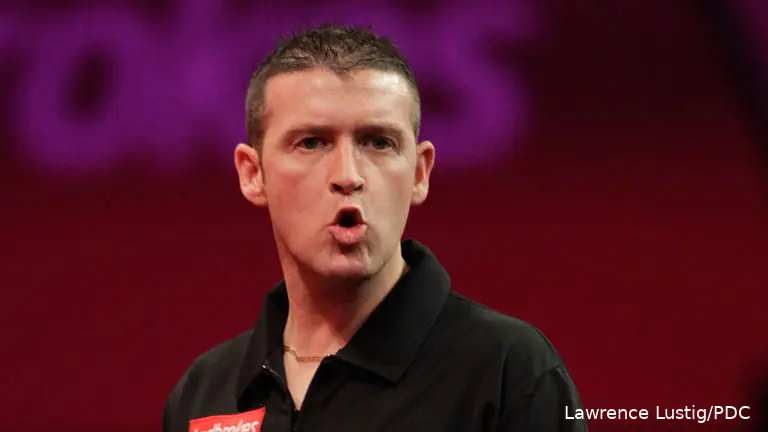
In this series, we regularly turn back the clock to look at a particular darts player. This time, it is Colin Osborne. The Englishman was a regular fixture on the PDC circuit during the second half of the 2000s, developing into a player capable of challenging the established order and competing with the very best on the biggest stages.
ADVERTISEMENT
With two ProTour titles, two nine-darters and a UK Open final to his name, Osborne enjoyed several highly successful years. Even so, his career has often been remembered with the feeling that there might have been even more to come.
Colin Osborne was born on 19 June 1975 in Middlesbrough. As a youngster, he was a promising table tennis player and even represented England, although he would later make Derby his home.
An early indication of his talent came in 2005, when Osborne remarkably hit two nine-darters in the same year. The first perfect leg came at a Players Championship event on the Isle of Wight, before he repeated the feat during the non-televised qualifying rounds for the World Matchplay.
Two nine-darters in the same year was a particularly impressive achievement at the time. It showed that Osborne was not only capable of winning matches, but also possessed the scoring power to produce something spectacular when at his best.

Colin Osborne in action
Impressive World Championship debut
Osborne's major breakthrough on the international stage came at the 2007 PDC World Championship. Making his debut at the tournament, he showed little sign of being overawed by the occasion and immediately reached the quarter-finals.
ADVERTISEMENT
There he faced Andy Jenkins. Osborne came close to reaching the semi-finals, but eventually lost a thriller 5-4 to his fellow Englishman. Despite the defeat, his World Championship debut had sent a clear warning to the rest of the field: Colin Osborne was a player to be taken seriously.
A few months later, he confirmed that status at the UK Open. Osborne recorded several notable victories, defeating the likes of Michael van Gerwen and Mervyn King on his way to the semi-finals.
There he came up against Vincent van der Voort in a match that remained in the balance until the final leg. Osborne eventually went down 11-10 to the Dutchman, but once again showed he was capable of going deep at a major.
Osborne also made his mark at the 2007 Las Vegas Desert Classic, where he defeated James Wade to claim another victory over one of the world's leading players. Peter Manley proved too strong in the second round.
A harsh lesson against Phil Taylor
ADVERTISEMENT
The 2008 season brought less success on the biggest stages. Osborne suffered a first-round exit at the World Championship, losing 3-1 to Dutchman Erwin Extercatte.
He bounced back at the World Matchplay, defeating Mervyn King in the opening round to book a place in the last 16. Waiting there, however, was an almost impossible assignment: Phil Taylor.
Taylor was in one of the most dominant periods of his career and Osborne experienced that dominance first-hand. The Englishman fell 10-0 behind before finally getting a leg on the board.
Although Osborne managed to add a few more legs, the deficit was far too great. Taylor eventually won 13-5 while averaging an impressive 109. For Osborne, it was a brutal reminder of the level required to truly overcome the very best in the world.
ADVERTISEMENT
Breakthrough year in 2009
If 2008 had been disappointing, Osborne more than made up for it in 2009. It was the year in which he reached his first major final and also claimed one of the biggest titles of his career.
At the 2009 World Championship, Osborne started strongly by defeating South Africa's Charles Losper 3-0 in the opening round. Vincent van der Voort awaited him in round two, and this time the Dutchman came out on top with a 4-1 victory.
Osborne's real breakthrough came at the UK Open. He grew stronger as the tournament progressed and eliminated several major names along the way. Raymond van Barneveld, Jamie Caven and Kevin Painter were all beaten as Osborne reached a major final for the first time in his career.
Once again, Phil Taylor stood between him and the title. For Osborne, it was another chance to avenge one of the most painful defeats of his career, but Taylor again proved too strong. Osborne battled hard but eventually went down 11-6.
ADVERTISEMENT
Even so, the tournament marked his definitive breakthrough. A player who only a few years earlier had largely been known to the more dedicated followers of the sport was now contesting a major final against the biggest name in darts history.
Revenge against Taylor
Remarkably, Osborne did not have to wait long for another chance against Taylor. Later in 2009, the pair met again, this time in the final of Championship League Darts.
On this occasion, Osborne came out on top.
A 6-4 victory over Taylor saw him win the 2009 Championship League Darts title. Combined with his UK Open final appearance, it made 2009 one of the most significant years of his career.
'The Wizard' becomes 'Ozzy'
ADVERTISEMENT
During this period, Osborne was known by the nickname 'The Wizard'. It was inspired by The Wizard of Oz and suited one of the more recognisable characters on the darts circuit.
Another nickname, however, was becoming increasingly common: 'Ozzy'. Commentator Sid Waddell in particular regularly used the name.
There was an obvious play on words behind it. 'Ozzy' worked as a shortened version of Osborne's surname, but it was also a reference to rock singer Ozzy Osbourne. That musical connection became even clearer through Osborne's choice of walk-on music.
He entered the stage to 'Paranoid' by Black Sabbath, the band famously fronted for many years by Ozzy Osbourne.
As Simon Whitlock became increasingly associated with 'The Wizard' nickname, Osborne officially switched to 'Ozzy' in 2011, giving himself an identity that was unmistakably his own.
ADVERTISEMENT
Read also
Strong at the Players Championship Finals
Osborne remained capable of deep runs at major tournaments in 2010. At the Players Championship Finals, he reached the semi-finals before once again losing to Mervyn King.
He also had an eventful Grand Slam of Darts campaign. Osborne lost his opening group match against Robert Thornton but responded superbly, beating Simon Whitlock and Dave Chisnall to secure his place in the knockout stage.
Gary Anderson awaited him in the last 16, where the Scot proved too strong in a 10-3 victory. Nevertheless, Osborne remained a prominent figure on the international circuit and returned to the third round of the World Championship a year later.
ADVERTISEMENT
Almost a famous win over Van Barneveld
At the 2011 World Championship, Osborne faced Raymond van Barneveld in a match where the Englishman came close to producing a major upset.
Osborne moved 3-2 ahead in sets, leaving Van Barneveld on the brink of elimination. The Dutchman, however, fought his way back.
The match completely turned as Van Barneveld eventually prevailed 4-3. It was another painful defeat for Osborne on a big stage, but also underlined his reputation as a dangerous outsider. At his best, Osborne was capable of giving almost anyone problems.
Colin Osborne's World Championship results
| Year | Round | Opponent | Result |
| 2007 | Quarter-finals | Andy Jenkins | 4-5 |
| 2008 | First round | Erwin Extercatte | 1-3 |
| 2009 | Second round | Vincent van der Voort | 1-4 |
| 2010 | First round | Simon Whitlock | 1-3 |
| 2011 | Third round | Raymond van Barneveld | 3-4 |
| 2012 | First round | Michael van Gerwen | 1-3 |
| 2013 | Second round | Simon Whitlock | 0-4 |
| 2014 | First round | Brendan Dolan | 0-3 |
The highest average ever?
In 2015, former major winner Paul Nicholson shared a remarkable story about Colin Osborne. According to Nicholson, Osborne had once produced a phenomenal average of 143.14 during a UK Open Qualifier.
Because there was no online scoring system in place at the time, the average was never officially recorded.
Nicholson was nevertheless adamant that the story was genuine, claiming the marker on duty had confirmed Osborne's extraordinary performance. If true, it would mean that neither Phil Taylor, Michael van Gerwen nor Luke Littler owns the highest PDC average ever recorded, but Colin Osborne, albeit unofficially.
It would certainly be a remarkable record for the Englishman to have to his name.
A versatile sportsman
Darts was far from Osborne's only sporting interest. The Englishman had previously represented England in table tennis and was also once a yo-yo champion. Golf and snooker were among his other hobbies.
That sporting versatility fitted the profile of somebody whose life did not revolve solely around throwing darts, although it was ultimately darts that made him a familiar name.
Osborne moved from his birthplace of Middlesbrough to Derby, where he lived with his wife Sarah. The couple had two sons, Colin Jr., born in 2003, and Alfie, born in 2006.
Osborne and Sarah also owned and ran the Greyhound pub on Village Street for around 18 months.
Long absence and return
After years as a regular on the PDC circuit, Osborne gradually disappeared from the spotlight. From March 2020 until 2023, he did not compete in darts events.
He returned to the sport in 2023, competing in the MODUS Super Series and putting himself back on the darts radar.
Although his peak years were long behind him, the name Colin Osborne remained associated with an era in which he regularly faced players such as Phil Taylor, Raymond van Barneveld, Mervyn King, Michael van Gerwen and Gary Anderson.
Osborne later made several attempts to regain a PDC Tour Card through Q-School, but was unable to do so. He does, however, still make occasional appearances in the MODUS Super Series.
Read also


A career filled with memorable moments
Colin Osborne's career cannot simply be summed up by the titles he won. His two ProTour victories and his 2009 Championship League title naturally stand out, as do the two nine-darters he produced in 2005.
But it was his performances on the biggest stages that really made 'Ozzy' a familiar name among darts fans.
His run to the quarter-finals of the 2007 World Championship, his UK Open semi-final that same year and, above all, his appearance in the 2009 UK Open final were among the highlights. There were also plenty of occasions where he pushed the very best close without quite getting over the line.
His 2008 World Matchplay defeat to Taylor was perhaps the most extreme example of that gap, while his victory over Taylor in the 2009 Championship League final showed exactly what Osborne was capable of on his best days.
Osborne may not have built the trophy cabinet of the greatest players of his generation, but he still holds a notable place in PDC history. With his heavy scoring, two nine-darters, victories over major names and distinctive 'Ozzy' identity, he left a lasting impression during his best years.
The combination of 'The Wizard', Black Sabbath and his performances against the world's best made Osborne one of the more colourful figures in darts during the 2000s: a player who, at his peak, was capable not only of troubling the biggest names, but of beating them.

Kieran WoodDarts Journalist
Kieran Wood is a sports journalist based in Wales and has been active in journalism since 2022. He contributes to DartsNews.com, where he covers professional darts through news, match reports, analysis, and live coverage across the PDC calendar and major tournaments.
A key part of his work is on-site reporting from leading events. Kieran has covered the PDC World Darts Championship in person, reporting daily from the venue and providing first-hand insight from the tournament. During his coverage, he has conducted interviews with leading players including Luke Littler, Luke Humphries, and Gerwyn Price.
He is also one of the leading voices of the English-language Dartsnews Podcast, contributing regular analysis and discussion on developments across the professional darts circuit.
In his reporting, Kieran places strong emphasis on careful sourcing, editorial accuracy, and updating articles when new, verified information becomes available.
claps 9visitors 3
Just in

Popular news

Latest comments
- i love darts but you can't seriously believe it's the second most popular sport in the uk. even top five is pushing it. it may be the fastest growing, though.colt13-10-2026
- I'm a big Clayton fan, but he's got this completely wrong. Qualification criteria exists for a reason - so just as failing to make the top 32/64 for the Euro championships/PT Finals means you miss out, so does not lifting a title for this one.26sForFun12-10-2026
- The players who deliberately slow the game down are usually boring and win very little in the way of silverware. Horrible to watch.MrYnyslas197112-10-2026
- [“The Gentle” then used a sweeping and questionable phrase...] You anglocucks are hilariously finished in every sense of the word.Critical99911-10-2026
- I love Jonny but I disagree. The Grand Slam was always supposed to be "champion of champions" type competition. If the top 16 are guaranteed participation in everything there will be so much less jeopardy involved in qualifying and each major tournament will lose its unique flavour which the PDC has worked hard trying to develop. I enjoy following the qualification races towards the end of the year, and while consistency should have its rewards, the truth is Jonny hasn't reached a major final all year or won a single event on the Pro Tour. Being consistent is one thing, but that alone should have consequences as the sport's elite should not be prepared to accept consistently strong performances, their foremost motivation should be to win and this should be what separates them from the rest, not the consistency of their performances. Jonny is expecting that losing should be enough; it shouldn't be, at least not as far as the Grand Slam is concerned.Deduce635811-10-2026
- Well being honest,it doesn't matter what level you play at, there's always someone who slows it down to suit themselves,and extra swig of water, replacing flights, asking the ref what the score is. It happens wherever. I'm not saying it's professional,but I'm sure we've all seen it beforerick6711-10-2026
- Agree completely. Not sure how a ranking event can have a criteria not based on rankings. And he right on popularity. In the UK second only to football.BandB11-10-2026
- Doesn't matter who's in it,it's boringrick6710-10-2026
- Assuming you qualify as one of the "muppets" in question. Classist too. And since you're so clearly interested in academia, look up "linguistic descriptivism" while you're at it. Oh, and better stay away from the working class sport of darts and maybe offer your insightful analysis to, let's say, croquet instead?Deduce635806-10-2026
- The consequences of being uneducated and grammatically challenged. "To all THOSE muppets not THEM " Everytime I see Arsepinall, I have an image of him wearing a cap, standing behind the counter of a fast food establishment.richieburnettrocks05-10-2026
Loading