"Do I just go do something else?" – Berry van Peer considered ending his career because of his battle with dartitis
PDC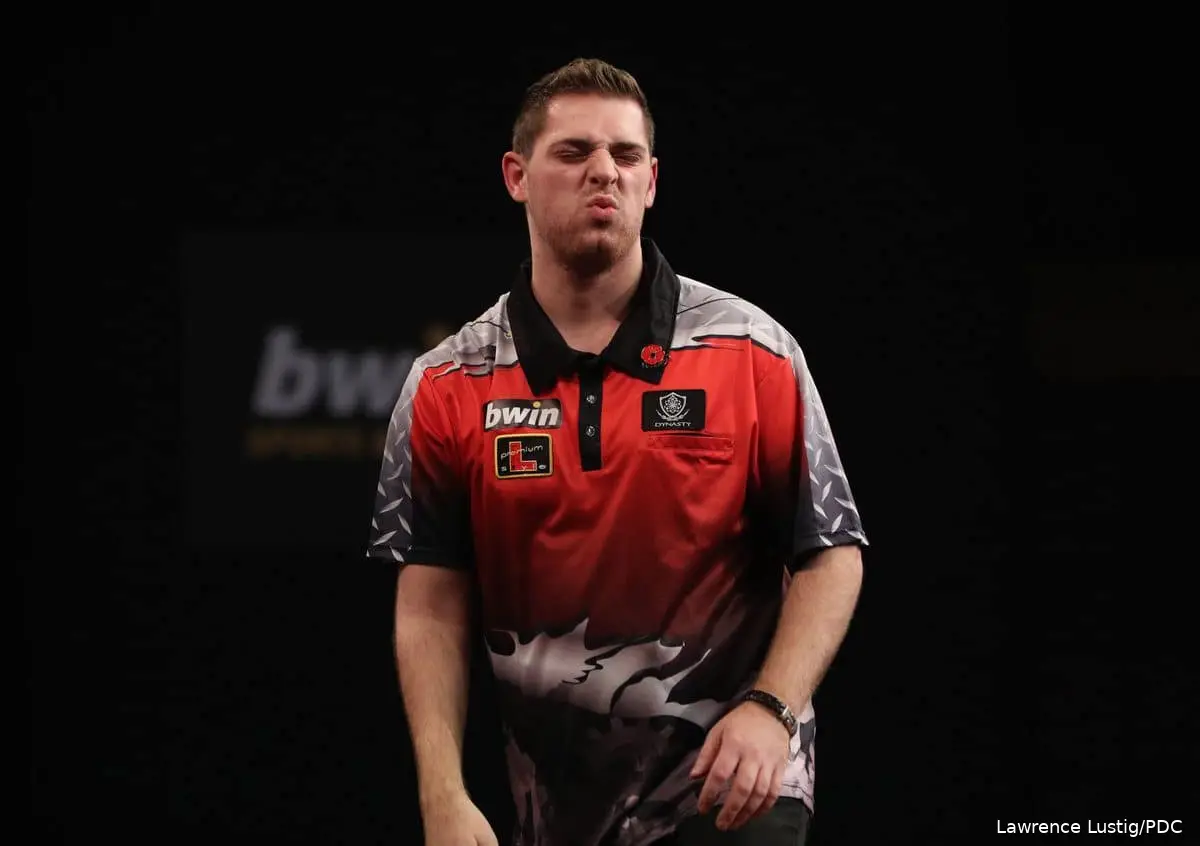
The very word can make darts players uneasy: dartitis. Berry van Peer knows better than anyone how destructive the problem can be. The Dutchman was long seen as a major talent, but his career almost derailed when he suddenly struggled to release his darts. In the feature Tungsten Talk by the MODUS Super Series, Van Peer looks back at that brutal period in detail and explains how he slowly fought his way out of it.
ADVERTISEMENT
The issue became visible to a wider audience at the Grand Slam of Darts in 2017, but Van Peer had been dealing with it for months by then. The first signs appeared at a smaller tournament.
Van Peer freezes completely: “Suddenly I stopped”
"It was actually, I think it was maybe like at least half a year before that. Kind of started like a smaller tournament. But I thought it was just a reflex of things going on," said Van Peer.
"And the rest of that weekend, nothing really happened. But then I went on to another tournament. And it happened again."
A key turning point followed at a European Tour qualifier. Van Peer played excellently and won his opener with an average around a ton. He eventually reached the final against Vincent van der Voort.
"I was playing really well that tournament. I won my first round with around 100 average. So I was like feeling good."
"And then at some point I was in the final against Vincent van der Voort. And I was leading. And then I was on a double or something. And things happened around me, like a lot of sounds. And I was so very, how do you say, like over-alert on it. So I was noting everything around me. And then my body just wanted to throw something. And something happened. And I just completely stopped."
ADVERTISEMENT
At first, Van Peer tried not to read too much into it. But the problem didn’t go away. "I missed doubles. And Vincent was like, I'm not sure what just happened. But I think it's the worst possible thing.
"And I actually went on to just throw my darts away. Like, just let him win, like, I don't know, 6-3, 6-4. I don't even remember. And he was after a game like, I'm so sorry, man. I was like, no problem. Like, maybe it just happened."
From that moment it kept getting worse. At the same time, Van Peer knew he had qualified for the Grand Slam of Darts. What should have been a highlight in his young career turned into a huge mental ordeal.
"You're telling yourself to be calm. You're just trying to imagine people are not there. The worst part was actually that in the practice room, I had it a little bit."
In the practice room it initially seemed manageable. "I was actually playing okay. Sometimes it took a little bit of time before I would throw. But no one really noticed I had it. And then once I got on there, my first nine practice darts were okay. So I was like, okay, it's going to be decent maybe.
ADVERTISEMENT
"But then the match started and I just completely blocked. I felt more bad for my opponent than for myself. And that's just something I couldn't handle more, I think."
Remarkably, Van Peer wasn’t only worried about himself. He mainly felt guilty towards his opponents. Against Simon Whitlock, Van Peer even managed to win despite his problems. The Australian didn’t understand at first what was going on. "Yeah, he was the first one I got. So yeah, that was really tough. I won it and I didn't even know what to say. And he was angry about it. Because he thought I was actually trying to put him off. But I was actually trying to get as fast as possible to let him get in his rhythm."
The crowd reaction didn’t make it easier either. During his match against Gary Anderson, many spectators initially didn’t understand why Van Peer needed so long to release his darts. "Yeah, so I was trying to get people into their rhythms. Because I wanted them to not feel anything like I was taking them off their game or anything. So I was trying my best for them, not even for myself.
"And I think because of that, I put so much pressure on trying to release it. That, yeah, it just got too much at some point. And especially against Gary. He was a great sportsman, 100%."
For a long time, Van Peer didn’t even want to hear the word dartitis. "People treat it like as a huge curse word. But then in the dart world, of course. Yeah, it was pretty much that for sure. It didn't really help me a lot when people actually mentioned it. I didn't want to hear the word at some point.
ADVERTISEMENT
"But it's because you're kind of like denying yourself to hear these words because they will maybe affect your game even more. So I avoided them a lot. But at some point I was like, I don't care anymore. Just say what you got and go on with it. And yeah."

In 2017, despite battling dartitis, Van Peer still made it through the Grand Slam of Darts group stage.
Van Peer pondered future
Van Peer knew the stories of players who had suffered from dartitis before. Eric Bristow is the most famous example. Still, the Dutchman never expected it to happen to him. The problem also came at a particularly unfortunate time. Van Peer was young, regarded as a big talent, and held a Tour Card. Suddenly his entire career was on shaky ground.
"Do I just go do something else? But I was like, I know I can reach top 64 of the world, but maybe even top 40, if I do actually reach my level most of the time. And I was still young, so I was trying to get to that level mostly. And then I just collapsed. So you have to find some more motivation to keep going. Yeah, luckily I did."
ADVERTISEMENT
In the end, he never gave up. His inner circle played a crucial role in that. Above all, his brother helped Van Peer through the toughest spell.
"Well, there is an endless amount of gratitude I have for my brother, of course. So much respect for even that period alone was crazy because he would just have to wait like maybe one minute, two minutes per throw. And he would still just throw a good level because he got used to it. So he definitely helped me. We did some certain games to try and get me going more instead of just 15 minutes, for example. And then my whole family supported me, friends, everything like that.
"It was really good. A really good environment to be supported in. Yeah. Like I said, I can't thank my brother enough to even go through with all those things because I think honestly, if he didn't want to be bothered by it or like practise less with me or something, I might have just said at some point, like, yeah, it's not working. I'm just going to give up more and more, get more lazy into the practise. So I would definitely clap my hands for that."
Van Peer also changed several aspects of his game. He adjusted his stance at the oche and tweaked his throw. He saw a physiotherapist and tried dry needling. But perhaps more important was the shift in his mindset.
"I was usually a person who would hit like an 85 and be like, come on, should it be more? But now I was like, even if it's 26, I'm like, you threw your three darts pretty nicely. They're nice in the board."
ADVERTISEMENT
His expectations had to come down drastically. Instead of thinking like a professional darter who must post high averages, Van Peer essentially started again from the very bottom.
"So I had to actually start from Pro Tour thoughts, like that level, to as bottom as I could. And I just had small steps. I used to practise a lot with my brother.
"But he also accepted the fact that if he wanted to practise for like an hour or two and if after 15 minutes or 20 minutes, I would just give up. If it didn't feel like it was my day, I would just quit because I just knew it wasn't going to work out and it wasn't going to be positive. So I just took those small steps every time."
Van Peer looks ahead again: PDC Tour return beckons
Van Peer now views his career very differently. After strong performances on the Challenge Tour he returned to the Pro Tour and is currently trying to climb again. Dartitis no longer rules his daily life, although he is still asked about it regularly because of his past.
ADVERTISEMENT
"Constantly aware of, no. Obviously, I still get a lot of questions about it. So if some people are struggling, they usually text me or they call me or see them at tournaments. They're like, hey, do you have any tips? I'll gladly help them. I actually also give clinics at a darts shop as well.
"Not all the time, of course, because I don't want to maybe do it all the time because then I might actually start thinking about it a lot as well. So overall, I'm not thinking too much about it. Darts is actually going pretty well."
His ambition is clear: return to the PDC Tour. He has support from the likes of Danny Noppert. "I'm motivated to get better and better again. Of course, I also got my best buddies on the dart tour missing me a little bit, like Danny for example. So he's motivating me as well to get back."
Van Peer also represents the Dutch national team and is looking forward to the European Cup. He says he has already won the World Cup with the Netherlands. There are targets there too, but his bigger mission remains the same: to prove again what he can do as a darter.
Read also
ADVERTISEMENT
For young players going through the same thing now, Van Peer has one main message. For a good darter, it can be especially hard to suddenly accept a level far below your own standard, Van Peer says. Yet that was ultimately the key for him.
"Well, first of all, obviously don't give up because you're still young. You have so many years ahead of you. You should try to enjoy the game, even though it's probably the worst thing you can experience.
"Just try to think easy, like don't put so much pressure on yourself. Every throw you do, don't expect you're going to hit a 180 or 100 every throw. You're just going to go with the lowest and build up from there.
"Even if you're a good player, the toughest thing to do is telling yourself, oh, you can accept that you're throwing a pretty bad average for your feeling, but you're actually making big steps. So I think that's definitely for the mentality for sure. It's a thing that you should just not be expecting too much of yourself."

Samuel GillChief Content Officer
Samuel Gill is the Chief Content Officer (CCO) of DartsNews.com, a role he has held since 2020. He is responsible for editorial governance across the platform, including setting content standards, overseeing accuracy and consistency, and guiding long-term editorial strategy across professional darts coverage. Since joining, he has contributed more than 10,000 articles and editorial pieces, playing a central role in the development and daily operation of the site.
Based in Leicester, Samuel has extensive experience in darts media and has been closely involved in coverage of the professional darts circuit for several years. Within the UK darts community, he is a recognised figure known for his consistent editorial output and ongoing reporting on major tournaments and developments across the PDC calendar.
In his current role, Samuel works closely with editors and writers to ensure content meets clear journalistic standards, with a focus on source verification, editorial consistency, and timely updates when new, confirmed information becomes available.
claps 0visitors 0
Just in
Popular news
Latest comments
- She is a professional. If darts is her income, she is a professional. Same as Adrian Lewis, Martin Adams. A tour card just means someone can play on the PDC tour. You could even make a case that Clayton wasn't a professional (until recently I believe) because he had employment elsewhere.BandB04-11-2026
- She's technically not a professional though as she doesn't hold a pro tour card.mr-pablo04-11-2026
- Such a shame that lakeside has been reduced to this. Fantastic venue,and previously a great tournament. Not any morerick6703-11-2026
- Seems to me that the top 16 players pick and choose whatever they want to play. Good,all the money will get spread out more. They get more money from exhibitions than tournaments so let them all withdrawrick6703-11-2026
- Play all legs and the winners split the pot. Luke gets the lot of he wins them all. If your occupation is darts player you can't enter, regardless of ability.BandB01-11-2026
- I'm quite a jaded person all things considered, but to be honest I found Beat Luke Littler to be pretty entertaining. It certainly wasn't seamless, which is to be expected given the lack of precedence, but I actually think the pacing was pretty good, the production was impressive, and there was a good sense of humour and levity to it. I think it was a very ambitious undertaking but one that, for the most part, paid off. I liked the system with the four pots and I think it added to the drama and intrigue. I enjoyed seeing the diverse range of entrants and learning about their backstories. I think the interactivity was pretty clever and well-integrated. The panel was a little incoherent at times; Lee Mack shone however, and his improvisational skills were appreciated during some more awkward interstitial moments. As far as the darts is concerned, it was a shame that the format didn't allow Littler to get into full flow. You obviously don't want him to steamroll everyone but you want to feel like you're getting the full Littler package rather than seeing him struggling to get out of first gear. I will say that his leg against Jayden Walker was very impressive, but it was mostly downhill from there. The attraction revolves around Littler being this untouchable, indomitable force, yet the format doesn't really allow him to fulfil that characterisation. As for Fallon Sherrock, she was mightily impressive and deserved the victory. It is a testament to her unshakeable character that she was able to bang in a 14-darter under such mind-bending pressure. Everything that has been said about the misleading marketing is valid, though they were clear about their eligibility criteria and were able to offload the responsibility somewhat by bringing the viewers into the decision-making process in real time. What is clear though, is that Fallon played the game according to the rules, and she should not be criticised for that, much less abused. I will admit though that it is a kick in the teeth for those true amateurs who committed time and money to the course, and I would also question those who think pub players would have no chance, given that some of Littler's winning legs were dispatched in 7 visits to the board! The great thing about darts is that it isn't so much that amateurs cannot replicate the feats of brilliance pulled off by professionals of the sport, than it is that they simply cannot replicate the consistency of their output, something that this format almost entirely removes from the equation. It should also be noted that, financially, Fallon certainly stands to benefit much less in relative terms from the paycheque than would your average pub thrower, as I'm sure she nets a fair income from the lucrative exhibition circuit alone. What I do hope is that she might use this as an opportunity to really build up a head of steam heading into the new season, as it seems long overdue that she come through Q-School and really take it to the pros on a week-in week-out basis, but whatever she chooses to do, she has certainly achieved enough already for one if not several lifetimes, so who am I to dictate terms? To conclude though, I will state once again that I found Beat Luke Littler to be a pretty enjoyable evening of entertainment. I do feel for the contestants who never actually had the chance to try their luck against the world #1, although I suppose it comes with the format, but all which inevitably raises the question: will Netflix be tempted to do it all again next year? It's hard to say. Whether it would be financially viable, I can't weigh in there. One point I have been making though, and which I touched on earlier, is that the entire concept relies on a public perception that Littler is more or less unbeatable, and that certainly hasn't been the case of late. If the execs had been trying to pitch the show in recent months while Littler has seemed vulnerable, rather than when he was mopping up almost every major title on the calendar, it would certainly be a tougher sell. We will have to see in about 6 months' time whether Littler can still reliably command perception as a near-unstoppable force in darts, and then we'll have a clearer idea about whether we should expect a second helping. Even as a one-off experiment though, and with all the controversy taken into account, I still don't think they disgraced themselves by any means, and that will probably be my lingering assessment of the event when all is said and done.Deduce635801-11-2026
- Fair play to Fallon. But...shows the mockery when a professional players wins what was meant to be an amateur v Pro event, Littlers performance was poor, and what about the players who didn't get a game? Would have been better if the pot was split amoungst all the winners and they all got a leg.BandB31-10-2026
- Not even slightly interestedrick6730-10-2026
- And yet the PDC has decided to aggravate this problem by doubling the Players Championship Finals field from 2027. I can't imagine there will be fewer withdrawals next year with even less reason to turn up. I can only hope that a whole slew of Challenge Tour top-up players receive enough prize money in the absence of much of the elite, that some of the more complacent among them struggle to scrape into even a heavily diluted field! More semi-pro players will get to test their mettle, but the standard of competition will be much inferior. It could hardly be said that the Players Championship series will provide an opportunity for darts' second string to test their Tour Card credentials anymore, but at least it will underscore the achievements of those Challenge Tour players of current and previous years, who were able to prove themselves as more than capable of competing with, and beating, the elite of the sport on a consistent basis, and reaping the due rewards.Deduce635828-10-2026
- No point in being there? Champions want to win.Deduce635828-10-2026