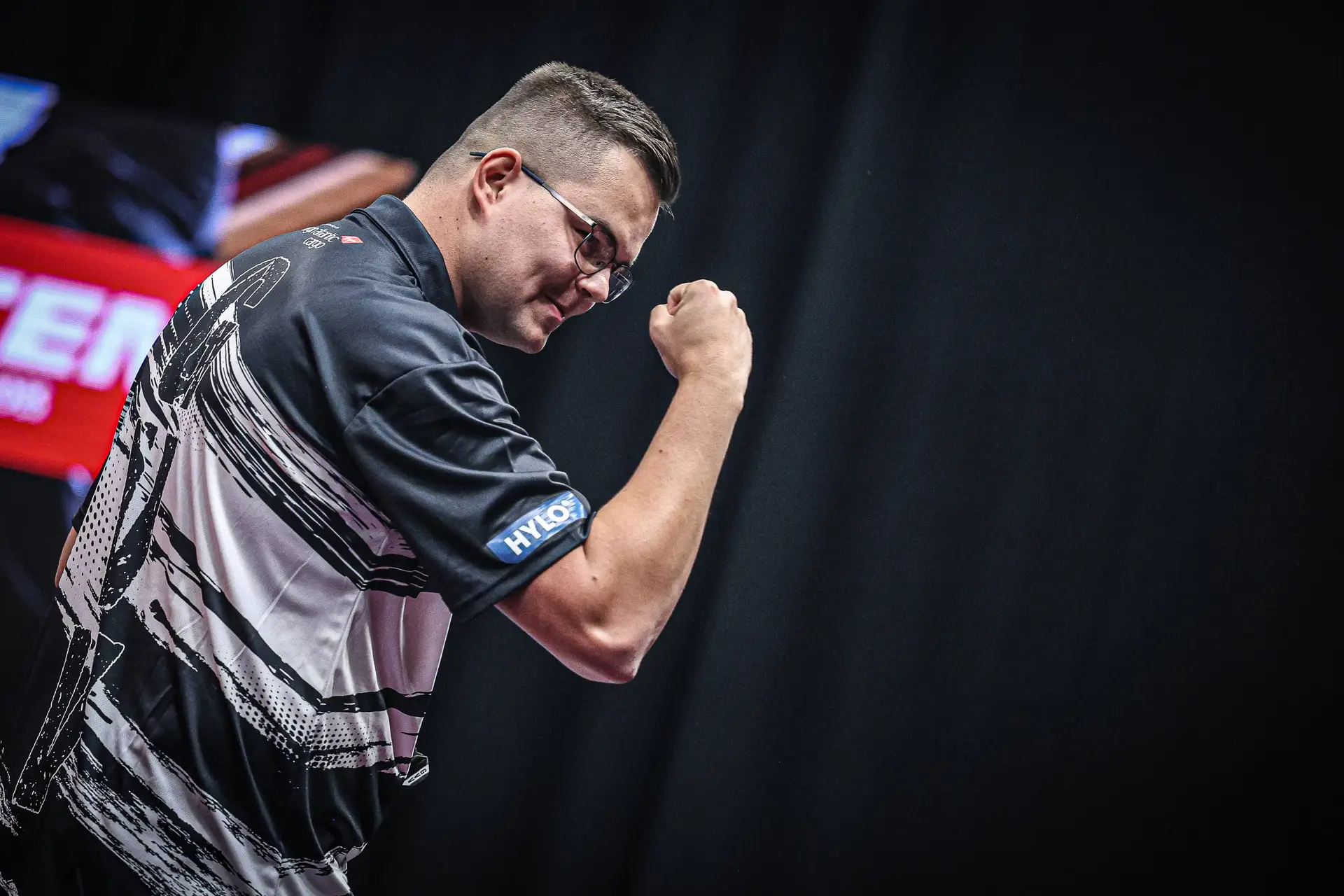
“He was quiet, even shy. And then he stepped on stage and became someone else” – Luke Woodhouse recognises himself in Freddy Mercury
PDC
In the latest episode of the Tops & Tales podcast hosted by a PDC referee, Luke Woodhouse joined the show. “Woody” recently reached his highest position in the world rankings and has been a mainstay on the Pro Tour for years. In this conversation, the Englishman spoke candidly about how balance, friendship, and mental calm are playing an increasingly important role in his career.
ADVERTISEMENT
Away from darts, Woodhouse is passionate about another sport: golf. “I’m a massive golf fan,” he says. “I play as much as I can. For me it’s completely separate from darts.”
He is a member of Beaulieu Pines Golf Club, mainly as a summer member, and often plays with people from the darts world. One name comes up immediately: Daz Rollings, PDC official and regular golf partner. Damon Heta also often joins them. “The great thing about golf is that it completely switches my mind off from darts,” Woodhouse explains. “I put my phone in my bag and don’t look at it for hours. You walk, you talk, you’re outside. Sometimes the golf is almost secondary.”
What stands out is how consciously Woodhouse deals with relaxation. Although he plays with Heta and Rollings, he actually tries to avoid talking about darts. “You don’t talk all the time about form or results,” he says. “Especially with Daz, who works within the PDC, you just want to keep it light. It’s general chat, not work-related.”
Playing with pain: “Sometimes it actually helps”
The conversation takes an unexpected turn when illness and injuries come up. Ware notes how remarkable it was that hardly any players or officials became ill during the World Championship at Alexandra Palace.
Woodhouse confirms that players sometimes have no choice but to play on. “If you get ill and you don’t turn up for the next round, you don’t get the prize money for that round. So unless you really can’t stand, you carry on.”
ADVERTISEMENT
He speaks from experience. During a European Tour event in Graz, he was struggling with back problems. “Throwing was fine, but even that little step up to the oche, you could feel it.”
“Sometimes it actually helps,” Woodhouse says. “You’re less obsessed with doing everything perfectly. You’re focused on surviving, on protecting yourself. And because of that, you sometimes actually play better.”
Ware then recalls Simon Whitlock once averaging over 104 while carrying an injury.

After a strong World Darts Championship, where he reached the fourth round, Woodhouse has risen to 21st in the world rankings.
The nine-darter that went around the world
ADVERTISEMENT
One of the most talked-about moments of Woodhouse’s career came at the World Championship, when he played against close friend Damon Heta. Heta hit a nine-darter and Woodhouse celebrated wildly.
“People immediately suggested I was celebrating because of the prize money,” Woodhouse says. “But that wasn’t it at all. I was just so happy for him.”
He points out that Heta had missed a chance at a nine-darter in an earlier match. “Then you see your mate do it on the biggest stage. That’s pure emotion.”
There was also some self-reflection. “Afterwards I did think for a moment: did I take his moment a bit? But everything worked out. It was genuine.”
What often gets forgotten is that Woodhouse went on to win the match anyway, coming back from 3–1 down in sets. He knocked out his friend with no room for sentiment. “On that stage, there are no friends,” he says calmly. “He wants to win, I want to win. That’s it.”
ADVERTISEMENT
Playing against good friends is almost unavoidable on the Pro Tour. Woodhouse is realistic about that. “You play each other so often that you just get used to it.”
There is little time for chatting, especially at the World Championship. Media duties take up a lot of time, and by the time interviews are finished, the opponent is often already gone. “People don’t always see that,” he explains. “But it’s just part of the job.”

Queen and Freddie Mercury
The conversation shifts to music, and Ware and Woodhouse turn out to be very much on the same wavelength. Both are huge Queen fans, with Freddie Mercury as their ultimate hero. “My dad always listened to Queen,” Woodhouse says. “In the car, on cassette tapes. That’s where it started.”
ADVERTISEMENT
What touches him most is the contrast between Mercury’s stage presence and his personality off it. “He was quiet, even shy. And then he stepped on stage and became someone else. That fascinated me.”
Woodhouse recognises himself in that. “You don’t always have to be extrovert. He showed you can still be great.”
His favourite song? From Mercury’s solo work he names “Barcelona”, and from Queen he picks “Now I’m Here”. “Yeah, I love it. My favourite Queen song is ‘Now I’m Here.’”
Although Ware has seen Queen with Adam Lambert several times, Woodhouse is more hesitant. “I’m a bit of a stick in the mud. For me, Queen is Freddie Mercury, so I don’t watch too much of Queen without Freddie.”
At the same time, he recognises Lambert’s quality. “From what I’ve heard, he’s just being him. He’s not trying to be Freddie. He brings his own twist, he’s not copying what Freddie used to do.”
ADVERTISEMENT


Kieran WoodDarts Journalist
Kieran Wood is a sports journalist based in Wales and has been active in journalism since 2022. He contributes to DartsNews.com, where he covers professional darts through news, match reports, analysis, and live coverage across the PDC calendar and major tournaments.
A key part of his work is on-site reporting from leading events. Kieran has covered the PDC World Darts Championship in person, reporting daily from the venue and providing first-hand insight from the tournament. During his coverage, he has conducted interviews with leading players including Luke Littler, Luke Humphries, and Gerwyn Price.
He is also one of the leading voices of the English-language Dartsnews Podcast, contributing regular analysis and discussion on developments across the professional darts circuit.
In his reporting, Kieran places strong emphasis on careful sourcing, editorial accuracy, and updating articles when new, verified information becomes available.
claps 0visitors 0
Just in


Popular news

Latest comments
- I agree,I can't believe the lack of coverage of this sad loss. Always enjoyed watching him,but I guess now it's all about littler,well it seems that way. Darts has sadly lost a good manrick6717-10-2026
- In the absence of a report regarding the death of Stefan Lord, I'll assist. An excellent player in the late 70s and early 80s, he actually won the now defunct 3rd place match at two World Championships and a couple of the News of the World Championships. A fabulous player and easily the best Swedish player ever. Rest peacefully Stefan.richieburnettrocks16-10-2026
- Joking aside, it is the second most watched sport on sky (more than golf, F1 etc) behind football only, and in participation is second to only football and swimming. It doesn't get the attention or sponsorship of "bigger" sports because it's not as sexy, but it's right up there.BandB13-10-2026
- i love darts but you can't seriously believe it's the second most popular sport in the uk. even top five is pushing it. it may be the fastest growing, though.colt13-10-2026
- I'm a big Clayton fan, but he's got this completely wrong. Qualification criteria exists for a reason - so just as failing to make the top 32/64 for the Euro championships/PT Finals means you miss out, so does not lifting a title for this one.26sForFun12-10-2026
- The players who deliberately slow the game down are usually boring and win very little in the way of silverware. Horrible to watch.MrYnyslas197112-10-2026
- [“The Gentle” then used a sweeping and questionable phrase...] You anglocucks are hilariously finished in every sense of the word.Critical99911-10-2026
- I love Jonny but I disagree. The Grand Slam was always supposed to be "champion of champions" type competition. If the top 16 are guaranteed participation in everything there will be so much less jeopardy involved in qualifying and each major tournament will lose its unique flavour which the PDC has worked hard trying to develop. I enjoy following the qualification races towards the end of the year, and while consistency should have its rewards, the truth is Jonny hasn't reached a major final all year or won a single event on the Pro Tour. Being consistent is one thing, but that alone should have consequences as the sport's elite should not be prepared to accept consistently strong performances, their foremost motivation should be to win and this should be what separates them from the rest, not the consistency of their performances. Jonny is expecting that losing should be enough; it shouldn't be, at least not as far as the Grand Slam is concerned.Deduce635811-10-2026
- Well being honest,it doesn't matter what level you play at, there's always someone who slows it down to suit themselves,and extra swig of water, replacing flights, asking the ref what the score is. It happens wherever. I'm not saying it's professional,but I'm sure we've all seen it beforerick6711-10-2026
- Agree completely. Not sure how a ranking event can have a criteria not based on rankings. And he right on popularity. In the UK second only to football.BandB11-10-2026
Loading