"If he gets caught again, it’s an immediate lifetime ban" – PDPA Chairman Alan Warriner-Little breaks silence on Dom Taylor doping case
PDC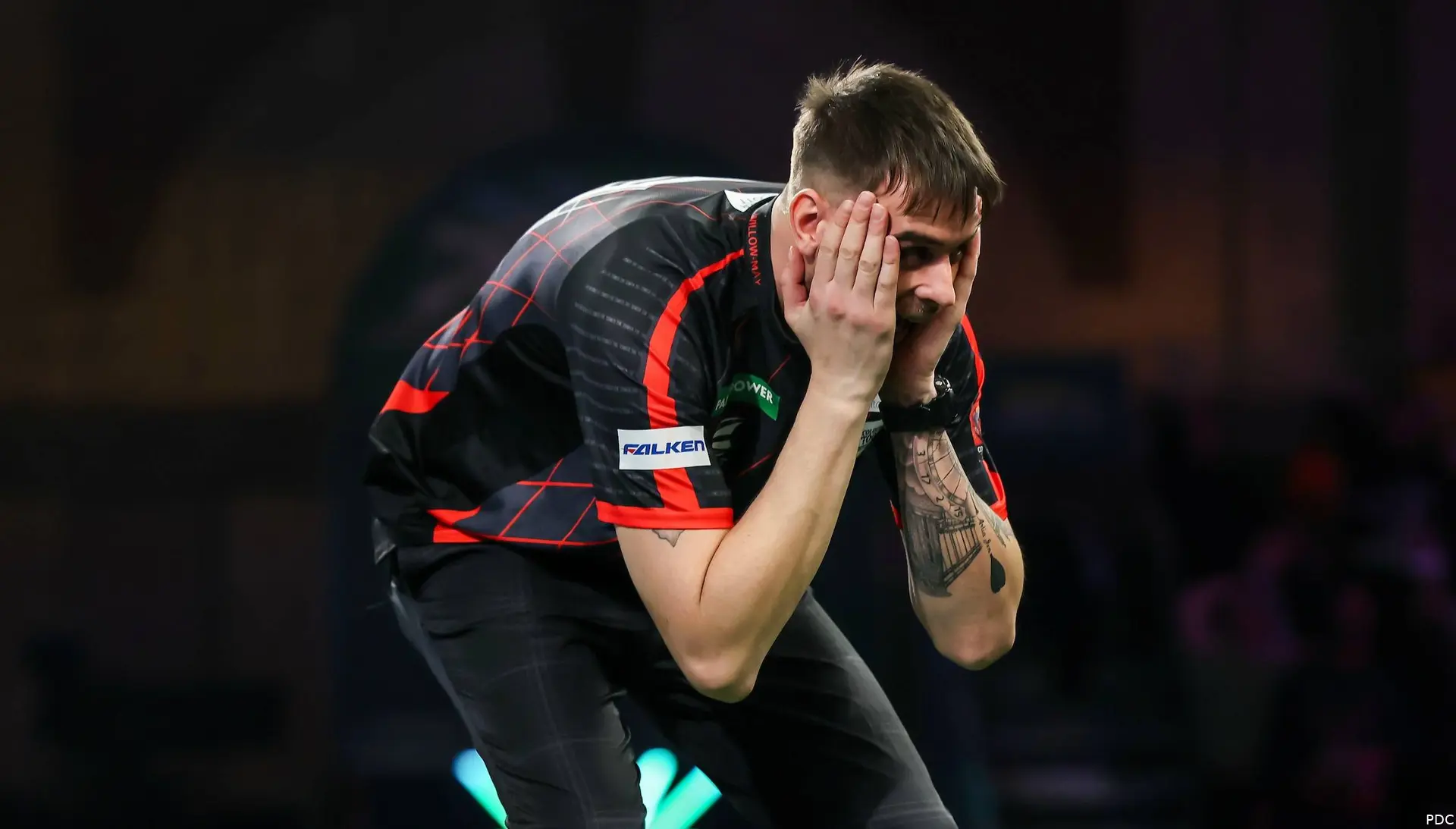
The doping case surrounding Dom Taylor has kept the darts world busy in recent weeks. On social media, in player groups and among fans, there has been heated debate about the relatively short six-month ban handed to the Englishman after a positive drug test. Some say it is far too lenient, others see it as a logical consequence of the rules. In an in-depth interview with Online Darts, PDPA chairman Alan Warriner-Little offers clarification. His message is clear: “It’s important to stick to the facts first and then people can make an opinion.”
ADVERTISEMENT
A topic that stirs emotions
Warriner-Little is well aware how sensitive the subject is. “Everybody can have an opinion on drugs because it’s the word ‘D’, isn’t it — drugs. It’s a very big topic,” he says. “I’ve seen how prolific it’s been online, so I think it’s important to stick to the facts first.” That, in his view, is the only way to have a meaningful discussion about what was actually decided by the Darts Regulation Authority (DRA), in cooperation with the PDC and the players’ union.
Read also
The Taylor case did not come out of nowhere. It is also not the first time the player has run into trouble. Last year he already missed the World Championship after an earlier positive test — a fact that has intensified the debate this time around.
One of the key misconceptions circulating, according to Warriner-Little, concerns the nature of the violation itself. “The only reason it’s on the banned substance list is because it’s illegal, not because it’s a performance-enhancing drug — because it’s not,” he explains.
He is emphatic on one point: “There’s no indication whatsoever of cheating.”
That does not make the offence insignificant, however. “If you get caught with a drug test — which the PDC, ourselves and the DRA do on a regular basis — you could be in trouble,” he says.
In competition or out of competition: the crucial difference
ADVERTISEMENT
At the heart of the sanction lies the distinction between use “in competition” and “out of competition.” “If Don Taylor had been in competition, that would have been four years,” Warriner-Little explains. “Out of competition, by the wider rules and regulations, is six months.”
He then clarifies what that distinction means in practice. “From 23:59 the day before the tournament starts, that’s considered out of competition. Anything after that is in competition.”
In Taylor’s case, the DRA concluded — after reviewing the test results and hearing submissions — that the offence fell into the former category. “They were quite happy that it was out of competition,” Warriner-Little says. “Hence he got what they say in the WADA guidelines, which is six months.”
He also acknowledges how close the case came to tipping the other way. “You’re absolutely right — it was borderline,” he admits.
The conversation also touches on how long cocaine remains detectable in the body. Medical guidance varies between 36 hours and up to four days, which raised questions about whether the test might still fall inside the competition window.
ADVERTISEMENT
Warriner-Little accepts that argument but adds crucial context. “Those are guidelines, which is fine,” he says. “But the use was very high, and that makes a difference.”
He illustrates the point with an analogy: “If you’ve had half a pint in the morning, half a pint in the afternoon and half a pint at night, you’re going to be over the limit. It’s the same with drugs — if you take a lot of it, the result is going to be distorted.”

“He was very lucky”
The interviewer describes Taylor as having been fortunate to avoid a far heavier sanction. “He was very lucky,” is the verdict — something Warriner-Little does not dispute. “Absolutely,” he responds.
Still, he stresses that the punishment carries real consequences. “Because it’s a six-month ban, in the PDC it’s effectively one year, because he can’t play Q-School until January.”
ADVERTISEMENT
While Taylor will be eligible to compete elsewhere after six months, that reality has caused frustration among players and fans alike. The prospect of earning significant prize money outside the PDC has fuelled debate about deterrence.
Warriner-Little understands the concern. “I really do,” he says. “It’s been the topic of conversation from everybody’s point of view.”
But he returns to the same conclusion. “You can only follow the rules. He’s done the crime and done the time in terms of the rules and the law.”
One more time means a lifetime ban
What is often overlooked, he adds, is the severity of any future offence. “If he gets caught again, it’s an immediate lifetime ban,” Warriner-Little states. “It couldn’t happen again.”
Beyond the regulations, the human aspect of the case weighs heavily. “The guy was in trouble,” he says. “He’s got an addiction. His life was all over the place. He was chaotic.”
ADVERTISEMENT
Providing support, he insists, was never optional. “Of course we helped him,” Warriner-Little says. “We would do that for anybody.” Taylor entered rehab shortly after the ruling. “He’s doing fine,” he adds. “I spoke to him this morning. He’s due out at the end of this week.”
The scale of what Taylor has lost is not glossed over. “Last year he missed the World Championship. This year he’s lost £25,000 in prize money, lost his tour card, lost his sponsorship,” Warriner-Little lists. “He’s lost a lot — and that’s all his fault.”
The PDPA funded the rehabilitation process. “Of course we have, yes,” he confirms. “It’s not cheap, but we have a fantastic support network.” Confidentiality, he adds, is essential. “We don’t stand on the rooftop and shout it out. We just do it quietly in the background.”
Damage to the sport
Warriner-Little does not downplay the impact on darts. “It doesn’t help the sport at all,” he admits. “The timing wasn’t great — the World Championship is the flagship event, so it made headlines.”
ADVERTISEMENT
He does, however, stress that the process moved as quickly as possible. “Everything was done as quickly as we could do it,” he says, pointing to the suspension, hearing, verdict and rehabilitation that followed.
Ultimately, he returns to where he began. “People can have an opinion on it — absolutely fine,” Warriner-Little concludes. “But those opinions should be based on the facts.”
Those facts are stark: Dom Taylor tested positive, received a six-month ban under the rules, lost his tour card and earnings, and now faces a lifetime ban should he fail again. “There’s nothing else anybody can do about it,” Warriner-Little says. “Other than make sure the player gets the support he needs.”

Samuel GillChief Content Officer
Samuel Gill is the Chief Content Officer (CCO) of DartsNews.com, a role he has held since 2020. He is responsible for editorial governance across the platform, including setting content standards, overseeing accuracy and consistency, and guiding long-term editorial strategy across professional darts coverage. Since joining, he has contributed more than 10,000 articles and editorial pieces, playing a central role in the development and daily operation of the site.
Based in Leicester, Samuel has extensive experience in darts media and has been closely involved in coverage of the professional darts circuit for several years. Within the UK darts community, he is a recognised figure known for his consistent editorial output and ongoing reporting on major tournaments and developments across the PDC calendar.
In his current role, Samuel works closely with editors and writers to ensure content meets clear journalistic standards, with a focus on source verification, editorial consistency, and timely updates when new, confirmed information becomes available.
claps 1visitors 1
Just in


Popular news
Latest comments
- I agree,I can't believe the lack of coverage of this sad loss. Always enjoyed watching him,but I guess now it's all about littler,well it seems that way. Darts has sadly lost a good manrick6717-10-2026
- In the absence of a report regarding the death of Stefan Lord, I'll assist. An excellent player in the late 70s and early 80s, he actually won the now defunct 3rd place match at two World Championships and a couple of the News of the World Championships. A fabulous player and easily the best Swedish player ever. Rest peacefully Stefan.richieburnettrocks16-10-2026
- Joking aside, it is the second most watched sport on sky (more than golf, F1 etc) behind football only, and in participation is second to only football and swimming. It doesn't get the attention or sponsorship of "bigger" sports because it's not as sexy, but it's right up there.BandB13-10-2026
- i love darts but you can't seriously believe it's the second most popular sport in the uk. even top five is pushing it. it may be the fastest growing, though.colt13-10-2026
- I'm a big Clayton fan, but he's got this completely wrong. Qualification criteria exists for a reason - so just as failing to make the top 32/64 for the Euro championships/PT Finals means you miss out, so does not lifting a title for this one.26sForFun12-10-2026
- The players who deliberately slow the game down are usually boring and win very little in the way of silverware. Horrible to watch.MrYnyslas197112-10-2026
- [“The Gentle” then used a sweeping and questionable phrase...] You anglocucks are hilariously finished in every sense of the word.Critical99911-10-2026
- I love Jonny but I disagree. The Grand Slam was always supposed to be "champion of champions" type competition. If the top 16 are guaranteed participation in everything there will be so much less jeopardy involved in qualifying and each major tournament will lose its unique flavour which the PDC has worked hard trying to develop. I enjoy following the qualification races towards the end of the year, and while consistency should have its rewards, the truth is Jonny hasn't reached a major final all year or won a single event on the Pro Tour. Being consistent is one thing, but that alone should have consequences as the sport's elite should not be prepared to accept consistently strong performances, their foremost motivation should be to win and this should be what separates them from the rest, not the consistency of their performances. Jonny is expecting that losing should be enough; it shouldn't be, at least not as far as the Grand Slam is concerned.Deduce635811-10-2026
- Well being honest,it doesn't matter what level you play at, there's always someone who slows it down to suit themselves,and extra swig of water, replacing flights, asking the ref what the score is. It happens wherever. I'm not saying it's professional,but I'm sure we've all seen it beforerick6711-10-2026
- Agree completely. Not sure how a ranking event can have a criteria not based on rankings. And he right on popularity. In the UK second only to football.BandB11-10-2026
Loading