"One of the finest throws the sport has ever seen” – Former world champion praises Raymond van Barneveld’s enduring legacy in darts
PDC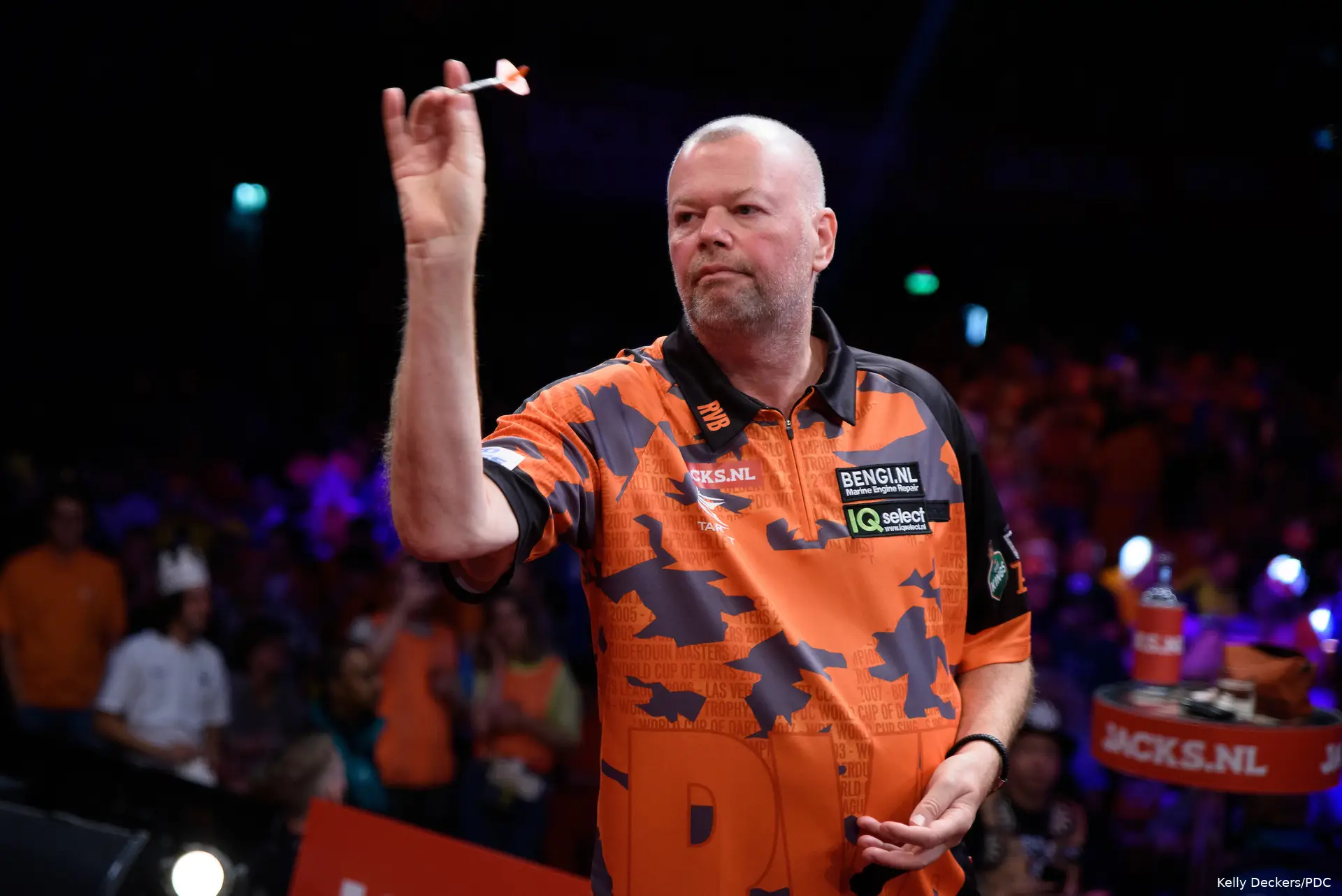
Few names in darts command as much respect as Raymond van Barneveld. A five-time world champion and for many the very definition of a living legend, his career now spans more than three decades. While his titles and triumphs are celebrated endlessly, it is his throw – distinctive, refined and iconic – that continues to capture the imagination.
ADVERTISEMENT
Like all sporting greats, Van Barneveld has never stood still. His throw, once simple and almost raw in its youth, has evolved into one of the smoothest and most recognisable actions in the modern game. Recently, “Barney” became the subject of an in-depth breakdown on MODUS Super Series – Break of Throw, where Glen Durrant – the former Lakeside champion turned coach – joined him to analyse his throw, stance and mentality. The result was both a fascinating dissection of a five-time world champion’s technique and a series of invaluable lessons for young players.
Read also
One of the sport’s most beautiful throws
Durrant was clear on the aesthetic and technical quality of Van Barneveld’s action. “Potentially one of the nicest throws in the game,” he said, before defining what he meant: “I think at the point of release… you’re looking for a very smooth release. You can see a jabby throw which can be absolutely fine, all players are different, but you’ll see with Barney it’s all about timing his throw — effortless, smooth — and that’s a big part.”
He also flagged the subtle pullback in Van Barneveld’s action as a teaching example for youngsters: “Even the pullback is something I want to highlight to players today. Nothing’s rushed and he’s got a unique grip… it’s just the smoothness.”
That elegance hides a career of constant adjustment. In the 1990s, Van Barneveld altered his throw to keep pace with Phil Taylor, whose stacking style on the treble 20 forced rivals to refine mechanics. Proof, if it were needed, that even the greats never stop evolving.

Raymond van Barneveld in action
ADVERTISEMENT
Stance and balance
For Van Barneveld, everything begins with stance. As he explained in the Live Lounge breakdown: “I’m a right-handed player… So if you’re right-handed you put your right foot up — not like this because this is the old Roland Scholten stand — but you’re further away from the board. I always put my foot like here, lean a little bit over, closer to the board and just release your darts. Don’t think too much because thinking in darts is a killer.”
Durrant agreed with the general idea while noting stylistic differences in today’s crop of players: “Yeah, it’s the way I stood as a player — flush to the board. My mindset was: I feel closer to the board. So I do agree with Barney on that one, but that side-on view is a great view of that release of the darts. The main thing is balance and stability. The lesson is that there isn’t one perfect stance, but you need consistency.”
The degree of lean remains a personal choice. “It’s trial and error,” Durrant said. “But your stance has to be sustainable. Over a career, your back and knees can only take so much.”

ADVERTISEMENT
“Thinking is a killer”
Van Barneveld put the mental point bluntly: “Don’t think too much because thinking in darts is a killer.” By that he meant the actual release must be instinctive — all the technical work is done beforehand.
Durrant echoed that advice from experience: “I reckon if you asked me when I won my first Lakeside… I wasn’t thinking at all about my action. Later, when I started tinkering, it fell apart. Barney’s absolutely right — once you over-analyse, you block yourself. Do the thinking in practice; on stage, your head must be clear. The best advice I can give is stare at the target area you’re looking for and let your technique — which you’ve honed over weeks, months, years, decades — look after itself.”

Barneveld's action has long been regarded as one of the smoothest in the sport
A grip like no other
ADVERTISEMENT
Another hallmark of Van Barneveld’s technique is his grip. In his own words: “If you think too much about how you’re holding your darts… I’m holding my dart like this but I never think about it. It’s just a grip, it’s just what it is. If you want to copy another player — people try to copy me with my darts — you can’t. It’s just you. You pick up your dart like you do and just get on with it.”
Durrant expanded on what makes Barney’s grip unusual: “He uses a lot of fingers on the barrel… the little finger comes off just on the point of releasing the dart. There’s a lot of fingers on the point of the dart with Raymond, and every single time the little finger comes off — it wouldn’t be the same player if the little finger wasn’t doing that job. For me, that’s a real thing of beauty; timing and smoothness is what that throw’s about.”
On the practical coaching side he offered a memorable analogy: “Try and hold it like a feather… the ideal way is just to really feather the dart and there’s no better way than Barney. He just makes it look like he’s throwing a feather.”
Rhythm and practice habits
ADVERTISEMENT
Beyond technique and grip, rhythm is crucial. Van Barneveld stressed practising to match conditions: “If you practise at home, your practise routine will be quicker than if you play another guy, and you have to practise on that as well. Walk back and now wait a couple of seconds — say like ten seconds — because normally there is an opponent in front of you. If you don’t wait these ten seconds you’re in a different routine than what normally happens in a normal game.”
Durrant called that often-overlooked routine “the pre-throw routine”: “I’ve only ever heard Bobby George talk publicly about how we used to stand back and role-play the fact that there’s a player in front of you. Too many people actually throw the darts and just sprint back to the oche. A big part of your game is what you’re doing while your opponent is throwing.”

Barney is one of the most successful players in the history of darts
Experimentation without doubt
Van Barneveld has long experimented with flights, stems, points and barrels. Critics sometimes read that as insecurity; Durrant disagreed. “Tinkering is not linked to thinking,” he said. “If you’re off the oche, understand how to change if you need to change — but once you step foot on the oche that doesn’t matter anymore. It’s all about what happens here: you and that board.”
ADVERTISEMENT
He urged patience: quick fixes rarely work. “It’s taken Raymond 30, 40 years to get to the standard he’s at now. Looking for a quick fix is panic stations and I wouldn’t recommend it.”
Read also
A champion still relevant
Despite his age — and a brief retirement — Van Barneveld remains a threat. He has again qualified for major events, including the World Matchplay, where a tie with Michael van Gerwen immediately turned heads.
Durrant underlined the pull of the Van Barneveld name: “The Raymond van Barneveld name is still a massive pull within darts. You can’t just make your way to the World Matchplay — you have to qualify — so he’s still there and thereabouts. He sets his own high standards; reaching a Matchplay is not enough for him. The way he’s bounced back from retirement is incredible. He still has that hunger. When he stops playing, that’s a different conversation, but right now he’s right in the mix.”
ADVERTISEMENT
For Van Barneveld, competing is never just about turning up. “People write me off all the time, but I’ve proved them wrong before and I’ll keep doing it,” he has said elsewhere — and he still talks of chasing titles rather than merely participating.
The legacy of a throw
If his career proves anything, it’s that a throw is never fixed. Van Barneveld has adapted, refined and reinvented — but never lost his identity. His style, defined by smoothness, control and simplicity, is now studied worldwide.
His lessons for the next generation are clear:
- Find your stance and balance.
- Develop a grip that works for you.
ADVERTISEMENT
- Train at match tempo.
- Don’t think on the oche — trust your throw.
For aspiring players there is no greater role model. Not only for his titles, but for his capacity to keep reinventing himself. Even today, the man from The Hague remains a true inspiration — a living legend who helped shape modern darts.
Kieran WoodDarts Journalist
Kieran Wood is a sports journalist based in Wales and has been active in journalism since 2022. He contributes to DartsNews.com, where he covers professional darts through news, match reports, analysis, and live coverage across the PDC calendar and major tournaments.
A key part of his work is on-site reporting from leading events. Kieran has covered the PDC World Darts Championship in person, reporting daily from the venue and providing first-hand insight from the tournament. During his coverage, he has conducted interviews with leading players including Luke Littler, Luke Humphries, and Gerwyn Price.
He is also one of the leading voices of the English-language Dartsnews Podcast, contributing regular analysis and discussion on developments across the professional darts circuit.
In his reporting, Kieran places strong emphasis on careful sourcing, editorial accuracy, and updating articles when new, verified information becomes available.
claps 0visitors 0
Just in
Popular news
Latest comments
- correct, but hey, it wouldn't be dartsnews without shamelessly misleading clickbait titles like this.colt17-11-2026
- No it wasn't the greatest checkout ever,who writes this stuff? And more importantly,he lost!!!rick6717-11-2026
- His back wasn't against the wall as he had already guaranteed he would top the group at that point, and it's nowhere near the greatest checkout of all time as there was consequently nothing riding on it. Littler made it clear that once he had achieved the requisite three legs he was no longer even taking the game seriously and was simply showing off with a shot he probably hits all the time in exhibtion play (I wouldn't know, I only watch real darts). Don't get me wrong though, it was still impressive.Deduce635817-11-2026
- Why not just donate £5 per ticket from the world championship? It's a worthy cause,I agree,but currently Taylor can't keep his nose out of anything,as he's cogging on. And he's not even bloody playing!!rick6716-11-2026
- Well,I suppose if you don't play the tournaments ,then why should any player qualify? There are players who enter every tournament,and if they don't win it,they carry on, spending money they haven't won,yet certain players seem to think they should qualify. Winners only I thinkrick6714-11-2026
- Everyone knows what a fantastic champion Taylor was,but his performances in the seniors were poor. He wouldn't throw littler off stage,as he'd miss these days!!rick6712-11-2026
- He produced some impressive numbers in that qualifying campaign. I'm excited to see him compete at the World Championship once again, even if it will be difficult to replicate last year's success even with an improved performance, with the draw playing a huge role in determining his fortunes.Deduce635811-11-2026
- I often think about this very question. I think they should revive the format. They could even invite representatives from MODUS Super Series, with four series winners from the past year, and the ADC, with finalists from the Global Championship and perhaps other events. Why not throw in eligible representatives from the JDC and even the soft-tip game too?Deduce635811-11-2026
- So what if littler missed out, he doesnt have to enter everythingant10-11-2026
- Good, absolutely no loss if we never see this dancing goof ever again......no that is not fair. He absolutely cannot and has never been remotely able to dance!richieburnettrocks10-11-2026