
In less than a month, the World Darts Championship gets under way at Alexandra Palace. But before the biggest tournament of the year, two other major events remain on the calendar. The first is the Grand Slam of Darts, which starts in Wolverhampton this Saturday. This edition will be a special one, as the tournament celebrates its 20th anniversary. For the first time in its history, a field of 48 players will take to the oche.
ADVERTISEMENT
The Grand Slam of Darts has carved out a special place on the darts calendar over the years. Since the inaugural edition in 2007, it has stood apart from the other major televised events on the PDC calendar. That is down not only to the presence of players from different darts organisations, but above all to its unique format. At most majors, a defeat meant immediate elimination. The Grand Slam group stage, however, gave players a chance to recover from a setback. That often led to memorable matches, surprising finishes and plenty of drama.
When BDO players could still shine at the Grand Slam
The PDC has now decided to abandon that familiar formula. The 2026 edition will feature 48 players, smaller groups and a much stricter qualification system for the knockout stage. It is a major change that could undoubtedly produce plenty of excitement, but it also raises questions. Will this revamped format really make the Grand Slam of Darts better?
To understand the scale of the change, it is worth looking back at how the tournament began. The PDC staged the first Grand Slam of Darts in 2007. It was an unusual initiative at the time, as the organisation did not invite players exclusively from its own circuit. Several leading BDO players were also invited to take on the PDC stars. That gave the event an extra dimension from the outset. It was not simply a new major, but also a chance to test the balance of power between different darts organisations.
At the time, the Grand Slam was not a ranking event. No world-ranking points were at stake. Instead, it was a prestigious invitational tournament that brought together the best players from different circuits. In that respect, it had something in common with the Premier League Darts, although the format was entirely different. It was a short, intense tournament in which players competed not only for the honour, but also for a highly prestigious title.
That original character made the Grand Slam unique from the start. The PDC already had several major tournaments, including the World Darts Championship, World Matchplay, World Grand Prix and UK Open. But the Grand Slam brought something new: a stage where the best players from different worlds could meet. That gave the event extra appeal, particularly in its early years.
ADVERTISEMENT
A unique format that stood the test of time
The Grand Slam stood out for more than its line-up. Its match format was also a distinctive feature of the PDC calendar for many years. From the first edition in 2007, 32 players took part. They were split into eight groups of four. In the group stage, each player faced the other three players in their group, with the top two advancing to the last 16.
This formula set the tournament apart from most other major events. In a traditional knockout tournament, there is no room for a bad day. Lose in the first round, and you are out. The Grand Slam was different. A defeat did not have to be fatal, and in exceptional circumstances, even two losses could leave a theoretical route through to the next round.
That possibility sometimes made the group stage remarkably unpredictable. Players could not afford too many mistakes, but they did have a chance to make up for a poor opening match. A strong second or third performance could suddenly make the difference between elimination and a place in the knockout stage.
With four players in each group, there were also several possible scenarios. In some groups, the first two matches were enough to secure a place in the next round. In others, the contest remained open until the final match. It was even possible for several players to finish level on points, making leg difference decisive.
ADVERTISEMENT

Luke Littler is the defending champion at the Grand Slam of Darts.
Then there were the notorious “one-leg shootouts”. If players could not be separated by the usual criteria after the group matches, a deciding leg could be needed to determine who advanced. One leg, one chance, and potentially the difference between a successful tournament and an early exit. Those moments perfectly captured the character of the Grand Slam.
That unpredictability gave the tournament its distinct identity. It was not only the form player who could progress. Players who made a slow start could fight their way back, while a favourite who felt comfortable after a strong opening match could suddenly find themselves in trouble.
The group stage also meant there were plenty of matches from the first day onwards with different stakes. Some players were fighting to keep their hopes alive, others were trying to secure top spot, while some depended on the result of a match in which they were not even at the oche. Few other tournaments offered the same dynamic.
From exhibition event to established major
ADVERTISEMENT
The Grand Slam’s status did change over the years. In 2015, the PDC gave the tournament full ranking status. It was no longer just a prestigious invitational event, but also an important part of the world-ranking race. Performances in Wolverhampton now carried added sporting and financial significance for the players.
For the most part, the tournament retained its original purpose. Players from different circuits could still meet, and the group stage remained in place. That changed for good after the BDO ceased to exist in 2020. Invitations to players from other organisations ended, and the Grand Slam increasingly became a contest between the leading players on the PDC circuit.
Even so, the event kept its own identity. The group stage remained a striking difference from the other majors. As the PDC calendar grew busier over the years and most major tournaments retained a traditional knockout structure, the Grand Slam stuck with a format that had been in place since its first edition in 2007.
That was remarkable in itself. The PDC is known for its willingness to adjust tournaments and formats when it believes it can improve the product. For years, the Grand Slam was an exception. Its original concept worked well and had secured a clear place on the darts calendar. That continuity is now coming to an end.
Grand Slam of Darts roll of honour
ADVERTISEMENT
| Year | Winner | Runner-up | Score |
| 2007 | Phil Taylor | Andy Hamilton | 18-11 |
| 2008 | Phil Taylor | Terry Jenkins | 18-9 |
| 2009 | Phil Taylor | Scott Waites | 16-2 |
| 2010 | Scott Waites | James Wade | 16-12 |
| 2011 | Phil Taylor | Gary Anderson | 16-4 |
| 2012 | Raymond van Barneveld | Michael van Gerwen | 16-14 |
| 2013 | Phil Taylor | Robert Thornton | 16-6 |
| 2014 | Phil Taylor | Dave Chisnall | 16-13 |
| 2015 | Michael van Gerwen | Phil Taylor | 16-13 |
| 2016 | Michael van Gerwen | James Wade | 16-8 |
| 2017 | Michael van Gerwen | Peter Wright | 16-12 |
| 2018 | Gerwyn Price | Gary Anderson | 16-13 |
| 2019 | Gerwyn Price | Peter Wright | 16-6 |
| 2020 | José de Sousa | James Wade | 16-12 |
| 2021 | Gerwyn Price | Peter Wright | 16-8 |
| 2022 | Michael Smith | Nathan Aspinall | 16-5 |
| 2023 | Luke Humphries | Rob Cross | 16-8 |
| 2024 | Luke Littler | Martin Lukeman | 16-3 |
| 2025 | Luke Littler | Luke Humphries | 16-11 |
From 32 to 48 players: a major change
For the 2026 edition, the PDC has decided to overhaul the Grand Slam of Darts. The field will expand from 32 to 48 players, adding 16 competitors and giving the group stage a completely new look.
Instead of eight groups of four, there will now be 16 groups of three. The group stage will be considerably shorter, with each player having just two matches to secure a place in the next round. Only the 16 group winners will advance to the knockout stage.
On paper, this may look like a relatively simple adjustment: more players, smaller groups and a knockout stage featuring 16 competitors. But the sporting consequences are significant. The difference between the old and new formats goes far beyond the number of matches.
ADVERTISEMENT
Under the old format, a player could recover after a defeat. Even a second loss did not necessarily mean the end in certain circumstances. In the new format, the situation is much clearer: lose your opening match and you are immediately up against it. A second defeat guarantees elimination, while even winning the opening match offers no guarantee of qualification.

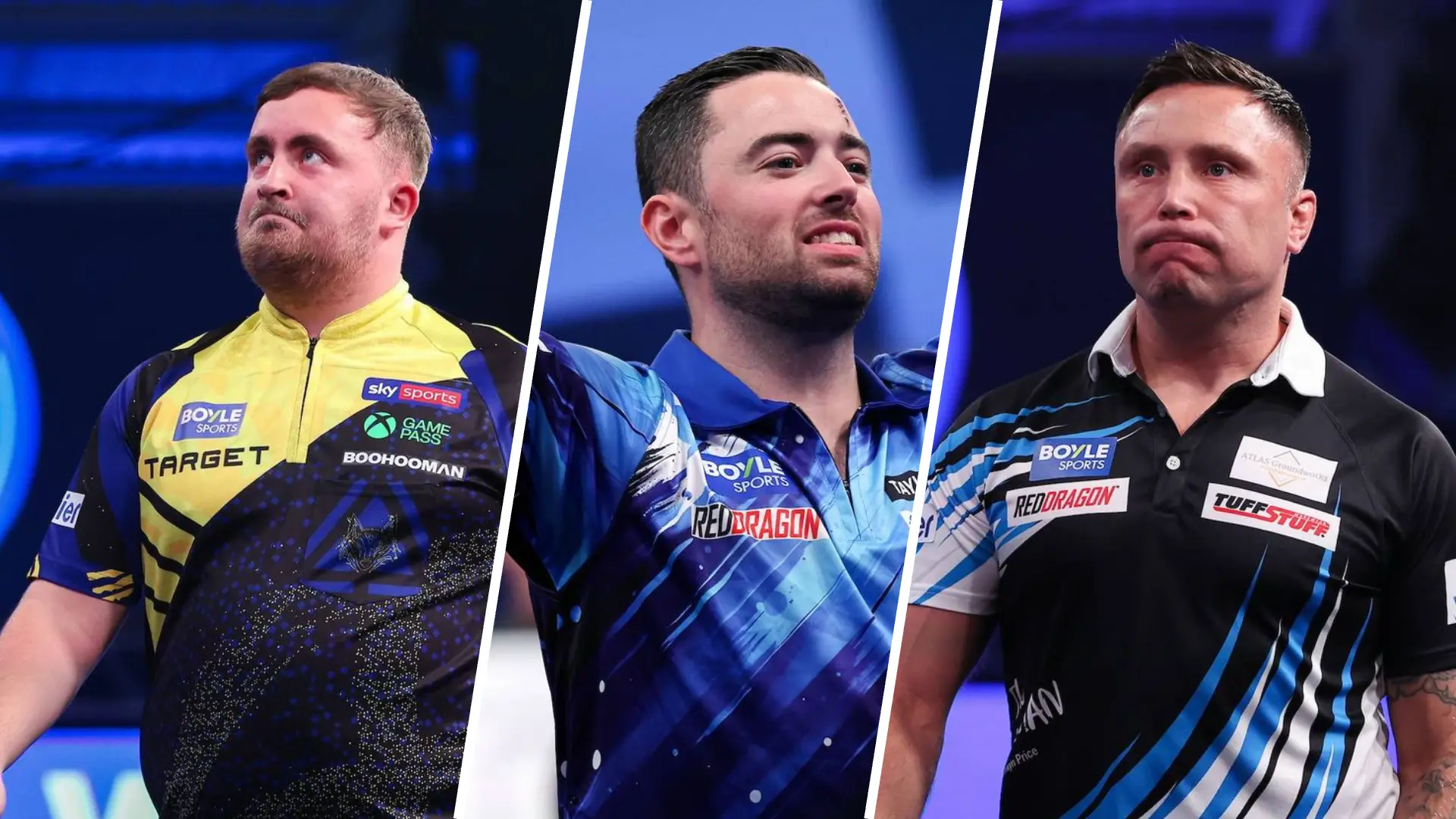
Gian van Veen, Michael van Gerwen and Niels Zonneveld are three of the Dutch players at the 2026 Grand Slam of Darts
With only two matches per player, there is little room for an off day. A favourite who loses the first match must win the second and will also depend on the result of the other match in the group. The chance of a top player going home after just two matches is therefore considerably higher.
That could make for a spectacle. The pressure will be high from the first dart, and every leg could matter. At the same time, the format removes some of the charm that made the Grand Slam so recognisable for years. The chance to recover from a setback was precisely what set the tournament apart from other majors.
A “group of death” featuring Littler, Greaves and Zonneveld shows what is at stake
ADVERTISEMENT
To see what the new format could mean, look no further than the group featuring Luke Littler, Beau Greaves and Niels Zonneveld. It is a perfect illustration of the consequences of the new system.
All three have been in excellent form in 2026 and have the ability to make a deep run at a major. Littler is, of course, among the world’s elite and one of the leading favourites at almost every event. Greaves has repeatedly shown in recent months that she can compete with the best male players. And Zonneveld has also shown enough quality and form to be taken seriously.
Under the old format, two of the three could in principle have advanced to the next round. Now, one defeat could quickly prove fatal. The risk of a big name suffering a surprise exit is greater, and every match takes on immediate sporting significance.
But the format also raises questions about fairness and the role of the draw. In a group of three, an unfavourable draw can have serious consequences. A player could perform brilliantly but still miss out on qualification because two other top players are in the same group. Elsewhere, a competitor with a much kinder draw could reach the next round relatively comfortably with two wins.
That is inherent in any group system, of course, but the effect is even stronger in groups of three. There are simply fewer matches in which to correct the balance of power. One standout performance, a missed double or an unexpected defeat can immediately make the difference.
ADVERTISEMENT
More players do not automatically mean more quality
The expansion to 48 players also has clear advantages. More players will get the chance to perform on the big stage, and for some, the Grand Slam could be a valuable opportunity to make an impression internationally. That could be a significant step, particularly for players who do not regularly appear at the biggest televised events.
A larger field also creates more scope for upsets. The PDC has a deep pool of players capable of beating the very best on their day. In many cases, the gap between the top 20 and those just outside it has become very small. Expanding the field could bring that development into sharper focus.
Still, it is fair to ask whether more players automatically make for a better tournament. For years, the Grand Slam was an event where all 32 selected players had earned their place through their performances and the qualification criteria. Increasing that number to 48 broadens the field, but it does not necessarily raise the average quality of the matches.
There is also a difference between giving more players the chance to compete and improving a tournament’s sporting concept. Those are separate issues. The PDC can reasonably argue that a larger field brings more excitement and greater commercial appeal. But the question remains: does it also enhance the Grand Slam as a sporting competition?
There is a risk that the tournament could lose some of its exclusivity. For years, players had to stand out at other major events and across different circuits to qualify for the Grand Slam. Simply taking part was an achievement. With 48 players, the bar is lower, although earning a place in the field remains a significant accomplishment.
English players at the 2026 Grand Slam of Darts
| English players |
| Luke Littler |
| Beau Greaves |
| Lisa Ashton |
| Tommy Morris |
| Stephen Bunting |
| Joe Hunt |
| Ryan Searle |
| Andrew Gilding |
| Charlie Manby |
| Rob Cross |
| Luke Humphries |
| Joe Cullen |
| Luke Woodhouse |
| Tom Sykes |
| James Wade |
| Ricky Evans |
| Cam Crabtree |
| Henry Coates |
| Bradley Brooks |
| Carl Sneyd |
| Chris Dobey |
| Ross Smith |
| Nathan Aspinall |
Drama versus sporting merit
The strongest argument for the new format may be the added drama. In a group of three, a great deal is at stake from the very first match. There is no longer time to ease into the tournament or make up for a poor opening performance with two strong displays.
That could appeal to television viewers. Every match counts, and it will be fascinating to see how players handle the pressure. A defeat leaves almost no margin for error. A win is not enough either: players must prove themselves again in a second match that could decide qualification.
But drama is not necessarily the same as sporting quality. A format can be highly exciting without being the best way to ensure the strongest player ultimately wins. That distinction matters.
The former group stage offered a better chance to assess the balance between players over a larger number of matches. A player who produced the best results across three games generally deserved a place in the next round. Under the new formula, the difference between advancing and going out could be much smaller.
Most successful players at the Grand Slam of Darts
| Player | Titles |
| Phil Taylor | 6 |
| Michael van Gerwen | 3 |
| Gerwyn Price | 3 |
| Luke Littler | 2 |
| Scott Waites | 1 |
| Raymond van Barneveld | 1 |
| José de Sousa | 1 |
| Michael Smith | 1 |
| Luke Humphries | 1 |
A new era for the Grand Slam
With this decision, the PDC has clearly chosen change. It is understandable that an organisation wants to keep reviewing its tournaments and look for ways to improve them. Darts has grown enormously in recent years, standards are exceptionally high, and interest in major televised events continues to rise. Expanding the Grand Slam fits that trend.
Read also


The new formula will undoubtedly give us a different kind of Grand Slam. It may even prove to be a successful experiment. Upsets are more likely, pressure on the players will increase, and the group matches will carry enormous significance. The new format could certainly produce memorable moments.

Samuel GillChief Content Officer
Samuel Gill is the Chief Content Officer (CCO) of DartsNews.com, a role he has held since 2020. He is responsible for editorial governance across the platform, including setting content standards, overseeing accuracy and consistency, and guiding long-term editorial strategy across professional darts coverage. Since joining, he has contributed more than 10,000 articles and editorial pieces, playing a central role in the development and daily operation of the site.
Based in Leicester, Samuel has extensive experience in darts media and has been closely involved in coverage of the professional darts circuit for several years. Within the UK darts community, he is a recognised figure known for his consistent editorial output and ongoing reporting on major tournaments and developments across the PDC calendar.
In his current role, Samuel works closely with editors and writers to ensure content meets clear journalistic standards, with a focus on source verification, editorial consistency, and timely updates when new, confirmed information becomes available.
claps 0visitors 0
Just in

Popular news
Latest comments
- Everyone knows what a fantastic champion Taylor was,but his performances in the seniors were poor. He wouldn't throw littler off stage,as he'd miss these days!!rick6712-11-2026
- He produced some impressive numbers in that qualifying campaign. I'm excited to see him compete at the World Championship once again, even if it will be difficult to replicate last year's success even with an improved performance, with the draw playing a huge role in determining his fortunes.Deduce635811-11-2026
- I often think about this very question. I think they should revive the format. They could even invite representatives from MODUS Super Series, with four series winners from the past year, and the ADC, with finalists from the Global Championship and perhaps other events. Why not throw in eligible representatives from the JDC and even the soft-tip game too?Deduce635811-11-2026
- So what if littler missed out, he doesnt have to enter everythingant10-11-2026
- Good, absolutely no loss if we never see this dancing goof ever again......no that is not fair. He absolutely cannot and has never been remotely able to dance!richieburnettrocks10-11-2026
- Yes Phil,now the money in the game is bigger than ever,you'd play littler. Well so would I! Retire on your memory Phil,and your successful careerrick6709-11-2026
- And why should he listen to you?Deduce635807-11-2026
- Ultimately it is a bye for whoever draws Barney. It will be another stroppy and sulky performance once he goes behind. Barney was excellent but really must completely call it a day now.richieburnettrocks07-11-2026
- I'm disappointed he was not able to secure a spot at the Grand Slam. With Carl Sneyd taking care of Daryl Gurney, he would have had to beat Andy Boulton before facing the winner of Sneyd vs Mensur Suljović for a Grand Slam spot. Unfortunately, after beating Filip Bereza comfortably, he succumbed to Boulton, and the board would ultimately be won by the highly inconsistent Carl Sneyd. Since he could instead have been drawn against the likes of Cristo Reyes, Dirk van Duijvenbode and Stephen Bunting, I think once Gurney was out of the picture he would have been favourite to win his board, and it seems like a massive missed opportunity to put 5 grand on his ranking and seal another major TV appearance ahead of the Worlds. The highs and lows of following Raymond van Barneveld!Deduce635806-11-2026
- Probably i will receive a lot of backlash and hate for this reaction, but well, so be it. I am more than sick and tired of those lies of you Barry Hearn. How dare you defend yourself over the back of Fallon’s son! He has a disability and not an illness, so let me correct that for you! I know because I have the exact same disability. I have tried to reach out to Fallon in the past, and offered her to help her and her son, because I was struggling with the same problems, and I understood the boy. I wanted him to have finally someone who understood him. However she told me that she did not want my help, and I have respected Fallon’s choice. I have never asked Fallon for money. They don’t need money in that case. I only ever wanted the best for Fallon and Rory, but I have to be honest about the situation. Fallon should tell the true story and not be forced to tell lies. I don’t hate Fallon, and I don’t begrudge or envy a single penny that she gets, but this situation/case is just not fair. I hate the lies and the dishonesty and injustice. I don’t want Fallon to be hated because there is an unfair disadvantage created. Don’t proclaim your false lies over the back of Rory! I only stand for integrity and justice. I am precisely the one who always sticks up for Fallon. And you don't, you don't give a damn about them. You were never there for them, and now you only want to save your own position! You are just trying to talk your way out of your own bad behavior at the expense of someone with a disability. And to Fallon, I don’t know if this may ever reach you, and you read it, but I want you to know I love you and I love your son Rory very much, I am sorry how things developed and went. I hope you and Harriet are still friends. I am sorry if I were too persistent to you, or you experienced it that way, but it was never my intention. Please understand I have autism as well. As Barry Hearn would say, I am only just a human being too, and I also make mistakes and misjudge things sometimes. I promise you I did everything out of the deepest love and care for you and Rory. If I were you, I should just keep all the money, only please never be dishonest or tell lies anymore for Barry Hearn, or anyone else. I hope you have the best life, and I wish nothing more than the best for you. I have always loved the two of you. Farewell.Hiddo05-11-2026