“Already, two darts academies have opened up since December" - Darts starting to take India by storm after Nitin Kumar's World Darts Championship heroics
PDC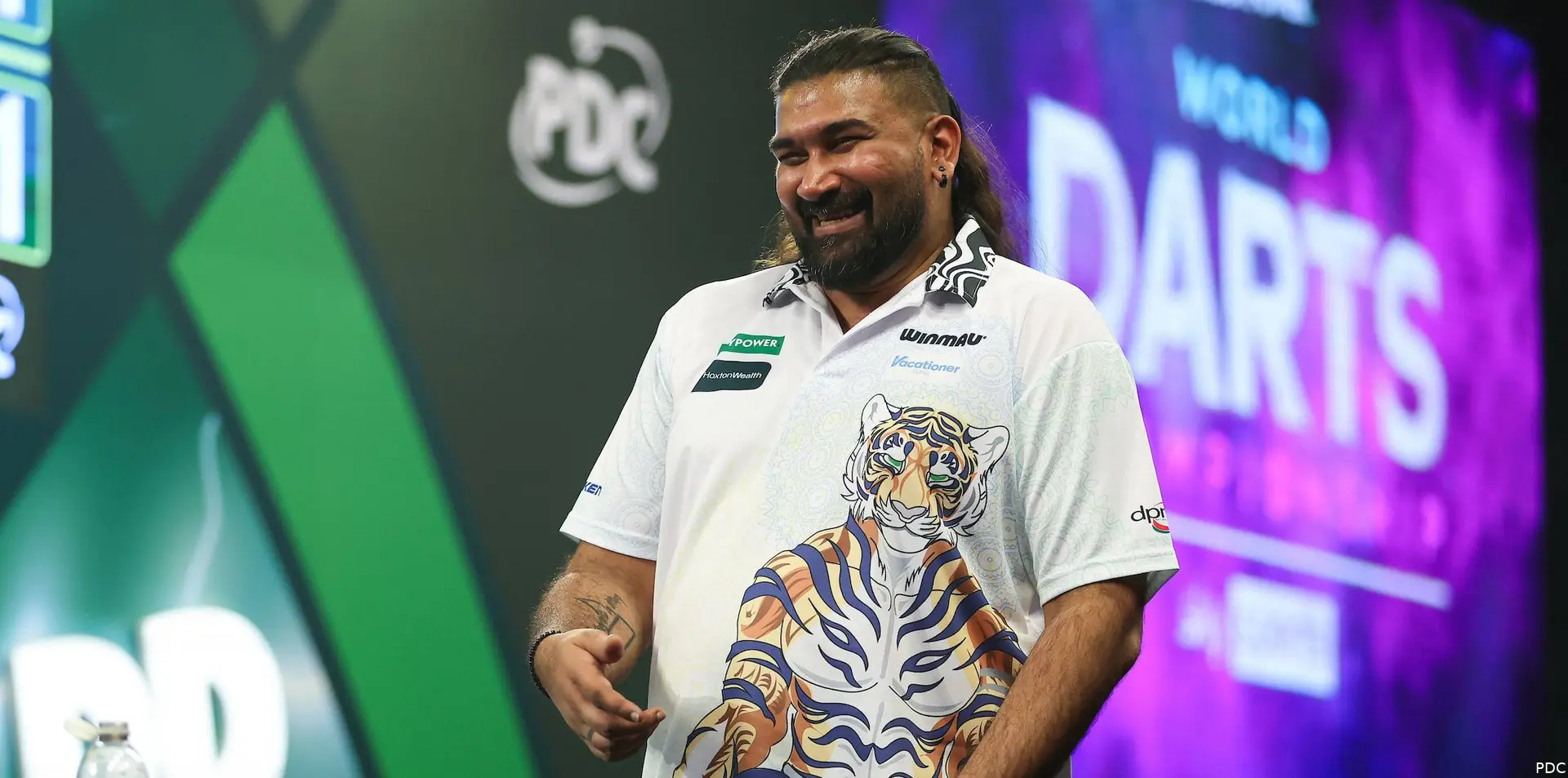
Amid the fancy dress, singing fans, and bright stage lights of the 2026 PDC World Darts Championship, Nitin Kumar delivered a moment in December 2025 that India will recount for years. The 40-year-old became the first Indian ever to win a match at the Alexandra Palace.
ADVERTISEMENT
For Kumar, nicknamed “The Royal Bengal,” it was already his fifth appearance on the sport’s biggest stage. Four times he fell in the first round. Four times he went home without a win. But this time everything was different.
In a pulsating five-set duel he beat Dutchman Richard Veenstra 3-2. Veenstra, ranked world number 48 at the time, was the favorite. Yet it was Kumar who raised his arms at the end of the match.
Mental strength as the key
Anyone who thinks Kumar spent months honing his technique with a team of coaches, physios, and sports psychologists is mistaken. The Indian’s reality is totally different from that of the established PDC pros.
Kumar works full-time as a marketing professional in Dubai. By day he is in the office; in the evening he stands at the dartboard in his living room. No luxury training facilities, no extensive support. Just discipline, passion, and immense mental resilience.
“Darts is such a game where the less mental stress you take, the better you always are going to play. And I just didn't think about it to be honest,” he said in conversation with The National. “That game that I won [against Veenstra], I didn't think about what people were thinking about me. It took me at least close to a month to get myself into that mental state."
ADVERTISEMENT
That sounds easier than it is. Especially when you represent a country that had never won a match at the Worlds. Expectations were high, the pressure immense. “Where it's very different, where you're representing a country, you want to do your best, but then now it's just, 'I don't care what people think of me, I'm going to do my best anyway'.”
That calm proved crucial in the key moments against Veenstra. In a deciding fifth set, Kumar kept his nerves under better control. When the winning double landed, something burst free that he had suppressed for weeks.
“I felt like there was a lot of pressure that was on my shoulders, which I didn't feel it at the time because I was training myself not think about it,” he said. “But then towards the end of the game, I just kept feeling it. And I'm like, 'Alright, you're closer to victory right now.' This is the first time you're on uncharted territory. I've never been there. And it's something that was weird.”

Nitin Kumar reached the second round at the 2026 World Darts Championship
Not raised in India
ADVERTISEMENT
Remarkably, Kumar is not a player who grew up in India. He moved to Dubai as a baby, where his father worked as an interior designer and his mother at the food company Al Kabeer. “I was here when I was one month old,” he says. “I just went to India just for my university and came back. I've been here all my life. I'm a Dubai boy.”
Darts entered his life at a young age through the city’s Indian community. At social gatherings, acquaintances had a dartboard at home. What began as relaxation grew into a serious passion. “My mum, of course, loved playing darts because it's a great stress reliever. You have three boys at home - so my dad, me, and my brother,” he laughs. “So for her, it was a great stress reliever. For my dad, it was a chance to go to the pub.”
Yet darts was not his first dream. Kumar was initially serious about basketball. He even returned to India to study and pursue his sporting ambitions. When that path closed, he focused on a career in communications and marketing.
“I had a very sort of creative mind and I like to think out of the box,” he said. “They let me do what I wanted to. And in that way, I'm really happy actually. I was lucky in that way. I was blessed.”

ADVERTISEMENT
The life of a ‘part-time’ darter
What sets Kumar apart from many other Worlds participants is his daily routine. While the elite can train ten hours a day, he must schedule his practice after an eight to nine-hour workday. “Whenever I'm back home, I need to practice at least an hour and a half or two hours every single day,” he says. “Apart from that, we have three nights where we actually play darts over here in the league."
He is acutely aware of the gap to the world’s best. “So if I practice a whole week, an hour and a half or two hours, I practice 10 hours in a whole week while they practice 10 hours in a day. So I'm always fighting a losing battle in that way.”
His next big goal is to earn a PDC Tour Card via Q-School. That would officially bring him onto the professional circuit.

Kumar was recently part of the inaugural Saudi Arabia Darts Masters
ADVERTISEMENT
Growth of darts in India
The impact of his win went beyond his personal success. In India, his Worlds victory sparked a wave of enthusiasm. “Well, there have been a lot of waves in India,” he said. “Already, two darts academies have opened up since December. There's another one opening next week. So people are taking it very seriously. They have a lot of youngsters in India."
Yet he also feels a responsibility. Because he lives in Dubai, he cannot mentor young Indian talents on a daily basis. “I sort of feel a little guilty that if I was in India, I could have taught them a little better. They'd always have access to me so I can teach them. There are lots of kids who can be led in a wrong way. Because if you're a professional darts player, you've got to think like a professional darts player. You've got to practice like one.”
He uses a telling comparison to explain the mental side of darts. “The highest score on a dartboard is 180,” he says. “You wake them at 3 o'clock in the morning while they're half asleep and tell them to hit a 180. Give them 10 minutes, they'll hit one. I tell the same people to do that in front of screaming fans behind and then you're talking about missing by a millimetre to missing by an inch and that is something that can't be taught. So this is what I have learnt, ideally, how to handle that.”
Dreaming of more
ADVERTISEMENT
Despite being 40, Kumar feels nowhere near the end of his development. On the contrary. “Of course, ambition is always to be a world champion. You've got to shoot for the stars.”

Kieran WoodDarts Journalist
Kieran Wood is a sports journalist based in Wales and has been active in journalism since 2022. He contributes to DartsNews.com, where he covers professional darts through news, match reports, analysis, and live coverage across the PDC calendar and major tournaments.
A key part of his work is on-site reporting from leading events. Kieran has covered the PDC World Darts Championship in person, reporting daily from the venue and providing first-hand insight from the tournament. During his coverage, he has conducted interviews with leading players including Luke Littler, Luke Humphries, and Gerwyn Price.
He is also one of the leading voices of the English-language Dartsnews Podcast, contributing regular analysis and discussion on developments across the professional darts circuit.
In his reporting, Kieran places strong emphasis on careful sourcing, editorial accuracy, and updating articles when new, verified information becomes available.
claps 0visitors 0
Just in


Popular news
Latest comments
- I agree,I can't believe the lack of coverage of this sad loss. Always enjoyed watching him,but I guess now it's all about littler,well it seems that way. Darts has sadly lost a good manrick6717-10-2026
- In the absence of a report regarding the death of Stefan Lord, I'll assist. An excellent player in the late 70s and early 80s, he actually won the now defunct 3rd place match at two World Championships and a couple of the News of the World Championships. A fabulous player and easily the best Swedish player ever. Rest peacefully Stefan.richieburnettrocks16-10-2026
- Joking aside, it is the second most watched sport on sky (more than golf, F1 etc) behind football only, and in participation is second to only football and swimming. It doesn't get the attention or sponsorship of "bigger" sports because it's not as sexy, but it's right up there.BandB13-10-2026
- i love darts but you can't seriously believe it's the second most popular sport in the uk. even top five is pushing it. it may be the fastest growing, though.colt13-10-2026
- I'm a big Clayton fan, but he's got this completely wrong. Qualification criteria exists for a reason - so just as failing to make the top 32/64 for the Euro championships/PT Finals means you miss out, so does not lifting a title for this one.26sForFun12-10-2026
- The players who deliberately slow the game down are usually boring and win very little in the way of silverware. Horrible to watch.MrYnyslas197112-10-2026
- [“The Gentle” then used a sweeping and questionable phrase...] You anglocucks are hilariously finished in every sense of the word.Critical99911-10-2026
- I love Jonny but I disagree. The Grand Slam was always supposed to be "champion of champions" type competition. If the top 16 are guaranteed participation in everything there will be so much less jeopardy involved in qualifying and each major tournament will lose its unique flavour which the PDC has worked hard trying to develop. I enjoy following the qualification races towards the end of the year, and while consistency should have its rewards, the truth is Jonny hasn't reached a major final all year or won a single event on the Pro Tour. Being consistent is one thing, but that alone should have consequences as the sport's elite should not be prepared to accept consistently strong performances, their foremost motivation should be to win and this should be what separates them from the rest, not the consistency of their performances. Jonny is expecting that losing should be enough; it shouldn't be, at least not as far as the Grand Slam is concerned.Deduce635811-10-2026
- Well being honest,it doesn't matter what level you play at, there's always someone who slows it down to suit themselves,and extra swig of water, replacing flights, asking the ref what the score is. It happens wherever. I'm not saying it's professional,but I'm sure we've all seen it beforerick6711-10-2026
- Agree completely. Not sure how a ranking event can have a criteria not based on rankings. And he right on popularity. In the UK second only to football.BandB11-10-2026
Loading
