COLUMN | The PDC has a major problem: why does nobody seem to care about the World Series Finals?
PDC
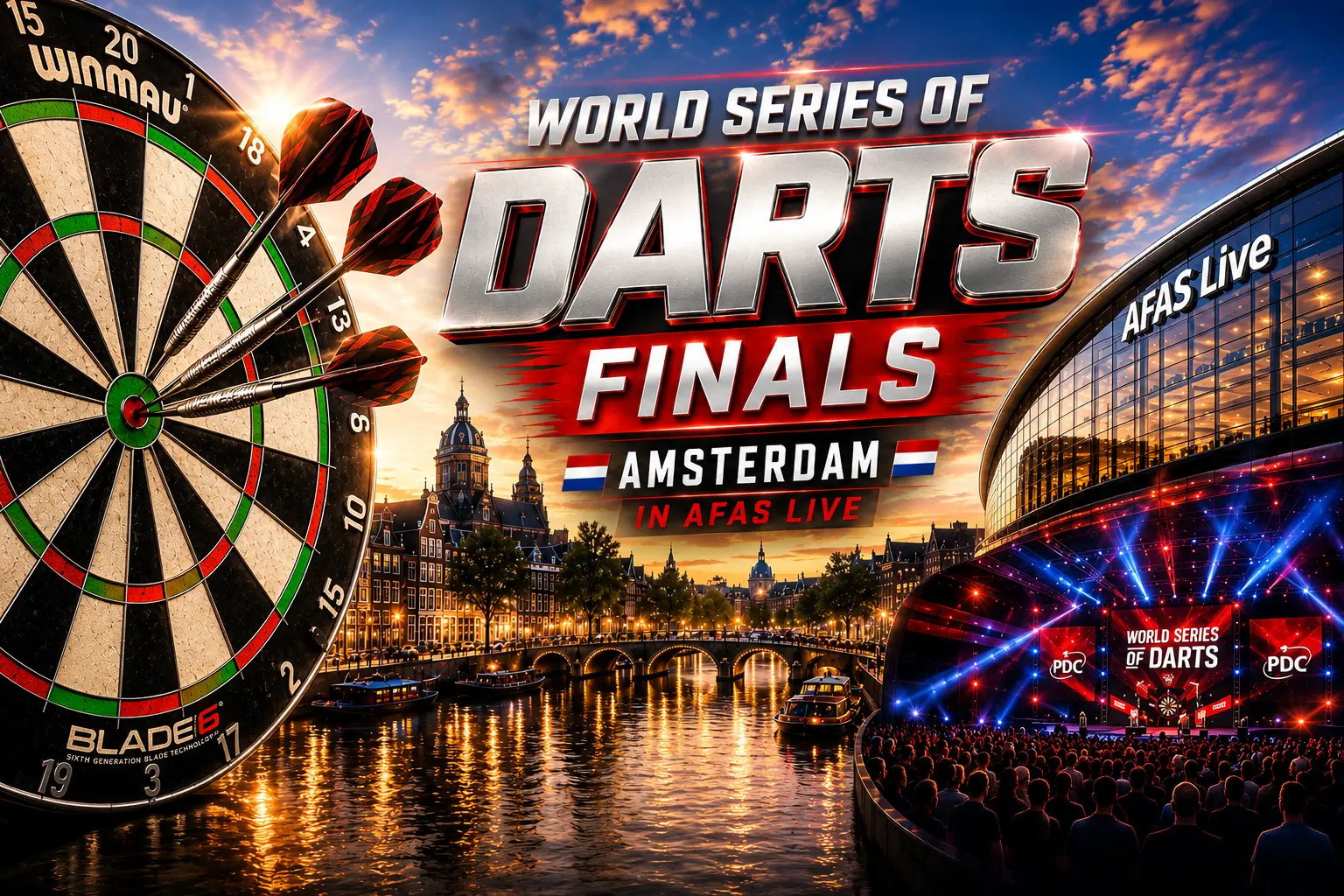
From 17 to 20 September, the AFAS Live in Amsterdam once again hosts the battle for the title at the World Series of Darts Finals. Officially the tournament is part of the PDC majors, but within the darting world it does not seem to command the same respect as many other televised events. A completely different format could change that from 2027 onwards.
ADVERTISEMENT
Ask a player which major he would most like to see dropped from the calendar or which big event he considers least important, and chances are the World Series Finals will be mentioned. That lack of prestige is perhaps best illustrated by Gary Anderson. The Scot declined an invitation for both the previous and the current editions.
The qualification set-up does not help either. The field features 32 players. In addition to a few winners from the Tour Card Holders’ Qualifier and four players invited via the world ranking, the top 24 of the World Series Order of Merit book their places at the Finals. It is precisely that last element that draws criticism.
Van der Voort hits out at the qualification system
Vincent van der Voort recently took aim at the current format on his podcast Darts Draait Door. According to the former professional, participation in World Series events is rewarded too heavily, without necessarily requiring strong results.
“There are people getting in who haven’t won a single match and they’re rewarded with a finals tournament. That makes no sense at all,” says Van der Voort. “If you practice sport, it’s about performance.”
Van der Voort cites Simon Whitlock as an example. Because the Australian has played multiple World Series events, he can, according to the ex-pro, collect enough points to finish high on the ranking even with two heavy defeats. “Which idiot came up with that? Then there’s something seriously wrong in your head.”
ADVERTISEMENT
A straightforward alternative might be to simply send the best 32 players from the World Series Order of Merit to the Finals. But Van der Voort sees little merit in that either. “Then you really get a very poor tournament. You’ll have people who lost 6-1 still in the frame. If they lost 6-0, they might still be close.”
According to Van der Voort, the current construction mainly shows that no better solution has been found. “Players always go on about how you have to perform. And then you do things like this. If you can’t come up with a better system than this, something’s wrong. They’re just winging it.”

Simon Whitlock qualified for the World Series Finals without winning a match
Unlink the Finals from the World Series
There is, in my view, a more compelling solution. From 2027, completely disconnect the World Series Finals from the regular World Series events. Give the event a new name, but preserve the international character the World Series was always meant to showcase.
ADVERTISEMENT
The inspiration partly comes from the revamped format of the Grand Slam of Darts. From this year, that field expands from 32 to 48 players, with athletes from various international circuits invited to a major PDC event.
That choice is striking to me. The Grand Slam of Darts holds high status, and this change brings quite a few non–Tour Card players to the stage. Why not allocate those international qualifying spots to a tournament that is explicitly dedicated to darts’ global character?
Sixteen world-class players and sixteen international qualifiers
A refreshed international Finals could still feature 32 players. The first sixteen spots would go to the top 16 of the PDC Order of Merit. That guarantees a field with the absolute elite represented.
Then twelve places become available for players who have actually produced results on the various international circuits. My proposal would be to allocate two tickets to circuits with a continental scope and one ticket to the more regional tours.
ADVERTISEMENT
Concretely, that would yield the following twelve entrants:
- Top 2 Asian Tour Order of Merit
- Top 2 CDC Order of Merit
- Top 2 African Tour
- Top 2 Championship Darts Latin America and Caribbean Tour
- Number one Nordic & Baltic Tour
- Number one Australian Tour
- Number one New Zealand Tour
- Number one China Pro Tour
When a circuit has not yet finished at the time of the tournament, players leading the relevant ranking at that moment can be invited.
The key difference from the current system is that participation alone is not enough. Anyone looking to secure a ticket must produce results on their own circuit during the season.
Four European wildcards complete the field
ADVERTISEMENT
With sixteen players from the top of the world rankings and twelve representatives from international circuits, 28 of the 32 spots are allocated. The remaining four tickets can be used to engage the European market more explicitly in the event.
A geographical split could be applied. One spot goes to the highest-ranked Tour Card holder from Eastern Europe, one to the highest-ranked player from Northern Europe, one from Western Europe, and one from Southern Europe.

To determine which countries fall under each region, the classifications normally used for World Darts Championship qualifiers and/or the European Tour can be followed.
Based on the current world rankings, Krzysztof Ratajski, Jeffrey de Graaf, Jermaine Wattimena, and Cristo Reyes would be eligible for an invitation under this model.
ADVERTISEMENT
Complete field
| 1 | #1 PDC Order of Merit | 17 | #1 Asian Tour Order of Merit |
| 2 | #2 PDC Order of Merit | 18 | #2 Asian Tour Order of Merit |
| 3 | #3 PDC Order of Merit | 19 | #1 CDC Tour Order of Merit |
| 4 | #4 PDC Order of Merit | 20 | #2 CDC Tour Order of Merit |
| 5 | #5 PDC Order of Merit | 21 | #1 African Continental Tour |
| 6 | #6 PDC Order of Merit | 22 | #2 African Continental Tour |
| 7 | #7 PDC Order of Merit | 23 | #1 Championship Darts Latin America and Caribbean Tour |
| 8 | #8 PDC Order of Merit | 24 | #2 Championship Darts Latin America and Caribbean Tour |
| 9 | #9 PDC Order of Merit | 25 | #1 Nordic & Baltic Tour |
| 10 | #10 PDC Order of Merit | 26 | #1 Australian Darts Association Tour |
| 11 | #11 PDC Order of Merit | 27 | #1 Dartplayers New Zealand Tour |
| 12 | #12 PDC Order of Merit | 28 | #1 China Pro Tour |
| 13 | #13 PDC Order of Merit | 29 | Highest-ranked Northern European player in the world rankings |
| 14 | #14 PDC Order of Merit | 30 | Highest-ranked Eastern European player in the world rankings |
| 15 | #15 PDC Order of Merit | 31 | Highest-ranked Southern European player in the world rankings |
| 16 | #16 PDC Order of Merit | 32 | Highest-ranked Western European player in the world rankings |
International profile and performance rewarded
This format keeps the field at 32 players and preserves the event’s international scope. In fact, players from Asia, North America, Africa, Latin America, Oceania, China, and different parts of Europe all get a clear pathway to the tournament. At the same time, quality at the top end is secured as the world’s best sixteen are automatically invited.
The crucial shift lies in how the remaining places are earned. Not the number of World Series invitations determines who reaches the season finale, but results achieved across the various circuits.
ADVERTISEMENT

Michael van Gerwen is current champion in the end of year Finals.
That would allow the PDC to hit three targets at once: retain a major with a distinctly international flavour, genuinely reward players from different regions for their performances, and, thanks to the presence of the global top 16, remain assured of a strong field. The World Series Finals, in my view, do not need to disappear from the calendar. But from 2027, the tournament concept could be completely revamped.
A completely new format also warrants a new name. If the finale is decoupled from the regular World Series, the title World Series of Darts Finals no longer fits. PDC Global Masters would be a suitable alternative. The name underlines the tournament’s global character, while “Masters” evokes an event that brings together the best from different regions. From 2027, the tournament would gain not only a new qualifying structure, but also its own identity that better matches the international nature of the field.

I stumbled into the world of darts quite by accident back in 2013. For a Journalism School assignment, I had to produce a live sports report and as it happened, the European Tour event in Veldhoven was the only available option. That weekend, I caught the darts bug. The post-match interviews especially appealed to me, as darts players tend to be much more open and approachable than what you usually see with footballers on television.
After a few detours, I joined Dartsnieuws.com in 2017 as editor-in-chief. I don’t have much competitive experience myself, although I once entered a PDC Development Tour weekend just to experience what it’s like from a player’s perspective. I even managed to win a leg against a Tour Card holder and, quite by accident, earned £50 in prize money.
In 2022, I was also involved in the founding of the TOTO Dart Kings, a commercial darts team, where I worked as media manager for three years. Unfortunately, due to new legislation in the Netherlands, that project came to an end in 2025.
Through my work in darts, I’ve been fortunate to travel to some incredible events, from Premier League nights at Ahoy Rotterdam, to several World Championships, and even the US Darts Masters at Madison Square Garden in New York.
Beyond darts, I’m a passionate sports fan in general. You can always wake me up for a game of tennis or padel, and I love following football, tennis, padel, cycling, Formula 1, and ice skating.
claps 1visitors 1
Just in




Popular news


Latest comments
- I agree,I can't believe the lack of coverage of this sad loss. Always enjoyed watching him,but I guess now it's all about littler,well it seems that way. Darts has sadly lost a good manrick6717-10-2026
- In the absence of a report regarding the death of Stefan Lord, I'll assist. An excellent player in the late 70s and early 80s, he actually won the now defunct 3rd place match at two World Championships and a couple of the News of the World Championships. A fabulous player and easily the best Swedish player ever. Rest peacefully Stefan.richieburnettrocks16-10-2026
- Joking aside, it is the second most watched sport on sky (more than golf, F1 etc) behind football only, and in participation is second to only football and swimming. It doesn't get the attention or sponsorship of "bigger" sports because it's not as sexy, but it's right up there.BandB13-10-2026
- i love darts but you can't seriously believe it's the second most popular sport in the uk. even top five is pushing it. it may be the fastest growing, though.colt13-10-2026
- I'm a big Clayton fan, but he's got this completely wrong. Qualification criteria exists for a reason - so just as failing to make the top 32/64 for the Euro championships/PT Finals means you miss out, so does not lifting a title for this one.26sForFun12-10-2026
- The players who deliberately slow the game down are usually boring and win very little in the way of silverware. Horrible to watch.MrYnyslas197112-10-2026
- [“The Gentle” then used a sweeping and questionable phrase...] You anglocucks are hilariously finished in every sense of the word.Critical99911-10-2026
- I love Jonny but I disagree. The Grand Slam was always supposed to be "champion of champions" type competition. If the top 16 are guaranteed participation in everything there will be so much less jeopardy involved in qualifying and each major tournament will lose its unique flavour which the PDC has worked hard trying to develop. I enjoy following the qualification races towards the end of the year, and while consistency should have its rewards, the truth is Jonny hasn't reached a major final all year or won a single event on the Pro Tour. Being consistent is one thing, but that alone should have consequences as the sport's elite should not be prepared to accept consistently strong performances, their foremost motivation should be to win and this should be what separates them from the rest, not the consistency of their performances. Jonny is expecting that losing should be enough; it shouldn't be, at least not as far as the Grand Slam is concerned.Deduce635811-10-2026
- Well being honest,it doesn't matter what level you play at, there's always someone who slows it down to suit themselves,and extra swig of water, replacing flights, asking the ref what the score is. It happens wherever. I'm not saying it's professional,but I'm sure we've all seen it beforerick6711-10-2026
- Agree completely. Not sure how a ranking event can have a criteria not based on rankings. And he right on popularity. In the UK second only to football.BandB11-10-2026
Loading