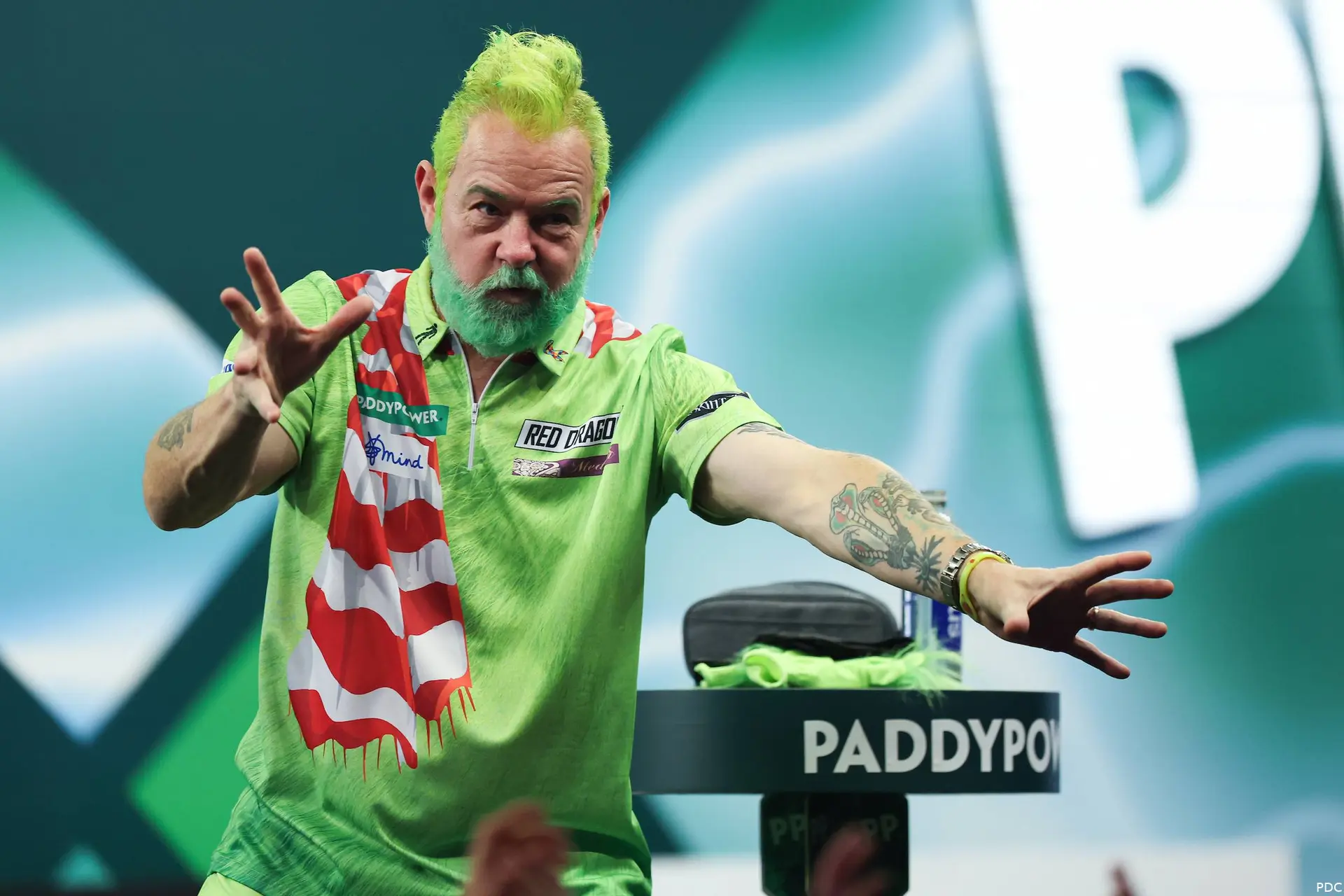
Over the last 12 months, Peter Wright’s fall
has been discussed by every fan, as the two-time World Champion finds himself
threatening his professional status in the PDC. Just three years since his last
major title at the European Championship, the Scotsman has fallen 30 places in
the rankings to 38th in the World.
ADVERTISEMENT
Missing out on all ranking
majors and defending £69,000 in the last two months of 2026, he could lose his
tour card before he knows it. What are the chances of this, though, and could
he have one year left to cling to his status as a darts player?
Where He Stands
8th in the World in 2023, 13th in 2024, to
38th now is a fall that speaks for itself, but wouldn’t threaten losing a tour
card. With players like Callan Rydz at 39th and Jeffrey De Graaf at 43rd, it’s
explicit that he’s still in a good position and has the potential to survive
another year, if not two. Delving into the financial figures, however, Wright’s
38th in the world is doing heavy lifting for the standing he may find himself
in. Sitting at £237,000 in the ranking, Wright defends £69,000 from 2024 and meaning in January the worst situation the
56-year-old could find himself in is £183,000.
Although in the current PDC Order of Merit Wright would be World Number
48, other players will mostly find themselves on more prize money by the time
January comes due to the increased prize money for the World Championships and
Players Championship finals, meaning Wright could end up on the wrong side of
the top 50 unless his World Championship earnings make up some of that £50,000.
Currently, Wenig occupies the World Number 64 spot with £117,250, which,
although bound to go up due to guaranteed World Championship money, doesn't
even match Wright’s 2025 earnings of £134,500 alone. It would take a lot of bad
luck for Wright to lose his card and, logistically, won’t happen, so why are
people saying he will?

Peter Wright won his last major title at the European Championship in 2023
The Slide In Numbers
| Season | Year-end ranking | Match win rate | Wins–losses |
| 2023 | #8 | 53% | 61–54 |
| 2024 | #13 | 49% | 64–66 |
| 2025 | #22 | 46% | 45–52 |
| 2026 | #38 (live) | 39% | 29–46 |
ADVERTISEMENT
On and off the board, Wright is getting
beaten. Winning just 29 matches from 75 in 2026, after a 2025 in which he still
qualified for the Matchplay, the Grand Prix and the European Championship,
Wright’s form has fallen off a cliff in the space of a year. Winning 53% of his
matches in 2023, this figure has only dropped over the years, down 14% in two
years. As well documented as this drop is, he doesn’t do himself any favours in
interviews, where honest answers that fans respect only seem to chip away further
at his confidence. Talking to Assendelft Media in March 2026, Wright
revealed, “It’s horrible when people go ‘I want to draw him because he’s
playing rubbish’”, and this statement, although transparent and true, almost
admits failure too early. Knowing you're playing rubbish doesn’t help and never
has done for darts players. Glen Durrant said the same in 2022, making his fall
inevitable, similar to Jules Van Dongen, who struggled with dartitis,
and now with Wright. Being on a list of darts’ biggest falls in the 2020s isn’t
desirable, and Wright has done this to himself. The damage is not something you
can measure, but his admission psychologically reinforces the long-term plan
that he has this devil on his shoulder every dart, saying “he’s playing
rubbish”, meaning he’s trying that extra one per cent. The short-term gain of
getting it off his chest may do him favours for a couple of weeks, but publicly
admitting at a major that started his elite career by winning it in 2017 that
he’s playing subpar is digging a deeper hole for himself.
Wright understands the problem but has no
solutions, and with 2027 meaning he defends his 2025 prize money, he may need
to find these solutions quickly. In 2025, he earned £134,500, which is nearly
4x his 2026 amount so far. Reaching the Players Championship 11 final and three
European Tour quarter-finals, he earned more in April to June in 2025 than he
has done this year as a whole, showing how fragile next year could be for
Wright. What’s worse, this downward slide won’t slow down, with every three months
he faces another 5-digit figure to defend. In July to September, £15,000;
September to December, £32,000. This means by July next year, he could find
himself in a similar position to players like Dimitri Van Den Bergh, who have
almost thrown in the towel for darts temporarily because his form is not
aligning with the amount he has to defend. Averaging 87.73 in the last 12
months, the Belgian has almost come to terms that he will lose his tour card,
sitting 59th in the rankings after starting 2026 25th on the PDC Order of
Merit. This is key for Peter Wright because, although his 2025 ranking money
doesn’t even tie Van Den Bergh’s 2024 figure he’s defended this year, it has
the same implications and possible result of losing purpose midway through the
year. Averaging 88.54 in the last 12 months, what does this below-tour standard
have to defend in 2027?
Roll-Off Arithmetic
| Step | Amount |
| Current Order of Merit total | £237,000 |
| Less 2024 money | −£69,000 |
| Worst case in January | £183,000 |
| Current world number 64 (Lukas Wenig) | £117,250 |
| Current world number 59 (Dimitri Van den Bergh) | £135,500 |
In 2025, Peter Wright qualified for Major
tournaments such as the World Matchplay, World Grand Prix and European
Championship. This means that Wright is defending £10,000 from the Matchplay,
£7,500 twice from the European Championships and World Grand Prix, three events
that he will not qualify for in 2027. This is guaranteed money to come off and
guaranteed confidence shatters for Wright, and with his constant monitoring of
the ranking system, he will only put more pressure on himself. At the Austrian Darts
Open back in May, Wright joked with Assendelft Media that, “When I win this
one, that’s 35 grand. I only need 10 grand”, showing his mental fragility and
the mountain he has to climb. Ending up losing in the subsequent match,
sympathy is the only expression justifiable for Wright. He knows he isn’t
playing his best, and his claim later that “he shouldn’t be in a World Cup. I’m
not playing well enough” again reinforces this harsh self-criticism that, in
respect, is correct, but not needed for him to say that. Winning two World Cup
trophies with Scotland, his acceptance is almost heartbreaking, and it won’t
just be his heart that will be broken; it will be his desire to play. The
ranking says 38th, but his head will say World Number 64, and this fight-or-flight
for a man of such experience only causes stress on shots he used to walk in.
The Scotsman is at the World Championship, meaning he can poke at least £15,000
into the defending fund of £50,000, the only real positive he could take. This
means his projected earnings in 2026 will be around £40,000, a £90,000
approximate drop, which means if he continues in this form, he will lose his
card and finish 2027 at World Number 73, as the current ranking system
suggests. This means he may not even lose his card narrowly; he will miss it by
a mile. With Van Den Bergh facing this situation in real time, how does his old
roommate's fall compare?
ADVERTISEMENT
How It Compares To Van Den Bergh’s Fall
2026 has been the Belgian’s worst darting year
to date, with the only chance at a big stage being a pundit job at the Premier
League of Darts in Antwerp. Winning 35% of his games in 2026, Van Den Bergh’s
match record has fallen. In 2024, Van Den Bergh was much more successful than Wright, winning the
UK Open, which ended his three-year major drought and picking up a World Grand
Prix Semi-Final, but there were still signs similar to Wright of him falling.
Averaging below 85 in 11 matches in 2024, signs of destabilising inconsistency
have been there, and after this figure shot up to 32.9%, it is a much starker
and bolder fall than Peter Wright. The money represents this, as Van Den
Bergh’s £135,000 at number 59, with still £40,250 to defend, means he will lose
his tour card, and with his 2025 figure being £74,500, nearly £50,000 off
Wright, his fall was much deeper. In 2024, he earned £310,500; establishing the
processes was different, but the result was the same. Dimitri Van Den Bergh
bravely said to OnlineDarts in June 2026, “I didn’t do enough … It’s hard when you put it all those practice
hours behind closed doors, and it doesn’t immediately translate”, showing,
similarly to Wright, he knows that he’s losing money but doesn’t have any
solution. Both players believe their level is better than what they show, but
also beat themselves up about not being good enough. This internal
contradiction, more relevant for Wright, is part of their falls, as they
haven’t been psychologically up to the standard.
The last 12 months is the best metric used to
compare the two, and with similar averages, it is clear to see they are on
similar paths. Wright is averaging 88.54 compared to Van Den Bergh’s 87.73, and
a first nine-point difference of 0.17 shows they are operating at almost
identical levels. Not just this, similar checkout percentages of 37.69%
compared to 33.57% show they are both pretty poor on doubles, most likely
caused by the internal psychological disruption affecting every dart at
doubles. What’s worrying for Wright is that Van Den Bergh is stronger in areas
such as leg win percentage when throwing second and in decisive legs, meaning
he deals better under pressure. Therefore, if a player who is currently
battling dartitis and ranked 59th in the world is better than Wright under
pressure, he is going to face a harsh reality. Van Den Bergh revealed in the
same interview with OnlineDarts, “You start questioning everything, your setup,
your throw, your preparation … I know what I am capable of, but right now it's
about taking it step by step”. Van Den Bergh said this, but if Peter Wright
said the same words, it would make nearly as much sense. Known for switching
his darts, Wright has been vocal when questioning his setup over the years, and
as a two-time World Champion, he knows his level. Age isn’t a limiting factor,
as he peaked in his 50s.
Wright VS Van Den Bergh
ADVERTISEMENT
| Last 12 months | Peter Wright | Dimitri Van den Bergh |
| Average | 88.54 | 87.73 |
| Opponent average | 90.18 | 89.42 |
| First nine | 95.19 | 95.02 |
| Checkout | 37.69% | 33.57% |
| Functional doubles | 45.75% | 40.23% |
| Legs won throwing first | 59.45% | 51.28% |
| Legs won throwing second | 32.65% | 35.85% |
| Deciding legs won | 41.38% | 45.45% |
| One-leg-margin matches (2026) | 8–15 | 9–4 |
| Matches averaging below 85 (2026) | 18 of 75 | 19 of 57 |
How The Fall Has Happened
Take away the interviews and the ranking
arithmetic, and Wright’s decline comes down to one thing: he is no longer
scoring like a top-32 player. Averaging 93.31 between March and September 2025,
the Scotsman had dropped to 87.32 by the middle of 2026, and his first nine
tells an even harsher story, falling from 101.32 to 92.25 over the same period.
Losing nine points in the opening three visits is the difference between
controlling a leg and chasing one, and his 180s per leg falling from 0.25 to
0.17 confirms that the heavy scoring that won him two world titles has deserted
him.
What makes this so frustrating for Wright
is that his finishing has actually improved. His functional doubles have
climbed from 43.86% to 47.47%, and with an opponent sitting on a double, his
checkout rate has jumped from 33.66% to 48.28%. Snakebite can still hit the
shot when it matters. The problem is how rarely he gets the chance, arriving at
his doubles a visit or two after the player opposite him. The clearest proof is
in his deciding legs, where his average has fallen from 95.62 to 80.34 in the
latest quarter. With everything on the line, Wright is scoring like a player
outside the top 64, and that is where his 8–15 record in matches decided by one
leg comes from.

Peter Wright's Tour Card will not be in problem for next year, but needs to perform to keep it in 2028
ADVERTISEMENT
Wright’s Quarterly Stats
| Statistic | Mar'25–Sep'25 | Sep'25–Mar'26 | Mar'26–Jun'26 | Jun'26–Sep'26 |
| Average | 93.31 | 87.91 | 87.32 | 89.66 |
| First nine | 101.32 | 94.79 | 92.25 | 95.99 |
| 180s per leg | 0.25 | 0.22 | 0.17 | 0.23 |
| Two-dart checkout | 46.84% | 44.58% | 41.51% | 41.38% |
| Functional doubles | 43.86% | 43.20% | 47.83% | 47.47% |
| Checkout, opponent on a double | 33.66% | 43.48% | 51.22% | 48.28% |
| Deciding leg average | 93.95 | 95.62 | 91.10 | 80.34 |
Glimpses of the old Wright are still
there. Averaging 98.98 against Andrew Gilding and 98.12 against Jeffrey de
Graaf, he lost both matches, but showed the level hasn’t vanished completely.
What has changed is how rarely it appears: just one 100-plus average from 75
matches in 2026, and 18 below 85. At the UK Open, Wright insisted, “I just need
to find that spark again on the floor and bring it straight to the main stage.”
Seven months on, the floor has given him very little, with 16 opening-round
exits from 30 Players Championships. The spark he spoke about in March has yet
to show, and with his 2025 money ready to drop off, he has twelve months to
find it before the rankings stop protecting him.
Read also
The Route Back
ADVERTISEMENT
What is the route back? Is there anything that
could salvage this for Wright? Losing by one leg is often the difference
between heartbreak and hope, and Wright has lost 15 matches by one leg. This
isn’t a psychological issue or an equipment issue; this is just 1 minute where
Wright, after pushing his opponent to the edge, has fallen at the last hurdle.
If Wright wants any rescue, winning these matches more often than not would be
a good starting point to build his confidence and start getting into more second-round
fixtures, rather than leaving Players Championship events empty-handed at a net
loss.
I stumbled into the world of darts quite by accident back in 2013. For a Journalism School assignment, I had to produce a live sports report and as it happened, the European Tour event in Veldhoven was the only available option. That weekend, I caught the darts bug. The post-match interviews especially appealed to me, as darts players tend to be much more open and approachable than what you usually see with footballers on television.
After a few detours, I joined Dartsnieuws.com in 2017 as editor-in-chief. I don’t have much competitive experience myself, although I once entered a PDC Development Tour weekend just to experience what it’s like from a player’s perspective. I even managed to win a leg against a Tour Card holder and, quite by accident, earned £50 in prize money.
In 2022, I was also involved in the founding of the TOTO Dart Kings, a commercial darts team, where I worked as media manager for three years. Unfortunately, due to new legislation in the Netherlands, that project came to an end in 2025.
Through my work in darts, I’ve been fortunate to travel to some incredible events, from Premier League nights at Ahoy Rotterdam, to several World Championships, and even the US Darts Masters at Madison Square Garden in New York.
Beyond darts, I’m a passionate sports fan in general. You can always wake me up for a game of tennis or padel, and I love following football, tennis, padel, cycling, Formula 1, and ice skating.
claps 0visitors 0
Just in


Popular news

Latest comments
- I agree,I can't believe the lack of coverage of this sad loss. Always enjoyed watching him,but I guess now it's all about littler,well it seems that way. Darts has sadly lost a good manrick6717-10-2026
- In the absence of a report regarding the death of Stefan Lord, I'll assist. An excellent player in the late 70s and early 80s, he actually won the now defunct 3rd place match at two World Championships and a couple of the News of the World Championships. A fabulous player and easily the best Swedish player ever. Rest peacefully Stefan.richieburnettrocks16-10-2026
- Joking aside, it is the second most watched sport on sky (more than golf, F1 etc) behind football only, and in participation is second to only football and swimming. It doesn't get the attention or sponsorship of "bigger" sports because it's not as sexy, but it's right up there.BandB13-10-2026
- i love darts but you can't seriously believe it's the second most popular sport in the uk. even top five is pushing it. it may be the fastest growing, though.colt13-10-2026
- I'm a big Clayton fan, but he's got this completely wrong. Qualification criteria exists for a reason - so just as failing to make the top 32/64 for the Euro championships/PT Finals means you miss out, so does not lifting a title for this one.26sForFun12-10-2026
- The players who deliberately slow the game down are usually boring and win very little in the way of silverware. Horrible to watch.MrYnyslas197112-10-2026
- [“The Gentle” then used a sweeping and questionable phrase...] You anglocucks are hilariously finished in every sense of the word.Critical99911-10-2026
- I love Jonny but I disagree. The Grand Slam was always supposed to be "champion of champions" type competition. If the top 16 are guaranteed participation in everything there will be so much less jeopardy involved in qualifying and each major tournament will lose its unique flavour which the PDC has worked hard trying to develop. I enjoy following the qualification races towards the end of the year, and while consistency should have its rewards, the truth is Jonny hasn't reached a major final all year or won a single event on the Pro Tour. Being consistent is one thing, but that alone should have consequences as the sport's elite should not be prepared to accept consistently strong performances, their foremost motivation should be to win and this should be what separates them from the rest, not the consistency of their performances. Jonny is expecting that losing should be enough; it shouldn't be, at least not as far as the Grand Slam is concerned.Deduce635811-10-2026
- Well being honest,it doesn't matter what level you play at, there's always someone who slows it down to suit themselves,and extra swig of water, replacing flights, asking the ref what the score is. It happens wherever. I'm not saying it's professional,but I'm sure we've all seen it beforerick6711-10-2026
- Agree completely. Not sure how a ranking event can have a criteria not based on rankings. And he right on popularity. In the UK second only to football.BandB11-10-2026
Loading