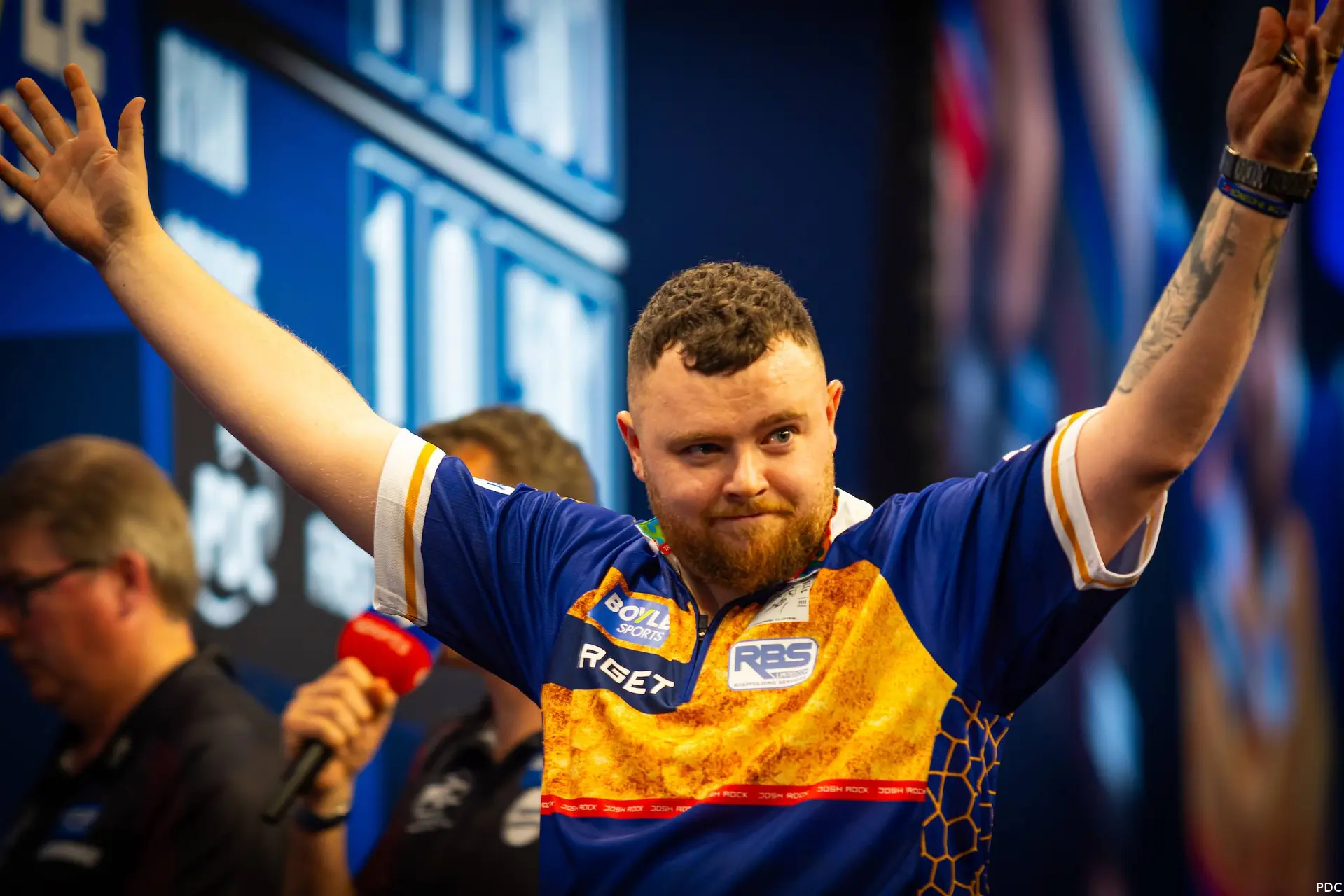
Josh Rock has welcomed Matchroom’s decision to stage a World Series stop in Saudi Arabia as “great for the sport,” while acknowledging the broader debate around the move — a debate that centres less on geography and more on questions about sportswashing and the optics of wealthy state-backed investment.
ADVERTISEMENT
Speaking to Dartsnews.com among other outlets in his post-match press conference following his nervy 2–1 win over Ryan Joyce at the World Grand Prix in Leicester, Rock said the chance to play in new territories is positive for darts. “Somewhere I’ve never been before, and great for darts,” he said. “I don’t think darts has ever been to Saudi Arabia before — first time outside of Dubai really — so it’d be fantastic. Boxing’s already there, and it’s good that darts is going global too.”
That stance sits alongside a rising chorus of concern among commentators and rights advocates. The unease is not simply that events are moving beyond Europe, but that the involvement of Saudi money — and figures closely associated with it — is widely viewed through the prism of sportswashing. Critics point to the influence of Turki Al-Sheikh, and to growing ties between Saudi investors and Matchroom figures such as Barry and Eddie Hearn, as reasons to scrutinise whether sporting partnerships are being used to soften international perceptions of the Saudi regime. Some observers even warn that a World Series stop could be an early step toward greater Saudi involvement in the sport’s calendar.
Rock, however, framed the issue more practically. “It’s good for the sport to get around the world,” he said, noting that while there have been changes to the calendar — fewer World Series events but extra European Tour dates — the expansion opens new opportunities for players and fans: “A lot of people have never been to Poland, never been to Slovakia. I’ve never been to Poland and stuff like that. So yeah, next year I hope it’s a hectic year for myself.”
Read also
Rock digs deep to earn first World Grand Prix win
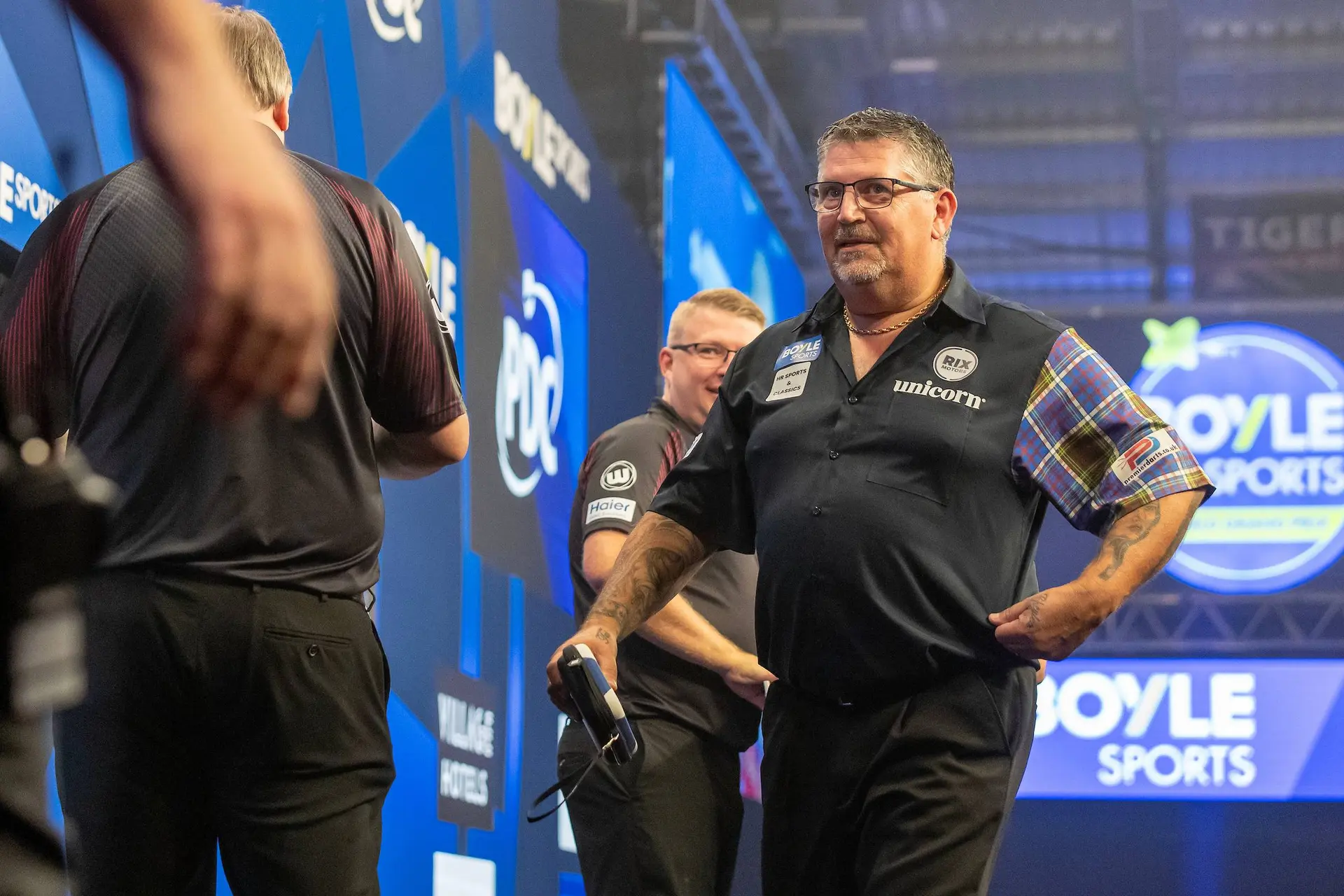
While the wider debate played out off-stage, Rock’s priority was much more immediate. The 23-year-old finally recorded his first World Grand Prix victory, coming from a set down to beat Joyce and move into the second round to face Gerwyn Price.
“I’m just happy I’m still here,” Rock said afterwards. “Everybody knows I kept switching between 16s and tops, but they both felt good tonight. I’d never won a set here before, and that was in my head. I think that’s why I lost the first one — I should’ve won it 3–0, no disrespect to Ryan. But I dug deep, worked hard, and got the win.”
ADVERTISEMENT
He admitted the finish was crucial. “I had to. If I hadn’t hit the 108, I think he’d have finished it. If that double 16 didn’t go in, I’d have been beaten.”
Spotlight, Premier League and title ambitions
Rock’s victory brings an immediate high-profile test: a second-round meeting with Gerwyn Price — a fixture that already promises fireworks given recent encounters. Yet Rock is measured in his ambition while still unequivocal about his aims.
“I’m not here to lose. I’m here to win the title, same as everyone else. You just need that first one under your belt, and I’m grateful I’ve got it,” he said. On elite status he was equally clear: “I’ll not class myself as elite until I’m in the Premier League. I don’t care if I’m top ten in the world — that doesn’t make you elite. When you’re in the Premier League, you’re in the spotlight for 17 weeks straight. That’s when you’re one of the elite players.”
ADVERTISEMENT
Phil Taylor’s counsel — “Go for tops the whole time” — was mentioned with a smile, Rock admitting he had “kept chopping and changing” between Taylor’s advice and his own instincts to go for 16s. He also brushed off the notion that he wants Luke Littler’s spotlight: “Me and Luke are very close… he’s won everything except this and the European Championships. He’s probably thinking, ‘Let someone else have a bit.’”
What it all means
Rock’s win was as much psychological as it was technical: a first set and a first match win at the Grand Prix removed a long-standing barrier and gave the youngster momentum. His public welcome for a Saudi World Series event sits against more complex questions about sport, money and morality. Rock emphasises the practical benefits of playing in new markets; others ask whether the sport has a duty to scrutinise the partners it chooses.
For now, Rock’s focus is straightforward: build on the confidence of Leicester, beat Price, and keep advancing. Beyond the board, the debate over Saudi involvement in sport will continue — measured, critical and attentive to both opportunity and consequence.
ADVERTISEMENT
Kieran WoodDarts Journalist
Kieran Wood is a sports journalist based in Wales and has been active in journalism since 2022. He contributes to DartsNews.com, where he covers professional darts through news, match reports, analysis, and live coverage across the PDC calendar and major tournaments.
A key part of his work is on-site reporting from leading events. Kieran has covered the PDC World Darts Championship in person, reporting daily from the venue and providing first-hand insight from the tournament. During his coverage, he has conducted interviews with leading players including Luke Littler, Luke Humphries, and Gerwyn Price.
He is also one of the leading voices of the English-language Dartsnews Podcast, contributing regular analysis and discussion on developments across the professional darts circuit.
In his reporting, Kieran places strong emphasis on careful sourcing, editorial accuracy, and updating articles when new, verified information becomes available.
claps 1visitors 1
Just in


Popular news

Latest comments
- Littler lost to crabtree in the youth/junior/whatever you call it. He had no point in being there. He's unfortunately now got to the stage,he feels all he has to do is get on the stage to win. Well,I hope he realises part of his fear factor has gone. Happened to Taylor,then van gerwen,and it's causing him to realise pretty sharp,he isn't unstoppable. It's good for the sport,not 1 single player in my 60 years has ever,or will ever be, unbeatable.rick6725-10-2026
- I think it's great to see Mark Webster looking good,good ladrick6725-10-2026
- I agree,I can't believe the lack of coverage of this sad loss. Always enjoyed watching him,but I guess now it's all about littler,well it seems that way. Darts has sadly lost a good manrick6717-10-2026
- In the absence of a report regarding the death of Stefan Lord, I'll assist. An excellent player in the late 70s and early 80s, he actually won the now defunct 3rd place match at two World Championships and a couple of the News of the World Championships. A fabulous player and easily the best Swedish player ever. Rest peacefully Stefan.richieburnettrocks16-10-2026
- Joking aside, it is the second most watched sport on sky (more than golf, F1 etc) behind football only, and in participation is second to only football and swimming. It doesn't get the attention or sponsorship of "bigger" sports because it's not as sexy, but it's right up there.BandB13-10-2026
- i love darts but you can't seriously believe it's the second most popular sport in the uk. even top five is pushing it. it may be the fastest growing, though.colt13-10-2026
- I'm a big Clayton fan, but he's got this completely wrong. Qualification criteria exists for a reason - so just as failing to make the top 32/64 for the Euro championships/PT Finals means you miss out, so does not lifting a title for this one.26sForFun12-10-2026
- The players who deliberately slow the game down are usually boring and win very little in the way of silverware. Horrible to watch.MrYnyslas197112-10-2026
- [“The Gentle” then used a sweeping and questionable phrase...] You anglocucks are hilariously finished in every sense of the word.Critical99911-10-2026
- I love Jonny but I disagree. The Grand Slam was always supposed to be "champion of champions" type competition. If the top 16 are guaranteed participation in everything there will be so much less jeopardy involved in qualifying and each major tournament will lose its unique flavour which the PDC has worked hard trying to develop. I enjoy following the qualification races towards the end of the year, and while consistency should have its rewards, the truth is Jonny hasn't reached a major final all year or won a single event on the Pro Tour. Being consistent is one thing, but that alone should have consequences as the sport's elite should not be prepared to accept consistently strong performances, their foremost motivation should be to win and this should be what separates them from the rest, not the consistency of their performances. Jonny is expecting that losing should be enough; it shouldn't be, at least not as far as the Grand Slam is concerned.Deduce635811-10-2026
Loading