“I probably had the most to lose” – Dennis Priestley reflects on bitter darts split and rivalry with Phil Taylor
PDC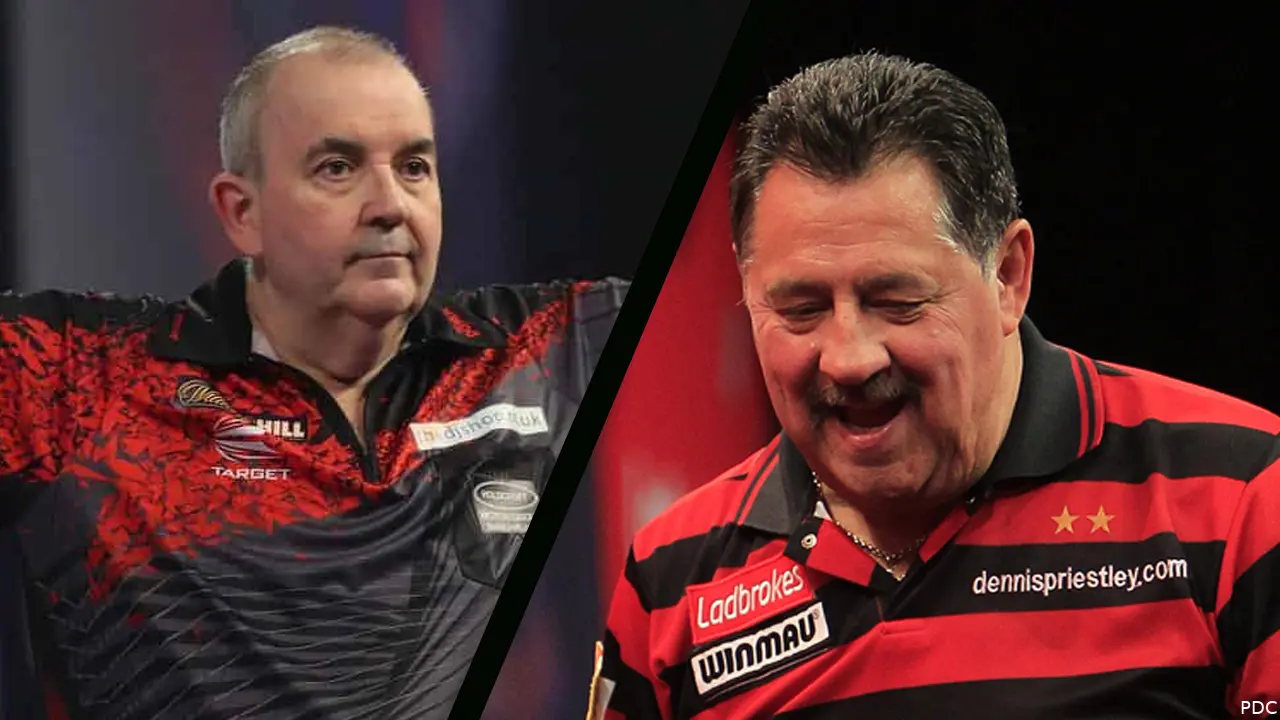
Dennis Priestley was among the players who helped lay the foundations for professional darts as it is known today. The 76-year-old Englishman became a world champion in both the BDO and the organisation that would later become the PDC, witnessing first-hand the bitter split that tore the sport apart in the early 1990s.
ADVERTISEMENT
Speaking to referee Huw Ware on the Tops & Tales podcast, ‘The Menace’ looked back on that turbulent period, the risks he took by joining the breakaway and his long-running rivalry with Phil Taylor.
Priestley’s journey to the top of the world had initially been a gradual one. After spending years playing in pubs, he was selected to represent Yorkshire in 1983. It was approximately another five years before he considered himself good enough to play for England. “Probably somewhere in the region of seven or eight years,” Priestley said. “I think I was first picked for Yorkshire in 1983, and then it was probably another five years before I gradually made it into the England team or became good enough to play for England.”
Just as Priestley had established himself at the very top of the sport, however, the battle over darts’ future erupted. The timing could hardly have been worse for him. “That was one of the things with the split,” he explained. “I was due to be England captain for the whole of 1993, but I never got that honour.”
“I probably had the most to lose”
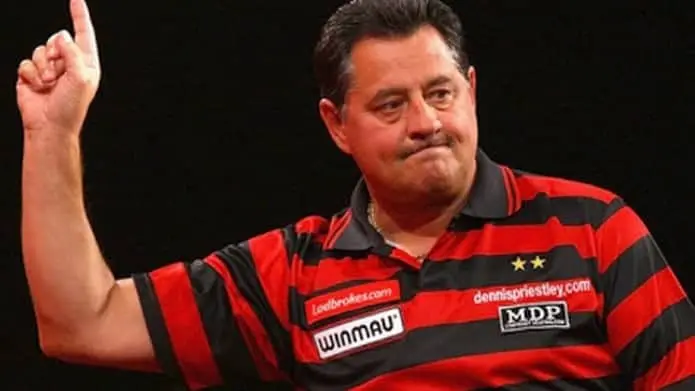
Priestley was not simply one of the leading players in the game at the time. He was the world number one and had won the Embassy World Championship in 1991. Two years later, he was supposed to captain England.
“I could be down in the mouth about that period because I probably had the most to lose out of all the 16 players who broke away,” he admitted. “I was world number one at the time and had been picked to captain England, but I never got the chance to do it.”
ADVERTISEMENT
The dispute subsequently escalated, with Priestley recalling the enormous pressure placed on the players who had chosen to break away from the BDO. “It was a very trying and testing time, to be fair,” he said. “There was all the talk of taking us to court, suing us and us losing our houses. I think that was more or less what made Mike Gregory go back. There was the pressure of potentially losing his bungalow and perhaps his wife wasn’t fully behind him.”
Priestley never wavered in his own decision, with his wife Jenny offering him her full support. “I always had the full backing of my wife,” he continued. “When a Yorkshireman says he’s going to do something, he’s going to do it. There was never any chance of me going back once we had broken away.”
Sponsorship dispute adds to tensions
One particular source of frustration concerned the players’ ability to display sponsors on their shirts. According to Priestley, an agreement had been reached in advance, only for the BDO to reverse its decision shortly before the 1993 World Championship.
“The managers and sponsors had reached an agreement with the BDO that we could have one sponsor’s patch on our shirts,” he recalled. “Then, when it came to the actual tournament in January 1993, they reneged on the deal. I think Jocky Wilson had to cut part of his playing shirt away to remove the sponsor, while others had black tape put over theirs.”
ADVERTISEMENT
Sponsorship was vital for players who were still attempting to earn a living away from the oche. Even after winning the 1991 Embassy, Priestley was not yet a full-time professional. “I was still an amateur when I came through and won the Embassy in 1991,” he explained. “I think I was ranked 22nd in the world, but I was still working for a living. Any little bit of help from a darts manufacturer, brewery or betting company was always welcome, but they wouldn’t allow us to wear even one badge.”
At the same time, darts was steadily disappearing from television. Priestley remembers approximately 12 televised tournaments being held in 1988, before the schedule was eventually reduced to little more than the World Masters and World Championship.
“You could see that there was definitely a problem,” he said. “The first people to feel that problem were obviously the darts manufacturers. If the sport wasn’t being shown on television, they weren’t selling their products. They knew something was wrong.”
Turmoil overshadows Priestley’s best form
ADVERTISEMENT
From a sporting perspective, Priestley should have entered the 1993 World Championship at the absolute peak of his powers. His results throughout the previous season had been remarkable and he genuinely believed himself to be the best player in the world.
“The 1993 World Championship was a tournament of turmoil, to be fair,” he said. “If I was ever going to win a second Embassy title, it should have been in 1993. During 1992, I played in 17 tournaments and won 12 or 13 of them. I reached the semi-finals or finals of the others. My form going into January 1993 was the best of my life, but I didn’t win.”
Priestley was unable to reclaim the Embassy crown, but he has no doubt about where he stood in the sport during the preceding year. “In 1992, yes,” he said when asked whether he had considered himself the best player in the world. “I felt that I was the proper world number one.”
The 16 players eventually made their decision during a meeting at the Lakeside Country Club, agreeing that they would go their own way after the World Championship.
“We were having to drag people in off the streets”
ADVERTISEMENT
The new organisation did not enjoy an immediate flying start. The inaugural World Darts Council World Championship, staged at the Circus Tavern in 1994, offered a stark illustration of just how small the breakaway operation remained.
“In the early days, we were having to drag people in off the streets to watch,” Priestley revealed. “We ended up at the Circus Tavern, which was ideal for us at the time because it was small and compact. Even then, we couldn’t fill it during the first few years.”
The tournament featured 24 players and began with a group stage. Priestley and Jocky Wilson were given the honour of contesting the first match in the new World Championship’s history. “The first two visits produced a 140 and a 180, so the quality was definitely there,” Priestley recalled. “It was Jocky who hit the 180, I must add. I scored the 140.”
Priestley grew into the tournament after arriving without a great deal of confidence. By the time he reached the final against Phil Taylor, however, he was producing his best darts of the event.
ADVERTISEMENT
Historic victory over Taylor
At that stage of their rivalry, Priestley had no reason to fear Taylor. In fact, ‘The Menace’ held the better head-to-head record during their early years at the top. “It was good until around 1994 or 1995 because I was always winning!” he joked when asked what it had been like to face Taylor. “For four or five years, I had the better record against him.”
Priestley raced into a 5-0 lead in the 1994 world final before completing a dominant 6-1 victory. “I didn’t have any baggage at that point from Phil beating me,” he explained. “There was no fear. I suppose I was a little surprised to be 5-0 ahead at the break.”
Having moved within one set of the title, Priestley attempted to simplify the situation by treating it like one of the shorter matches he had played while representing Yorkshire or England.
“I told myself to treat it like playing a best-of-five match for Yorkshire in the county set-up or representing England and to get the job done as quickly as possible,” he said. “Phil came roaring back and won a set, but I put it to bed in the next one. I won the seventh set on double eight.”
ADVERTISEMENT
Priestley thereby became the first world champion crowned by the breakaway organisation, three years after defeating Eric Bristow for the BDO title. “It was double 16 when I beat Eric and double eight when I beat Phil,” he recalled.
Taylor treated darts as his job
The balance of power between the two men subsequently changed. Priestley watched as Taylor adopted an increasingly professional approach and dedicated himself to countless hours on the practice board.
“He began practising more than I did,” Priestley said. “I was getting a little older, while he was maturing as a player and practising far more than any of the rest of us. He treated darts as a job. He often said that if he were still working in the potteries, he would be doing eight-hour shifts, so why shouldn’t he put the same amount of time into playing darts? He was a very good professional.”
Asked whether Taylor’s extraordinary work ethic was a decisive factor in his success, Priestley did not hesitate. “Definitely,” he replied. “He put hours and hours into it.”
ADVERTISEMENT
Priestley continued to challenge Taylor for many years. He lost a memorable World Championship final 6-4 in 1996 before suffering a 6-3 defeat the following year. The 1998 final proved considerably more painful, however, as Taylor completed a crushing 6-0 victory.
“I was disgusted,” Priestley admitted. “I couldn’t put my finger on why I missed so much. Obviously, I must have missed a lot of doubles. I think I only won three legs in the entire match. To go from being a top player who was competing with Phil and pushing him all the way to being annihilated was a bit of a shock.”

Dennis Priestley became the first world champion in PDC history
Mental baggage against ‘The Power’
As Taylor’s victories accumulated, Priestley found that the psychological dynamic between them inevitably began to change.
“If you keep getting beaten by the same person, there is bound to be some doubt in your mind,” he acknowledged. “If I had been younger, I might have handled it a little better. Phil is 10 years younger than me. As you get older, your game is obviously not quite as good. As Phil was getting better, I was beginning to drop away.”
Priestley reached one final World Championship final in 2000. Looking back, he believes he might have retired earlier had the prize money available then been comparable to the sums offered in the modern game.
“After winning the Embassy, I told my friends that if I could get 10 years out of the game, I would be satisfied,” he said. “I got those 10 years, but age was catching up with me when I began to fade and encounter different problems.”

Painful World Matchplay memory
The World Matchplay also holds a significant place in Priestley’s career. He reached the inaugural final at the Winter Gardens in 1994, but surrendered a commanding lead against American Larry Butler after allowing a comment during the interval to disrupt his concentration. “I look back on it with great disgust on my part, to be fair,” Priestley admitted. “I think I was leading 7-2 or 7-3 going into the break. Larry Butler said to me, ‘Dennis, could you have a word with the MC and try to get some order, please?’”
Until then, Priestley had been oblivious to the noise coming from the crowd. “When I was playing my best darts, I couldn’t hear a thing,” he explained. “I was completely focused and didn’t do anything about it. After he had beaten me, I realised that I had heard the crowd throughout the rest of the match. He had planted that seed in my mind and I didn’t get rid of it. It was my own fault. I should never have lost that one.”
Remarkably, that was not Priestley’s first appearance at the Winter Gardens. He had already played there in the Dunlop Classic nine years earlier and won the tournament. “I can tell you the exact date as well,” he said. “It was May 11, 1985.”
The day remained etched in Priestley’s memory for a far more sombre reason. After returning home from his victory and meeting his wife and friends in their local pub, he saw news footage of the Bradford City stadium fire.
“I had been thinking I was the bee’s knees because I had won the Dunlop Classic, but there were people dying,” he recalled. “It brought me straight back down.”
Eyesight problems and changing dartboards
Priestley began experiencing worsening eyesight problems later in his career and underwent laser surgery which, he believes, gave him additional time at the top. He stressed that the procedure had not gone wrong, although its effects gradually began to reverse.
“My eyes had been getting extremely tired and I was suffering from headaches because I was straining so much to concentrate,” Priestley explained. “There were many occasions when I would ask whoever was commentating, ‘Is that in?’ That became one of my famous sayings!”
Priestley also sees a clear difference between the dartboards used during his career and those played on today. The scoring segments have not increased in size, but the thinner wiring has created more room for players to find their targets.
“The dartboards have obviously improved considerably as well,” he concluded. “The trebles aren’t any bigger, but you can see more of them because the wires are so thin. That does contribute to the higher averages we see today.”

Kieran WoodDarts Journalist
Kieran Wood is a sports journalist based in Wales and has been active in journalism since 2022. He contributes to DartsNews.com, where he covers professional darts through news, match reports, analysis, and live coverage across the PDC calendar and major tournaments.
A key part of his work is on-site reporting from leading events. Kieran has covered the PDC World Darts Championship in person, reporting daily from the venue and providing first-hand insight from the tournament. During his coverage, he has conducted interviews with leading players including Luke Littler, Luke Humphries, and Gerwyn Price.
He is also one of the leading voices of the English-language Dartsnews Podcast, contributing regular analysis and discussion on developments across the professional darts circuit.
In his reporting, Kieran places strong emphasis on careful sourcing, editorial accuracy, and updating articles when new, verified information becomes available.
claps 0visitors 0
Just in


Popular news
Latest comments
- I agree,I can't believe the lack of coverage of this sad loss. Always enjoyed watching him,but I guess now it's all about littler,well it seems that way. Darts has sadly lost a good manrick6717-10-2026
- In the absence of a report regarding the death of Stefan Lord, I'll assist. An excellent player in the late 70s and early 80s, he actually won the now defunct 3rd place match at two World Championships and a couple of the News of the World Championships. A fabulous player and easily the best Swedish player ever. Rest peacefully Stefan.richieburnettrocks16-10-2026
- Joking aside, it is the second most watched sport on sky (more than golf, F1 etc) behind football only, and in participation is second to only football and swimming. It doesn't get the attention or sponsorship of "bigger" sports because it's not as sexy, but it's right up there.BandB13-10-2026
- i love darts but you can't seriously believe it's the second most popular sport in the uk. even top five is pushing it. it may be the fastest growing, though.colt13-10-2026
- I'm a big Clayton fan, but he's got this completely wrong. Qualification criteria exists for a reason - so just as failing to make the top 32/64 for the Euro championships/PT Finals means you miss out, so does not lifting a title for this one.26sForFun12-10-2026
- The players who deliberately slow the game down are usually boring and win very little in the way of silverware. Horrible to watch.MrYnyslas197112-10-2026
- [“The Gentle” then used a sweeping and questionable phrase...] You anglocucks are hilariously finished in every sense of the word.Critical99911-10-2026
- I love Jonny but I disagree. The Grand Slam was always supposed to be "champion of champions" type competition. If the top 16 are guaranteed participation in everything there will be so much less jeopardy involved in qualifying and each major tournament will lose its unique flavour which the PDC has worked hard trying to develop. I enjoy following the qualification races towards the end of the year, and while consistency should have its rewards, the truth is Jonny hasn't reached a major final all year or won a single event on the Pro Tour. Being consistent is one thing, but that alone should have consequences as the sport's elite should not be prepared to accept consistently strong performances, their foremost motivation should be to win and this should be what separates them from the rest, not the consistency of their performances. Jonny is expecting that losing should be enough; it shouldn't be, at least not as far as the Grand Slam is concerned.Deduce635811-10-2026
- Well being honest,it doesn't matter what level you play at, there's always someone who slows it down to suit themselves,and extra swig of water, replacing flights, asking the ref what the score is. It happens wherever. I'm not saying it's professional,but I'm sure we've all seen it beforerick6711-10-2026
- Agree completely. Not sure how a ranking event can have a criteria not based on rankings. And he right on popularity. In the UK second only to football.BandB11-10-2026
Loading