“I think most women realise they probably don’t have much chance of beating her” – Gemma Hayter on why Beau Greaves is so hard to beat
PDC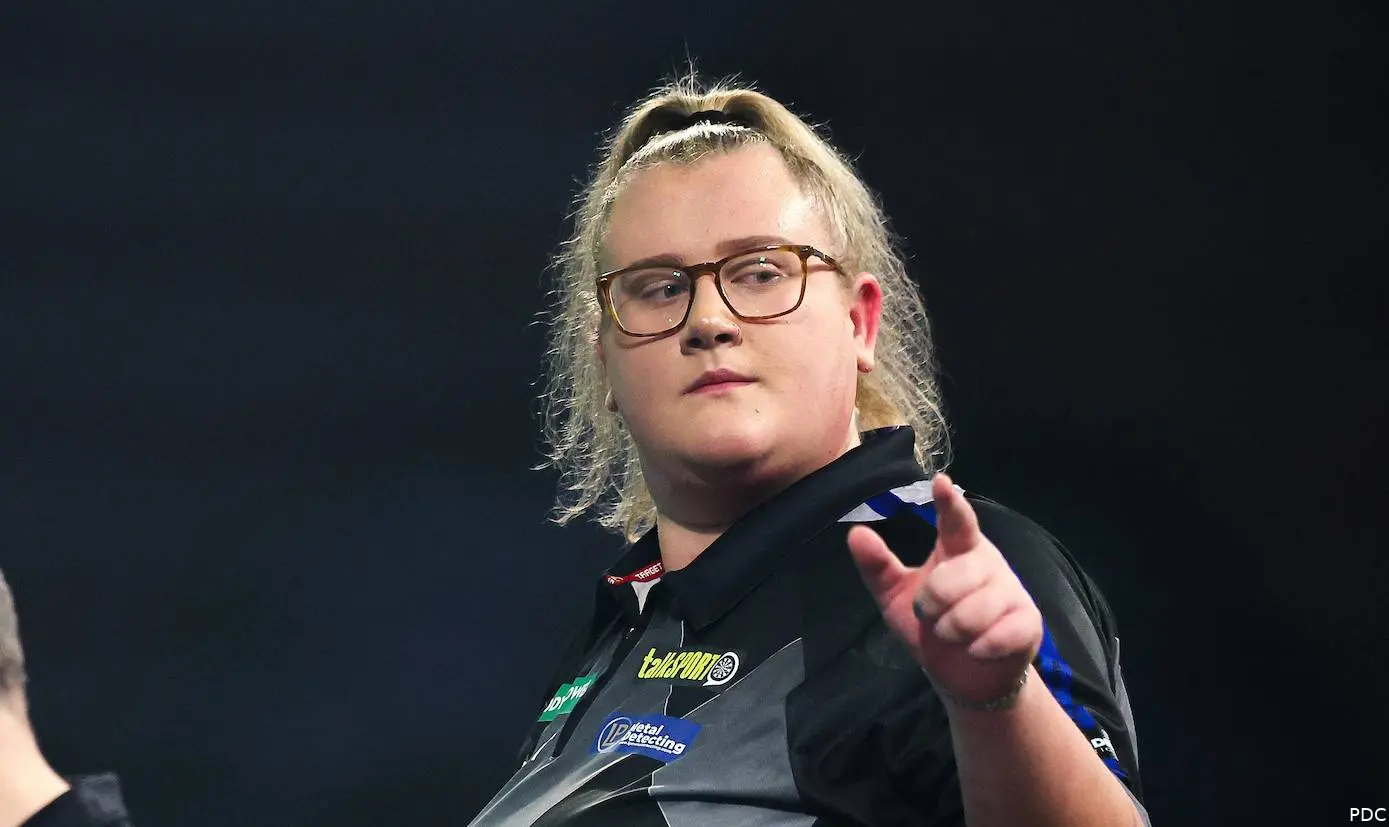
Gemma Hayter’s darts year is running at full throttle. Barely recovered from a busy weekend on the Women’s Series, the next challenge is already looming with the Challenge Tour, while MODUS and the WDF calendar also fill her schedule. For Hayter, it’s clear: standing still is not an option.
ADVERTISEMENT
“It’s full-on at the minute,” she says matter-of-factly. “I’m at MODUS next week as well, so yeah—lots going on.” While some players carefully ration their calendar, Hayter deliberately opts for volume. Her plan for 2026 was clear from the start: play as many matches as possible, across as many circuits as possible.
“I think I just want to support different tours and play as much as I can,” she explains. “Obviously, I’m doing a bit of WDF now and looking into the Challenge Tour—I’m going to give that a go. I just want to improve, and I think the more you play, the more that’ll happen—hopefully."
That approach suits a player who has visibly progressed in recent years. Since returning to the competitive circuit, Hayter has steadily raised her level, helped by experience on various stages.
If there’s one platform Hayter says has played a key role in her development, it’s the MODUS Super Series. “I think MODUS has been huge for me,” she says. “Getting that experience—playing in front of a live crowd on a Saturday night and with TV cameras—that’s been massive.”
Rising standard on the Women’s Series
The PDC Women’s Series also remains an important benchmark for Hayter. The circuit has grown enormously in recent years, both in numbers and standard. “I love the Women’s Series, and I think that’s where the best female players are."
That rise is more than just a feeling. Recent events increasingly feature quarterfinals and semifinals with averages above 90. The bar is higher than ever. “The numbers are going up, the entries are going up, and I do think the standard is improving.”
ADVERTISEMENT

Another development Hayter notes is the growing international spread within the women’s field. “For a while, it was mainly Rhiannon Sullivan and Lorraine Hyde,” she explains. “But now you’ve got players like Louise Patterson coming through, and Rachel Kingdon and Leanne Topper. So yeah, it’s growing—it’s getting there."
The past year also brought Hayter something she had barely dared to dream of: appearances on the biggest stages in darts. With participation in the Women’s World Matchplay and her debut at the PDC World Darts Championship at Alexandra Palace, she took major steps in her career.
“It’s something I didn’t think I’d do,” she admits. “The Matchplay was kind of what I was aiming for, and then when the Worlds became a possibility, it was just something I never imagined—especially doing it so quickly.”
Learning on the biggest stage
ADVERTISEMENT
Her outing at Ally Pally wasn’t flawless, but it delivered valuable lessons. “I was a bit disappointed after the first set,” she reflects. “I only averaged about 67, and I knew that was poor.” Yet she gradually found her rhythm. “I got a leg, which I was pleased with, and then I settled in more as the match went on, which helped.”
It typifies her development: critical, but realistic. And always focused on improvement. A taste of the big stage leaves her wanting more. Hayter knows she hasn’t hit her ceiling yet. “I’ve only hit two 80-plus averages,” she says. “One against Fallon Sherrock at the Matchplay, and one against Josh. I know I can do better than that, so that’s the aim."

Hayter made her PDC World Darts Championship debut last December.
Alongside her PDC activities, Hayter has also deliberately chosen to play more WDF this year. “I just want to support all the women’s tours,” she explains. “I always talk about supporting them, and WDF was one I hadn’t done much before.”
That choice has delivered immediate results. Thanks to victory on the Isle of Man, she has already qualified for the WDF World Darts Championship at Lakeside. “I’ve already qualified for Lakeside,” she says. “So that’s secured.”
ADVERTISEMENT
Participation in the World Masters in Las Vegas, one of the biggest WDF tournaments of the year, is also beckoning. “It’s a big competition—probably the second biggest in the WDF—so I’m just waiting for more details before booking it.”
The magic of Lakeside
For many players, Lakeside remains a dream stage – and that goes for Hayter too. “It’s so iconic,” she says. “It’s the only World Championship for women and girls, so that’s a huge draw.” The pull of a world title remains enormous. “Who doesn’t want to be a world champion? I’d love to do it, so yeah—it still has that prestige.”
With a Worlds ticket secured, Hayter could face an interesting choice later in the year: Lakeside or Alexandra Palace again. “I’ve got no idea, to be honest,” she laughs. “At the minute, it’s just Lakeside. If the choice comes, I’ll make one—but right now, I’ve got no preference. I just wanted to make sure I was in one of them.”

ADVERTISEMENT
For now, the focus is on the here and now – and on keeping the results coming. In the short term, those results could be affected by physical issues. During the last Women’s Series her shoulder flared up again. “I felt a bit of a niggle in my shoulder come back,” she says. “So it’s about managing that and seeing how I throw.”
Her expectations for the Challenge Tour are therefore deliberately modest. “Hopefully, I’ll get a couple of wins—but if not, then it is what it is.”
The Beau Greaves phenomenon
No discussion about women’s darts omits the name of Beau Greaves. The young Englishwoman has dominated the Women’s Series for some time and is now impressing on the Players Championship too. “I think she’s more than capable [of winning a Players Championship],” says Hayter. “She’s so consistent and regularly hitting high averages.”
Success also brings extra pressure. “She’s a bigger target—everyone wants to beat her.” Strikingly, Hayter senses a difference in how opponents approach Greaves across circuits. “On the men’s side, players will fancy their chances more,” she explains. “I think most women realise they probably don’t have much chance of beating her.”
ADVERTISEMENT
That makes the dynamic completely different – and underscores Greaves’ dominance within the women’s field. According to Hayter, Greaves’ impact on the Women’s Series cuts both ways. “Some people say there’s no point entering because Beau will win them all,” she says. “And she often does.” At the same time, Greaves also brings attention and audiences. “She also brings attention and new audiences to the women’s game, which is really important.”


Lucas MichaelDarts Journalist
Lucas Michael is a darts journalist and reporter based in Cambridge, UK, and has been part of the DartsNews team since 2025. He covers professional darts through reports, analysis, round-ups, and live coverage, with a focus on clear context and accurate reporting across the PDC calendar.
A key part of his work is liveblogging major tournaments throughout the year, providing real-time updates, match coverage, and contextual reporting across the professional circuit. He also reports regularly from events on site and has covered the PDC World Darts Championship from the venue, delivering first-hand insight throughout the tournament.
Within the newsroom, Lucas works closely with the editorial team and supports coverage alongside Chief Content Officer Samuel Gill and reporter Kieran Wood.
Lucas holds a BA (Hons) in Sports Journalism. In his work, he places strong emphasis on careful sourcing, editorial accuracy, and updating content promptly when new, verified information becomes available.
claps 0visitors 0
Just in


Popular news

Latest comments
- I agree,I can't believe the lack of coverage of this sad loss. Always enjoyed watching him,but I guess now it's all about littler,well it seems that way. Darts has sadly lost a good manrick6717-10-2026
- In the absence of a report regarding the death of Stefan Lord, I'll assist. An excellent player in the late 70s and early 80s, he actually won the now defunct 3rd place match at two World Championships and a couple of the News of the World Championships. A fabulous player and easily the best Swedish player ever. Rest peacefully Stefan.richieburnettrocks16-10-2026
- Joking aside, it is the second most watched sport on sky (more than golf, F1 etc) behind football only, and in participation is second to only football and swimming. It doesn't get the attention or sponsorship of "bigger" sports because it's not as sexy, but it's right up there.BandB13-10-2026
- i love darts but you can't seriously believe it's the second most popular sport in the uk. even top five is pushing it. it may be the fastest growing, though.colt13-10-2026
- I'm a big Clayton fan, but he's got this completely wrong. Qualification criteria exists for a reason - so just as failing to make the top 32/64 for the Euro championships/PT Finals means you miss out, so does not lifting a title for this one.26sForFun12-10-2026
- The players who deliberately slow the game down are usually boring and win very little in the way of silverware. Horrible to watch.MrYnyslas197112-10-2026
- [“The Gentle” then used a sweeping and questionable phrase...] You anglocucks are hilariously finished in every sense of the word.Critical99911-10-2026
- I love Jonny but I disagree. The Grand Slam was always supposed to be "champion of champions" type competition. If the top 16 are guaranteed participation in everything there will be so much less jeopardy involved in qualifying and each major tournament will lose its unique flavour which the PDC has worked hard trying to develop. I enjoy following the qualification races towards the end of the year, and while consistency should have its rewards, the truth is Jonny hasn't reached a major final all year or won a single event on the Pro Tour. Being consistent is one thing, but that alone should have consequences as the sport's elite should not be prepared to accept consistently strong performances, their foremost motivation should be to win and this should be what separates them from the rest, not the consistency of their performances. Jonny is expecting that losing should be enough; it shouldn't be, at least not as far as the Grand Slam is concerned.Deduce635811-10-2026
- Well being honest,it doesn't matter what level you play at, there's always someone who slows it down to suit themselves,and extra swig of water, replacing flights, asking the ref what the score is. It happens wherever. I'm not saying it's professional,but I'm sure we've all seen it beforerick6711-10-2026
- Agree completely. Not sure how a ranking event can have a criteria not based on rankings. And he right on popularity. In the UK second only to football.BandB11-10-2026
Loading