“It was like a game of tennis. You'd knock the ball back, you'd pass that test” – Rob Cross compares facing Luke Littler to peak Michael van Gerwen
PDC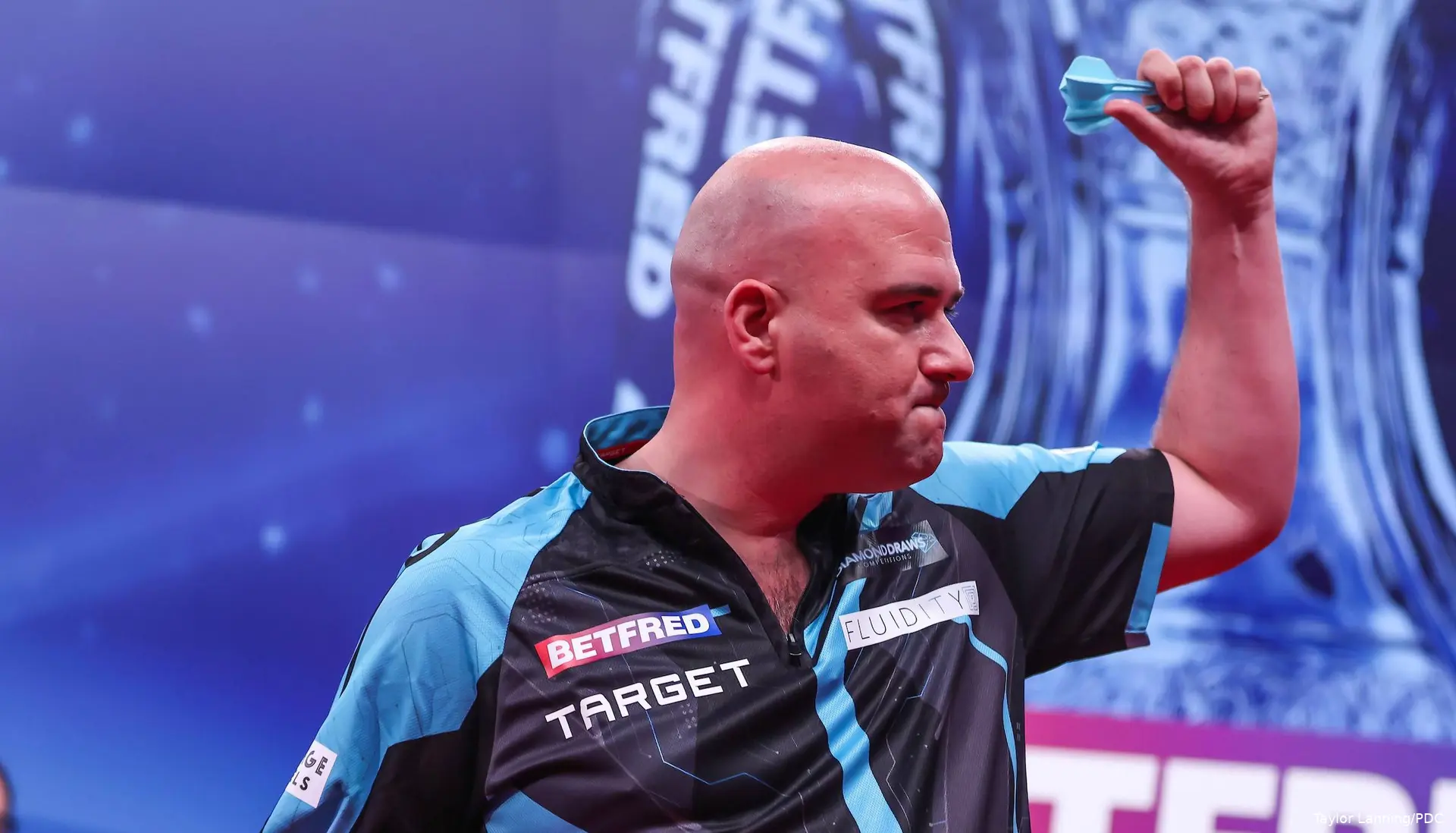
Rob Cross knows better than anyone what it takes to beat an elite player on a big stage. The Englishman made history at the 2018 PDC World Darts Championship by defeating Michael van Gerwen and Phil Taylor back-to-back, so he understands how to make a true world‑class opponent crack under maximum pressure. According to Cross, the key against players of that calibre is not to outgun their top level, but to hang in and strike when the rare openings appear.
ADVERTISEMENT
The debate around Luke Littler has intensified in recent months. The young Englishman has become a player who can get into opponents’ heads before the first dart is thrown. Cross recognises that feeling but stresses a match isn’t lost until the final dart has gone.
“It's all about hanging in there. You're not going to get as many chances as if you played someone else,” Cross explains. “You're going to get many more chances. It's about taking your chances and trying to send them to somewhere where they don't want to be.”
For the former world champion, that’s exactly the difference when you face a generational talent. Against players like Littler, and previously Taylor and Michael van Gerwen, one small error can have major consequences. A single missed dart at a double can see a leg slip away completely.
Long tennis rally
Cross compares playing Van Gerwen to a long tennis rally. For years, the Dutchman imposed an extremely high standard on opponents, and anyone who failed to keep pace was punished without mercy.

“I would always say that years ago, when you played Michael, he had such a threshold and it was like a game of tennis. You'd knock the ball back, you'd pass that test, he'd knock it back and then you've got to answer again,” Cross reflects.
ADVERTISEMENT
Even so, you don’t need to throw better throughout to win a match like that. Cross points out that one good chance in a leg can be enough. That’s why it’s vital to stay upright when the opponent is firing.
“One dart sometimes is good enough in a leg to win, and if you miss it, you know, potentially it's a runaway or a freight train. So, yeah, you've got to hang on their shoulder and you've got to dig in as deep as you can.”

Rob Cross became world champion in 2018
Mental battle
That mental battle, Cross says, is at least as important as what the scoreboard shows. If you can plant doubt in a favourite’s mind, you can steer a match in a different direction. As a contest heads into its decisive phase, the pressure can keep ramping up.
ADVERTISEMENT
“Once you get past that, if you can get them maybe where they're a little bit nervous, if you can get them nervous or get them thinking.”
Cross isn’t just talking about playing the perfect match, but about creating doubt. A player who normally runs on autopilot can be forced by a tight game to consider the consequence of every dart. That, Cross believes, can be the moment a match turns.
“You can drag a bit of overtime where that game's getting a bit closer towards the end and try and pick the pieces up there,” he explains.

Timing plays a crucial role
ADVERTISEMENT
Timing is crucial in all of this. It’s not only about hitting doubles but about striking at the right moment. If you take your chances at the decisive time, you can turn a match even against a player throwing the higher average. “Your timing has to be good. The moment you take your chances has to be right. And you’ve got to be pretty solid on your own throw.”
Cross also looks at Littler’s recent form. At the World Matchplay in Blackpool, the young Englishman again showed how ruthless he can be. Once Littler hit his rhythm, opponents found it almost impossible to stop him.
“On the first attempt, maybe there was a chance there,” Cross analyses. “No one was living over that many legs.”
Still, Cross refuses to write off the chasing pack. He believes the coming period offers fresh opportunities for players looking to challenge Littler. The key is that not every tournament uses the same format. Where long matches allow Littler time to eventually break opponents, shorter formats can create a very different dynamic. “We're going to go into other tournaments, we're going to have shorter formats, set play comes in, and all set plays are totally different games,” Cross emphasises.

ADVERTISEMENT
That’s where the world number 23 sees openings for the field. In a short format, you don’t have to live with Littler for as long. One strong start or a decisive burst can be enough to put the young favourite under pressure.
“I think there's chances, massive chances there for players coming up in the next few tournaments,” says Cross. At the same time, he stays realistic. If Littler strings together another long run of legs, it will be exceptionally hard to stop him.

Lucas MichaelDarts Journalist
Lucas Michael is a darts journalist and reporter based in Cambridge, UK, and has been part of the DartsNews team since 2025. He covers professional darts through reports, analysis, round-ups, and live coverage, with a focus on clear context and accurate reporting across the PDC calendar.
A key part of his work is liveblogging major tournaments throughout the year, providing real-time updates, match coverage, and contextual reporting across the professional circuit. He also reports regularly from events on site and has covered the PDC World Darts Championship from the venue, delivering first-hand insight throughout the tournament.
Within the newsroom, Lucas works closely with the editorial team and supports coverage alongside Chief Content Officer Samuel Gill and reporter Kieran Wood.
Lucas holds a BA (Hons) in Sports Journalism. In his work, he places strong emphasis on careful sourcing, editorial accuracy, and updating content promptly when new, verified information becomes available.
claps 0visitors 0
Just in




Popular news


Latest comments
- I agree,I can't believe the lack of coverage of this sad loss. Always enjoyed watching him,but I guess now it's all about littler,well it seems that way. Darts has sadly lost a good manrick6717-10-2026
- In the absence of a report regarding the death of Stefan Lord, I'll assist. An excellent player in the late 70s and early 80s, he actually won the now defunct 3rd place match at two World Championships and a couple of the News of the World Championships. A fabulous player and easily the best Swedish player ever. Rest peacefully Stefan.richieburnettrocks16-10-2026
- Joking aside, it is the second most watched sport on sky (more than golf, F1 etc) behind football only, and in participation is second to only football and swimming. It doesn't get the attention or sponsorship of "bigger" sports because it's not as sexy, but it's right up there.BandB13-10-2026
- i love darts but you can't seriously believe it's the second most popular sport in the uk. even top five is pushing it. it may be the fastest growing, though.colt13-10-2026
- I'm a big Clayton fan, but he's got this completely wrong. Qualification criteria exists for a reason - so just as failing to make the top 32/64 for the Euro championships/PT Finals means you miss out, so does not lifting a title for this one.26sForFun12-10-2026
- The players who deliberately slow the game down are usually boring and win very little in the way of silverware. Horrible to watch.MrYnyslas197112-10-2026
- [“The Gentle” then used a sweeping and questionable phrase...] You anglocucks are hilariously finished in every sense of the word.Critical99911-10-2026
- I love Jonny but I disagree. The Grand Slam was always supposed to be "champion of champions" type competition. If the top 16 are guaranteed participation in everything there will be so much less jeopardy involved in qualifying and each major tournament will lose its unique flavour which the PDC has worked hard trying to develop. I enjoy following the qualification races towards the end of the year, and while consistency should have its rewards, the truth is Jonny hasn't reached a major final all year or won a single event on the Pro Tour. Being consistent is one thing, but that alone should have consequences as the sport's elite should not be prepared to accept consistently strong performances, their foremost motivation should be to win and this should be what separates them from the rest, not the consistency of their performances. Jonny is expecting that losing should be enough; it shouldn't be, at least not as far as the Grand Slam is concerned.Deduce635811-10-2026
- Well being honest,it doesn't matter what level you play at, there's always someone who slows it down to suit themselves,and extra swig of water, replacing flights, asking the ref what the score is. It happens wherever. I'm not saying it's professional,but I'm sure we've all seen it beforerick6711-10-2026
- Agree completely. Not sure how a ranking event can have a criteria not based on rankings. And he right on popularity. In the UK second only to football.BandB11-10-2026
Loading