“Let’s just pool that prize money” – Baggage issues unexpectedly meant extra prize money for Vincent van der Voort at an exhibition featuring the sport’s world elite
PDC
Gian van Veen travelled to New Zealand well ahead of his World Series Down Under debut, but his preparation took an unexpected turn en route. The Dutchman’s suitcase failed to arrive in Auckland and turned out to have been left behind in Paris after the first leg of the journey. According to Vincent van der Voort, Van Veen is far from the first darter to face this. The former professional once experienced a similar situation himself during a trip with, among others, Michael van Gerwen and Raymond van Barneveld.
ADVERTISEMENT
Van Veen is taking his followers along via a vlog during his adventure on the other side of the world. He shows not only the darts, but also how players travel and stay during a World Series trip like this. Van der Voort sees the appeal, even though he is not a big fan of vlogs himself.
“He’s vlogging his whole trip. That’s fun of course, also for people who are interested. He also shows a few private things, which hotel room he has and how he travels. The PDC always pays for this, of course. Then it’s also funny to see what Business Class looks like.”
Van der Voort is not exactly a regular viewer of such videos himself. “I’m not into vlogs,” he admits on the Darts Draait Door podcast.

Van Veen turns to social media after missing suitcase
The situation became much more troublesome when it emerged that Van Veen’s baggage had not reached its final destination. His suitcase went missing early in the long journey.
“It was still in Paris. It was lost after the first flight already. He’s in Auckland now, of course. You have to hope it heads over there fairly quickly, otherwise that’s really annoying.”
ADVERTISEMENT
Van Veen decided to publicise his problem via social media. That quickly drew a response from the airline. According to Van der Voort, that is a smart way to put some pressure on the case.
“Of course that’s smart. An organisation like that is allergic to this, obviously. I’ve been through it in the past as well. If you tag the airline in the entire post, you get an answer in no time. They’ll want to solve it as quickly as possible.”
According to the former darter, that also includes letting people know afterwards that the matter was handled properly. “If you then also mention that everything was resolved perfectly, they’re happy again too. Why wouldn’t you use that?”
Van der Voort went through the same with the world’s elite
Van der Voort can speak from experience about lost baggage. It once went wrong during a trip to an exhibition tournament on a small island near England. Van der Voort travelled at the time with Van Gerwen and Van Barneveld via Heathrow to the final destination.
ADVERTISEMENT
“We had to go from Schiphol to Heathrow and from Heathrow take a very small flight to that little island to play the demo there. After the first flight the baggage was already lost. And everything was in there.”
Van der Voort found himself in illustrious company. Big names like Phil Taylor, Adrian Lewis, Gary Anderson and James Wade were also present.
“Taylor, Lewis, Anderson, Wade, all the top players in the world were there. And me,” Van der Voort jokes.
Because virtually the entire group faced the same problem, things moved quickly behind the scenes. “Then suddenly a lot gets arranged so that we still had our stuff on time.”

ADVERTISEMENT
Lost suitcases actually earned Van der Voort money
For Van der Voort the problem even brought an unexpected financial upside. The exhibition had prize money attached, with players going deepest earning extra.
Because everyone was without their own baggage, the players decided it would not be fair to pay out the prize money according to the usual distribution.
“Because none of us had a suitcase, we said: this isn’t fair either. Let’s just put the prize money into one pot.”
For Van der Voort it was not a tough decision. With so many world-class players in the field, he knew an equal split would likely work in his favour.
ADVERTISEMENT
“If you’re going up against the top seven... I was the easiest to convince. So I profited nicely from that,” he says with a laugh.
When the suitcases finally did arrive, Van der Voort naturally had no intention of going back on the agreement. “Then the suitcase turned up and I said: we can’t go back now. We’ve made an agreement, we’re sticking to it. That’s what happened in the end. I took something nice home from that as well.”
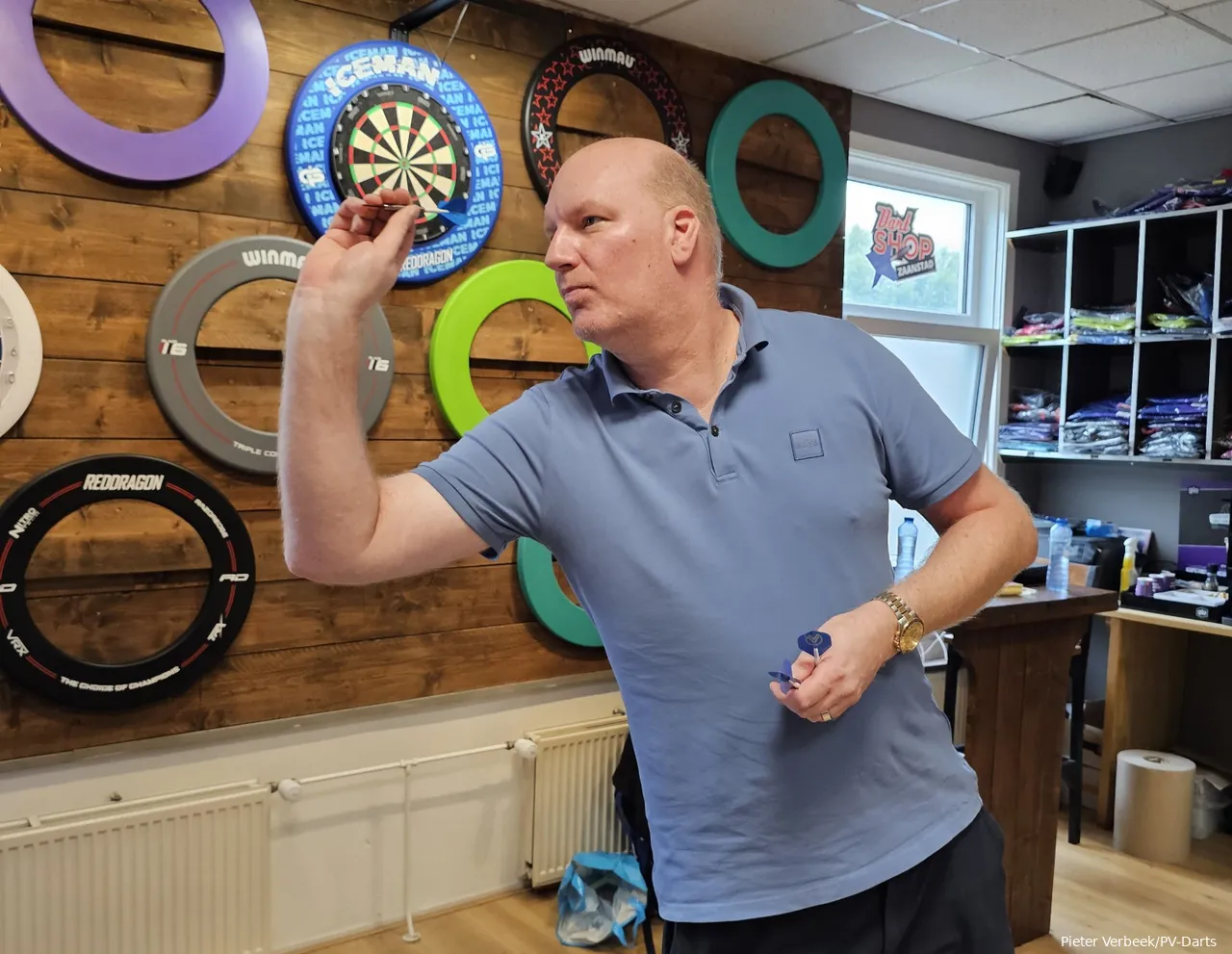
Thanks to a lucrative deal, Vincent van der Voort took extra prize money home
Spare darts can prevent a lot of grief
A lost suitcase is a bigger issue for a professional darter than missing clothing alone. Darts are not usually allowed in hand luggage on a flight and therefore typically go in the hold. If a suitcase disappears, a player can be left without his most important equipment.
ADVERTISEMENT
According to Van der Voort, there are several ways to mitigate that risk. He cites Niels Zonneveld and Wessel Nijman as examples.
“I know that Niels and Wessel both put a set together in each other’s suitcase. If one goes missing, you still have one. That’s smart, of course.”
Van der Voort chose a different solution during his career. He ensured spare kit was always available in England.
“What I did was leave a pair of smart trousers, a shirt and my darts with my management in England. You can also leave it with the officials, of course, so it’s always at the Pro Tour. You can hand it in at the PDPA. So there really are options.”

ADVERTISEMENT
By train to the Worlds
For the most important tournament of the year, Van der Voort no longer wanted to take any risks. In his final years at the Worlds, he therefore regularly chose the train to London.
“That’s why in the last few years I went to the Worlds mostly by train. Then you could just keep it with you. The suitcase can’t go missing then. Anything can happen, of course, but the chance is very small.”
The train also proved a practical option. “You arrive in the heart of London and it was just a ten-minute trip to the hotel. And I can tell you it’s fairly busy in London around Christmas. So by far the easiest solution.”
ADVERTISEMENT

Kieran WoodDarts Journalist
Kieran Wood is a sports journalist based in Wales and has been active in journalism since 2022. He contributes to DartsNews.com, where he covers professional darts through news, match reports, analysis, and live coverage across the PDC calendar and major tournaments.
A key part of his work is on-site reporting from leading events. Kieran has covered the PDC World Darts Championship in person, reporting daily from the venue and providing first-hand insight from the tournament. During his coverage, he has conducted interviews with leading players including Luke Littler, Luke Humphries, and Gerwyn Price.
He is also one of the leading voices of the English-language Dartsnews Podcast, contributing regular analysis and discussion on developments across the professional darts circuit.
In his reporting, Kieran places strong emphasis on careful sourcing, editorial accuracy, and updating articles when new, verified information becomes available.
claps 0visitors 0
Just in




Popular news

Latest comments
- I agree,I can't believe the lack of coverage of this sad loss. Always enjoyed watching him,but I guess now it's all about littler,well it seems that way. Darts has sadly lost a good manrick6717-10-2026
- In the absence of a report regarding the death of Stefan Lord, I'll assist. An excellent player in the late 70s and early 80s, he actually won the now defunct 3rd place match at two World Championships and a couple of the News of the World Championships. A fabulous player and easily the best Swedish player ever. Rest peacefully Stefan.richieburnettrocks16-10-2026
- Joking aside, it is the second most watched sport on sky (more than golf, F1 etc) behind football only, and in participation is second to only football and swimming. It doesn't get the attention or sponsorship of "bigger" sports because it's not as sexy, but it's right up there.BandB13-10-2026
- i love darts but you can't seriously believe it's the second most popular sport in the uk. even top five is pushing it. it may be the fastest growing, though.colt13-10-2026
- I'm a big Clayton fan, but he's got this completely wrong. Qualification criteria exists for a reason - so just as failing to make the top 32/64 for the Euro championships/PT Finals means you miss out, so does not lifting a title for this one.26sForFun12-10-2026
- The players who deliberately slow the game down are usually boring and win very little in the way of silverware. Horrible to watch.MrYnyslas197112-10-2026
- [“The Gentle” then used a sweeping and questionable phrase...] You anglocucks are hilariously finished in every sense of the word.Critical99911-10-2026
- I love Jonny but I disagree. The Grand Slam was always supposed to be "champion of champions" type competition. If the top 16 are guaranteed participation in everything there will be so much less jeopardy involved in qualifying and each major tournament will lose its unique flavour which the PDC has worked hard trying to develop. I enjoy following the qualification races towards the end of the year, and while consistency should have its rewards, the truth is Jonny hasn't reached a major final all year or won a single event on the Pro Tour. Being consistent is one thing, but that alone should have consequences as the sport's elite should not be prepared to accept consistently strong performances, their foremost motivation should be to win and this should be what separates them from the rest, not the consistency of their performances. Jonny is expecting that losing should be enough; it shouldn't be, at least not as far as the Grand Slam is concerned.Deduce635811-10-2026
- Well being honest,it doesn't matter what level you play at, there's always someone who slows it down to suit themselves,and extra swig of water, replacing flights, asking the ref what the score is. It happens wherever. I'm not saying it's professional,but I'm sure we've all seen it beforerick6711-10-2026
- Agree completely. Not sure how a ranking event can have a criteria not based on rankings. And he right on popularity. In the UK second only to football.BandB11-10-2026
Loading