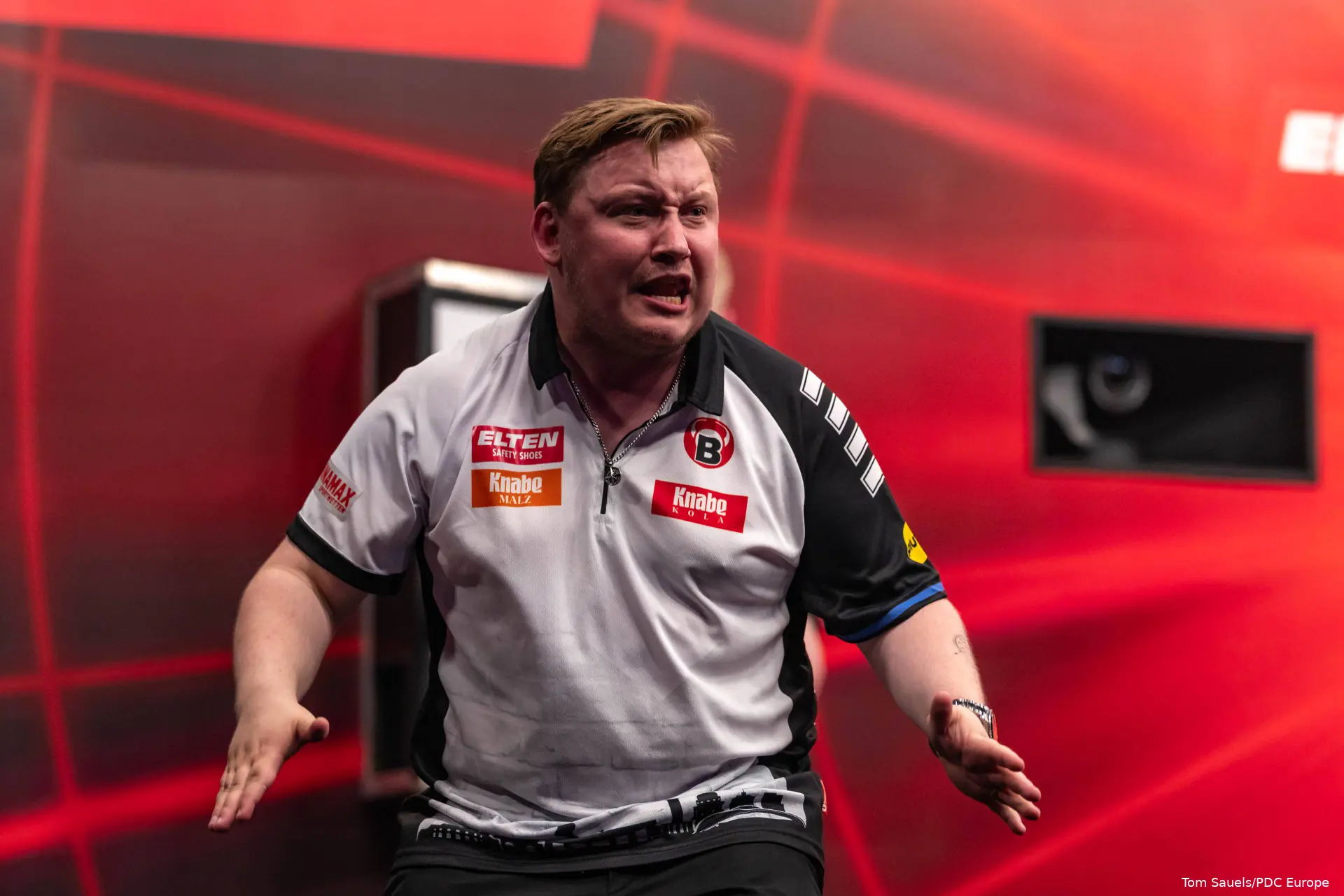
After two successful years of growth on tour, Martin Schindler has hit a roadblock in his progression and endured a poor 2026. Following his World Matchplay loss after leading 6-2 against eventual finalist Gerwyn Price, this was the first time many saw Schindler’s downfall in real time.
ADVERTISEMENT
Averaging just 90.69 in this match and losing more matches than he’s won this year, Schindler has underlying problems in his game that are starting to reveal themselves. How does 2026 compare to his 2024 and 2025? Is this the start of a downward spiral for the German number one?
Why 2024 and 2025 were so good
Three European Tour titles were just the tip of the iceberg for the German. 2024 saw two of these, with high averages on TV and the floor starting to show after years of flirting with success. Breaking through with Germany on the World Cup Stage, 2024 was the first year where Schindler came into the World Cup as the most exciting German, and this is evident with his results. Winning the European Tour 3 in April, Riesa saw the start of Schindler’s rise, and with a 105.05 average against Cullen in the second round and not dropping below a 95 average across the whole weekend, prolonged excellence started to become a trait that Schindler would carry.
The previous European Tour event saw this as well, beating Aspinall and Dobey with 98+ averages whilst reaching the semi-final. Eventually losing to Michael van Gerwen in the semi-final, Schindler’s class on the European Tour started to become a habit. Another semi-final later in the year in Rosmalen and two quarter-finals in Hildisheim and Graz made it clear how Schindler was moving up the rankings: European Tour prize money.
Facing the best players on stages of similar size to many UK majors, the landscape of his game shifted from a solid tour player to a player who walks into majors as a dark horse. European Tours could be seen as mini-majors, often showing who might go far in tournaments due to the translation; therefore, Schindler’s unrivalled support in Europe and especially Germany rose him to fame. With this, Schindler walked in adored and confident, which explains the performances he put up, especially against the English opponents.
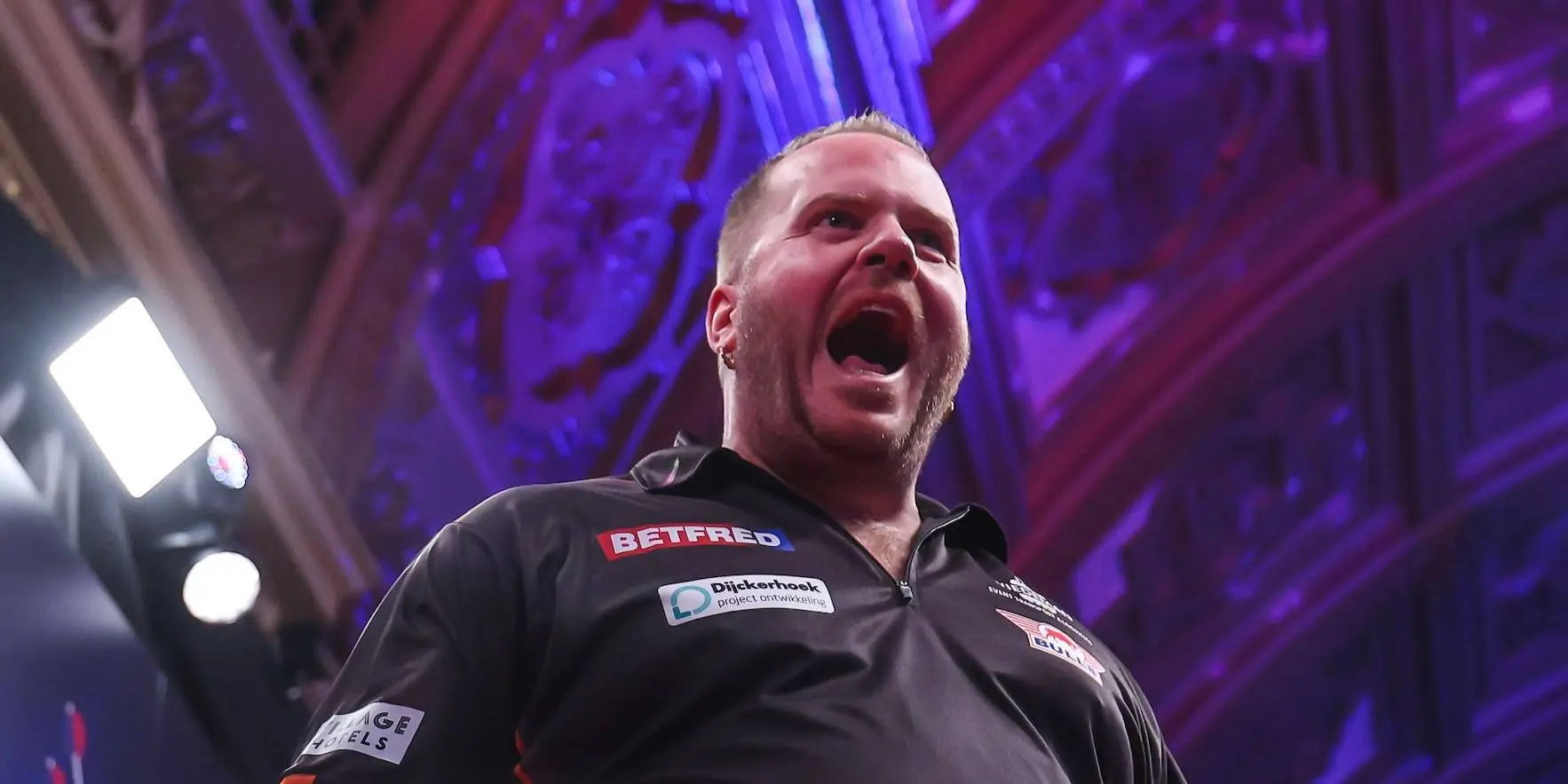
A 111.37 average against Wade in Hildisheim and 106.04 against Woodhouse in Rosmalen shows the A game of Schindler is produced when he is supported. Although this could prove to be a long-term issue in his game, Schindler profited from this support that he cultivated and won another European tour at the twelfth event. Winning in Switzerland, Schindler produced an inspired comeback on the back of the unwavering support and defeated Ryan Searle, with the Englishman at one point holding a 7-4 lead.
ADVERTISEMENT
Although European Tours made up a large portion of Schindler’s £230,750, his Players Championship form was also solid during 2024 despite not picking up a title. Reaching a semi-final and producing countless 100+ averages, Schindler was a force to reckon with in 2024, and his Grand Slam proved this. Qualifying for all majors in 2024, with the most recognisable one being the Grand Slam. Going out in the groups on legs won may seem like his tournament didn't go well, but a tournament average of 99.57 was one of the highest and proves that the translation of performance from the European Tour and UK majors was starting to iron out as a result of his European glory. Averaging in the high 90s puts any player in contention for a title, but nearly averaging 100 over three games and averaging 109.15 in a 5-2 loss is a fluke. This mentality brought Schindler’s 2025, which saw even more success.
Schindler Year by Year: The Build to the Peak
| Year | Ranking | Earnings | Win % |
| 2022 | 27th | £138,250 | 63% (90/52) |
| 2023 | 23rd | £202,000 | 56% (66/51) |
| 2024 | 15th | £230,750 | 60% (70/46) |
| 2025 | 15th | £241,250 | 64% (93/53) |
| 2026 | 19th | £134,000 | 46% (31/37) |
Two more titles and further major success perfectly spell out Schindler’s 2025. A European Tour 5 win in Sindelfingen and a Players Championship 8 win are the highlights, with the win in Germany the most impressive. A 107.78 average against Dobey in the quarter-finals, as well as averages above 90 across the tournament, showed how he extended this prolonged quality into a different ceiling. In short formats, Schindler was too good for opponents, and his heavy 180 hitting of 37% per leg and a checkout percentage of 44.8% in 2025 meant his game was elite.
In other areas of the year, he produced a European Tour semi-final at European Tour 3, where one year later he won his maiden title. This isn’t two individual spikes. This is three European Tour titles, four individual titles and performance that put him into the top 16 by the time 2026 started. The steps were there, and 2026 proved to be the biggest test: starting to perform in the majors.
ADVERTISEMENT
Not yet having gone past a quarter-final in any majors, the performances started to show this was possible. In Players Championship 25, he produced 100+ averages in five of his six matches, showing it was now single-day excellence as well as weekend-long. There was a natural progression. Week-long success. Yet, it all started to look a bit blurry by the time Alexandra Palace came. A Grand Slam last 16 was the best major result in 2025, and although high averages, tangible results started to become a huge worry. One underlying problem was clear, however, and that was his equipment and mindset. He was consistently playing at a high level but wasn’t receiving the major results that he deserved, and with a demanding German media, doubts started to creep.

Martin Schindler a far cry from his best.
In 2024, Schindler played with a natural silver tungsten barrel and solid opaque blue integrated flights. This was a familiar set-up he’d been using for years and, in technical terms, had a friction coefficient of 0.42. This meant that with his throw, they could slip out of his hands, and with Schindler’s throw experiencing more delibration, an upgrade in friction coefficient was on the cards to guarantee consistent darts. This is what 2025 delivered, increasing his friction coefficient by 38.1% to 0.58. Keeping his solid opaque blue integrated flights and with a black-coated barrel rather than solid silver tungsten, his timing reliance was 0.38 milliseconds, which was more stable. Schindler was described as playing with supreme freedom, releasing the darts more effortlessly. Schindler even commented on this change, saying he realised that stability was everything for his game.
More importantly, as he attempted to make inroads in majors, the black PVD coating wicked sweat away from the contact points when he threw his darts. This is important because PDC stages often reach temperatures above 30 degrees Celsius, and the perspiration in his hand affected his darts less compared to his silver tungsten.
This is because on his silver tungsten, the perspiration on his palm created a lubricant film that reduced the friction. Schindler described the stage pressure as needed to know what your equipment was going to give you, and this 2025 swap, in simple terms, gave him advanced trust in his darts. In 2024, he produced 75 90+ averages and no Players Championship titles.
ADVERTISEMENT
In 2025, with his equipment change, he averaged 90+ on 95 occasions, picking up a Players Championship and earning £9,750 more than his 2024 breakthrough. Not just this, his language was motivating and never played down his ability. Whatever he spoke, he delivered on. This was a psychological boost that transformed beyond his darts. Speaking to PDC Europe in 2025, he said, “You have to experience it, feel it, go through it, and then simply execute better as best as you can. As a player, you shouldn't think about external views; you're here for yourself and have to pull through your own game”.
This is an elite mindset. He didn’t hope for performances; he internalised the expectation of performance and built his game around it. He didn’t care about the German media or his record in majors. He wanted to create a better present by forgetting the past, which can’t be said in 2026. In the same interview, he described the qualities he had: “I know what kind of fighting spirit I have inside me. I go in with the same mindset: I stay positive, I take my moments, and I focus strictly on my warm-up routine.” This proves again how he knows what he’s great at and just kept building.
This explained his 2024 to 2025 peak: he knew what he was good at and didn’t stop. Compare this to 2026: he started to look for change, and this started with the equipment that scientifically proved to be better for him.
The equipment evolution: What changed and when
ADVERTISEMENT
| Parameter | 2024 Setup | 2025 Setup | 2026 Setup |
| Barrel Coating | Natural Silver Tungsten | Black PVD Titanium | Natural Silver Tungsten |
| Static Friction | 0.42 | 0.58 (+38% vs 2024) | 0.40 (-31% vs 2025) |
| Flight Type | Solid Opaque Blue | Solid Opaque Blue | Clear Translucent |
| Visual Contrast Ratio | 8.4:1 | 8.4:1 | 1.3:1 |
| Release Timing Variance | ±1.15ms | ±0.38ms | ±2.10ms |
| 180s per Leg | 0.29 | 0.37 | 0.22 |
| Checkout % | 39.2% | 44.8% | 34.5% |
The 2026 Contrast and the £249,750 Problem
2026 hasn’t been what many expected for Schindler. With a clear path to improve his major records to start to threaten the top 10 and consolidate himself in the top 16, 2026 saw Schindler actually ranked at a career peak of 15th, but now he sits outside the top 16. This regression is most clear in his win percentage. Throughout his whole career, he has never had a win percentage fall below 50%, but in 2026, he has lost 37 and won just 31. This 46% win percentage explains his prize money fall to £134,000, and although there are four months left to play and with many majors Schindler is guaranteed to play in, this is a considerable fall, and with his major results throughout the years and his form in 2026, he could be in a really poor situation to match 2025.

Martin Schindler will soon have problems.
On his PDC Tour Card, 2026 contributes just 18.2% of his rankings, and without the 2026 World Championships is just £81,500. His key 2026 results aren’t a pretty read, with just a Players Championship semi-final and a European Tour quarter-final in Sindelfingen, which paints a pretty bleak contrast. By this time in the last two years, he had won European Tours, reached semi-finals and won Players Championships.
ADVERTISEMENT
A highlight being a European Tour quarter-final is not impressive and is borderline sugarcoating, with players such as Jimmy Van Schie reaching quarter-finals. 13 first-round exits in Players Championship events and a World Matchplay, his fifth consecutive World Matchplay first-round exit, are the tangible results. The reasoning behind this is the exact reason why he succeeded in 2025. Equipment and mindset.
Where 2026 Has Gone Wrong: Quarterly Stats
| Metric | Feb-Aug 25 | Aug-Feb 26 | Feb-May 26 | May-Aug 26 |
| Average | 94.11 | 94.04 | 91.88 | 93.30 |
| Checkout % | 38.72% | 40.19% | 39.16% | 34.53% |
| First Nine | 103.59 | 102.20 | 99.36 | 102.63 |
| Deciding Leg Average | 93.01 | 98.31 | 93.21 | 90.17 |
| 180s per Leg | 0.28 | 0.28 | 0.23 | 0.33 |
| Functional Doubles % | 45.42% | 47.73% | 46.43% | 41.06% |
| First Dart T20 % | 35.87% | 34.06% | 34.38% | 31.74% |
In 2026, he returned to his silver tungsten, and this has undone all his good work. Although the message when switching equipment is mostly the comfort and feel of the dart in the player's hands, the drop in performance is blinding. His friction coefficient for these new darts is 0.40, down 31% from his 2025 figure, and his release timing variance in 2026 is 2.10 milliseconds. In 2025, this was 0.38 milliseconds. This means Schindler isn’t releasing his darts at the same rhythm as he was in 2025 due to this equipment change, and his 180s per leg show this. 23% 180 hit rate in 2026 shows that Schindler doesn’t feel this same rhythm.
In greater depth, Schindler's release timing variation of 1.8 milliseconds shifts the release angle by 0.45 degrees. As a result, there is a 21.7 millimetre vertical displacement. This is twice the width of the treble twenty bed. Comfort may be a factor, but these facts are deafening for the German number 1. Martin Schindler has changed his flights to a clear flight, and this means it has eliminated his peripheral flight tracking. During any dart player's backswing, peripheral vision is used to track flight position, and with clear flights being more transparent, this effectively makes the flights disappear in peripheral vision during motion. This means that Schindler is second-guessing his alignment mid-throw, producing hesitations and head movement.
ADVERTISEMENT
Read also
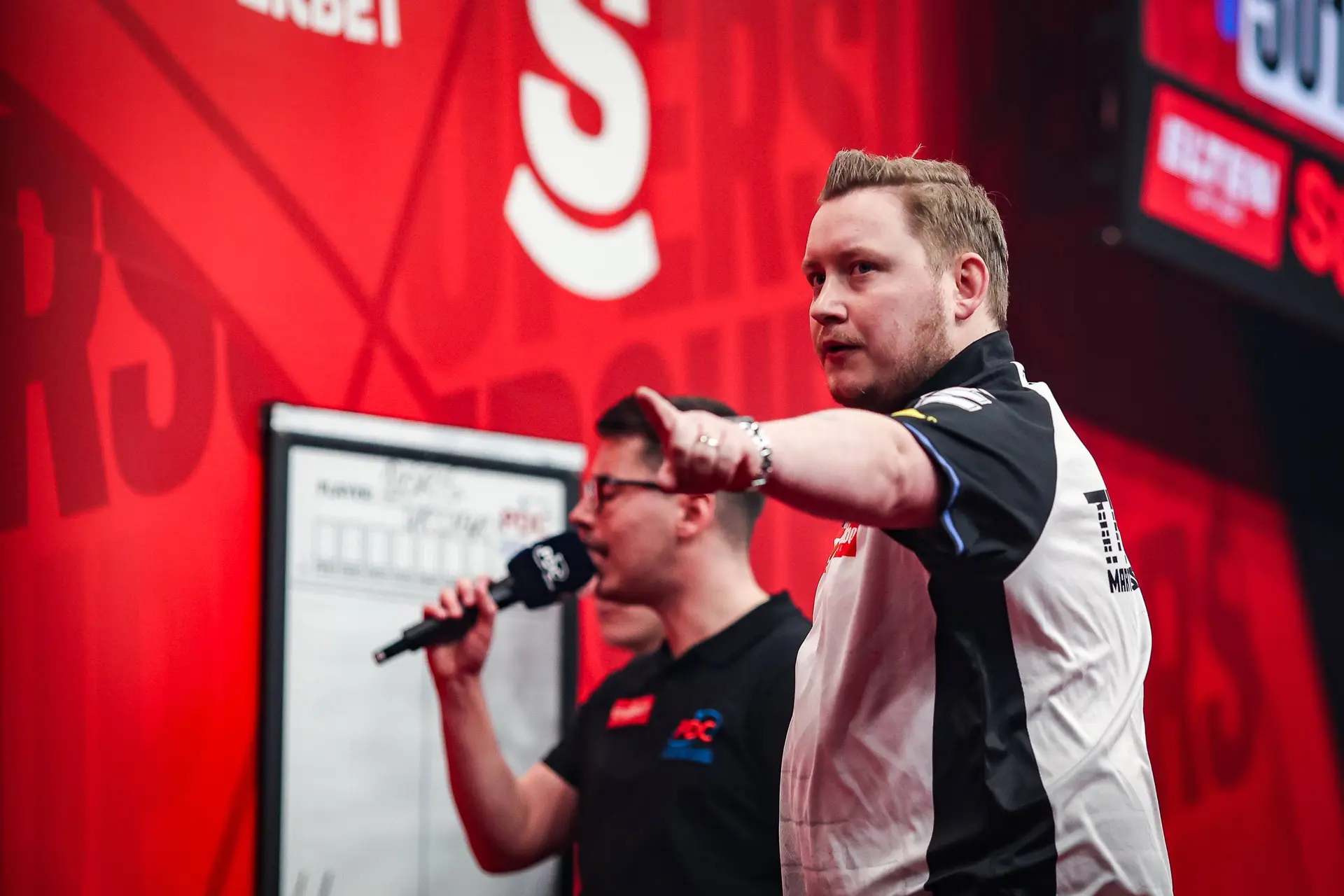
This is detrimental at a pro level, and Schindler’s neglect to address this is the key meaning behind his 2026 falloff. He has mentioned this in interviews, telling DartsNews, "At the very first Players Championship, I noticed that I wasn't myself at all. I couldn't turn it around no matter what I tried. I was not in control of the situation at all: I think only my body was functioning while my head felt like it was two metres away."
A clear factor contributing to this is the aforementioned equipment change, and now this is fundamentally changing his psychological game that was so strong and which led to many of his comebacks. Now doubts are creeping in. Later on in the interview, Schindler shows this: “I just don't have that complete natural confidence right now to bring it onto the board. I feel on the practice board that I have a great touch and the game in my fingers, but I actually have to show it and deliver it “.
This equipment change has now led to a decrease in trust and stability of his dart, a part of his game where he mentioned how important it is. This seems like backwards thinking that a player of his ability cannot afford. This stress in his game is a result of an absence of trust in his equipment. "I need to find this extra level. I need to find this extra element of being relaxed when I play, not stressing, not thinking about things that can go wrong, lots of ifs and maybes." There are so many factors now affecting his game, and with a demand to now improve, Schindler could be faced with a really difficult truth.
ADVERTISEMENT
The ranking money at risk
| Season | Ranking Money | % of Total |
| 2024 | £115,500 | 25.9% |
| 2025 | £249,750 | 55.9% |
| 2026 (so far) | £81,500 | 18.2% |
| Total | £446,750 | 100% |
How could it get worse? He mentioned, “I was experimenting a bit with my darts, the points, and also the length of the shafts. I just thought, just give it a go, just do it. And yeah, now I have to stick with it”.
He can’t afford to stick with his darts, and with recent results pointing to no signs of improvement, defending £249,750 could be an impossible task. The numbers tell the story that the results already suggest.
In 2026, Schindler has earned £10,187 per month. Even with improvement across the final four months of the year, the trajectory points toward a total of roughly £170,000 for the season. Less than the £230,750 he earned in his 2024 breakthrough year. That matters because 2024 money starts dropping off the two-year window from October onwards, with £115,500 ageing out before 2025's £249,750 follows. The combined defence is £365,250.
His current earnings rate replaces a fraction of it. Richie Edhouse currently sits at the bottom of the top 32 with £298,750. If Schindler cannot significantly accelerate his results across the European Championship, Grand Slam, Players Championship Finals and World Championship, four events where his recent form gives little reason for optimism, his two-year total will fall below that threshold.
Dropping outside the top 32 means losing automatic World Matchplay qualification, losing seeding protection at the World Championship, and losing the platform that produced the European Tour titles, which built his ranking in the first place. He would have to earn his way back in. At £10,187 per month, that process does not start quickly.

Ben James is a darts writer at DartsNews.com, covering professional darts with a focus on analysis, player storylines, and match context. He contributes articles on tournaments, player performances, and developments across the PDC calendar.
Ben is currently completing his A Levels in History, Sociology, and Business, with predicted grades of A, A, and A. He also completed an Extended Project Qualification (EPQ), awarded an A grade, titled “To what extent do psychological factors and equipment specifications determine performance in competitive darts?”, reflecting a strong interest in the analytical and psychological aspects of the sport.
He has published early work on platforms such as Medium, including articles on Joe Cullen and Niels Zonneveld, and is developing his experience in sports journalism. Ben is also set to attend a PDC event, building first-hand insight into the professional darts environment.
His interest in darts spans player narratives, match dynamics, scoring strategy, and the mathematical and psychological elements of performance. In his writing, he focuses on clear structure, contextual analysis, and accurate reporting.
claps 7visitors 2
Just in

Popular news

Latest comments
- Agree completely. Not sure how a ranking event can have a criteria not based on rankings. And he right on popularity. In the UK second only to football.BandB11-10-2026
- Doesn't matter who's in it,it's boringrick6710-10-2026
- Assuming you qualify as one of the "muppets" in question. Classist too. And since you're so clearly interested in academia, look up "linguistic descriptivism" while you're at it. Oh, and better stay away from the working class sport of darts and maybe offer your insightful analysis to, let's say, croquet instead?Deduce635806-10-2026
- The consequences of being uneducated and grammatically challenged. "To all THOSE muppets not THEM " Everytime I see Arsepinall, I have an image of him wearing a cap, standing behind the counter of a fast food establishment.richieburnettrocks05-10-2026
- I don't understand Littler's reason for playing this tournament.rick6705-10-2026
- James Wade has become James Wide. He has piled on the tonnage considerably, he barely fits in his shirt.richieburnettrocks03-10-2026
- Littler will play whatever tournaments he decides. But does every headline have to start with him? Bristow bought Taylor through,and he followed that with Lewis. I can't see littler doing the same. Let him choose,and lose,he's getting good at that lately!rick6702-10-2026
- I believe he has it in him to qualify for the Worlds as he consistently wins matches, even if it is only one or two at a time, although his recent PC quarter-final run was somewhat encouraging in that regard. I think there is a lot of pressure for him to retire, people in the media accusing him of tarnishing his legacy. I think that is a ridiculous line of thinking. How ungrateful it is to attach terms and conditions to the amazing moments he has provided us over the course of his career. What position are we in to dictate to him how he should manage his career when it is he who achieved those successes in the first place? What's more, this is his life and the passion that sustains it, it is not for us to decide when his career is over when it is he who must bear the genuine ramifications of that decision. Since I'm sure money is not a concern, the only question on which the decision should rest is whether he truly continues to enjoy competing. He has retired once before, but the desire to compete is what brought him back. We see a lot of negative body language and he does genuinely look miserable when he is not playing well, but only he will know when he wakes up the next day whether he wants to go and do it all over again. If he wants to compete, he should, it's as simple as that, this is a decision that should not involve anyone else but him and his family. He should not retire to indulge the whims of the media or the public. What satisfaction would he receive by being forced into retirement? What closure would it bring to such a brilliant career? When Phil Taylor decided to retire, his decision was final and resolute. I believe RvB needs to get to this point himself, no matter how many 70 averages it might take. We see the likes of John Part continue to compete on a regular basis well past his prime, I say more power to him, and who knows, further glory could be around the corner, it's darts after all, you just never know. Sometimes I worry that RvB is acutely aware of the clamour for him to retire and that this pressure may even have an impact on his performances as he begins to question whether there is even a place for him in darts anymore, further compounding his poor form and creating a vicious loop. Perhaps to take his future into his own hands would provide him with a levity and freedom that would lend itself to better performances, not to mention an improved wellbeing. In any case, it is under these conditions that one can clear-headedly and definitively settle an issue so profound as retirement, not when you feel you're being rushed out the door. If his performances can no longer sustain his presence on the tour, so be it; as it stands his card seems safe for this year but is in serious jeopardy next year. He could always allow himself to drop off the tour naturally rather than forfeiting his place in the top 64, this could provide a sense of finality while offering a route back through Q-School if he so desired; after all, he's done it before. In conclusion, I just hope that RvB can play - or not play - for his own sake, rather than anyone else's, so that when the time comes he can be in no doubt as to his decision, leaving no lingering questions, so that he can reflect with no regret or uncertainty on the marvelous career he has had.Deduce635826-09-2026
- Luke Littler has been good for the sport of darts, no question. But he is not above it. For his sake and ours, he needs to be put in his place sometimes, rather than having his every whim catered to. That is not how you build a good person nor a good sporting organisation, and it's beginning to have consequences.Deduce635826-09-2026
- Extremely disappointing decision. It used to be that, along with major events and Euro Tours, the Players Championship series constituted one of three standards against which successful darts players could be measured, one of three challenges every successful darts player should be expected to master to consider themself among the elite. Now they are dead weight in the darting calendar, and player turnout and the standard of competitiveness will reflect that. The truth is that Luke Littler and other big names would rather play lucrative exhibitions than put in the hard graft that being a successful dart player requires. It undermines the authority of the PDC and the game in general. So what do they do about it? Give them exactly what they want. Of course, why wouldn't they? They are their star attractions. It is ironic that an organisation formed in protest by the sport's elite should be undermined and disrespected by their contemporary equivalents, but the PDC had a chance to stand up to them with a firm message: play 2 events all year and expect the final to be played without you. Instead, they caved in. These events will be hardly worth playing anymore and this decision may have grave consequences for the future of floor events at the elite level. Some may say the calendar is overstuffed, yet these elite players have more than enough time to play plenty of exhibitions. The Premier League in particular is gruelling, but busy players are not expected to play every event, they are expected to manage their playing schedule carefully in order to apportion their time and energy appropriately. Clayton and Humphries, for instance, both sit in the top 20 of the Players Championship and European orders of merit, in addition to competing in the Premier League; they have proven it is absolutely possible and this change is an insult to their efforts in effectively managing their calendars. I think we are seeing players who simply think they are too good for Pro Tour events, arrogance which should be punished rather than rewarded as we are seeing here. Furthermore, why should success in Euro Tours qualify you for the Players Championship Final? The PDC are blurring the lines between those three disciplines of darting excellence, and in so doing destabilising the very foundations upon which the organisation and its success is built. Some may say I'm overreacting, but this, in addition to the PDC's subservience and snivelling obsequiousness toward their biggest assets, makes me fear for the future of professional darts.Deduce635826-09-2026
Loading