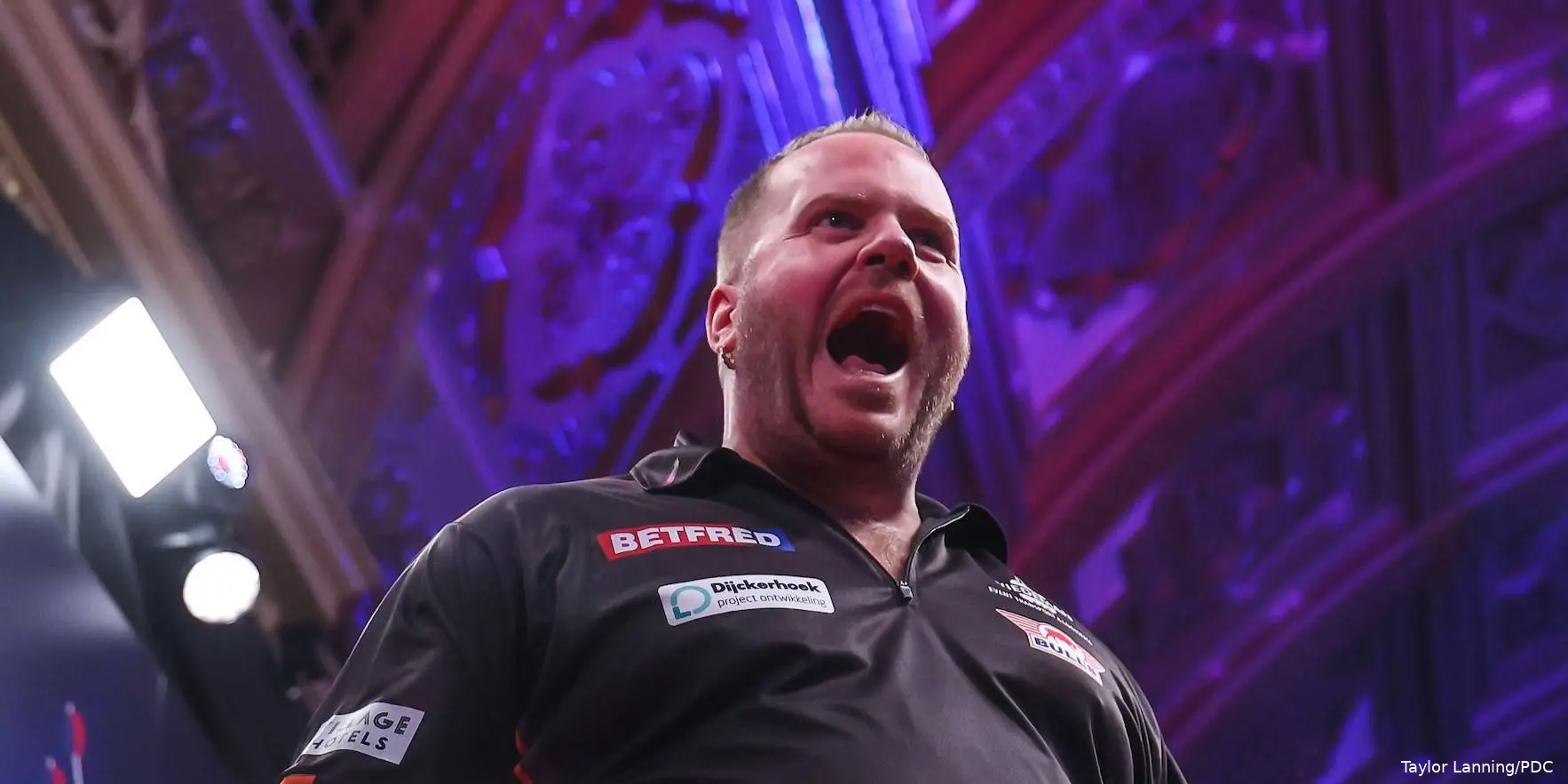
Dirk Van Duijvenbode reached his best major result for six years at the World Matchplay, reaching the semi-finals at the Winter Gardens before losing 5-17 to eventual champion Luke Littler. Going into the tournament 100/1 to win it according to Betfred odds, a semi-final run wasn’t on the cards for the Dutchman.
ADVERTISEMENT
Beating Chris Dobey, Michael Van Gerwen and Gary Anderson on the way, he navigated one of the hardest possible routes to the semi-final and still defied expectations. Yet, how does his form suggest this was overdue, rather than a shock result?
The injury that nearly ended it all
In 2022, Dirk van Duijvenbode was playing top 8 darts in the world. With a 96.90 average across the year and the third most 180s in a year, many would be forgiven for thinking that in 2023 Dirk was ready to explode onto the biggest stage. In 2024, however, a chronic shoulder blade and nerve injury hit him, meaning he couldn’t physically lift his arm past 75 degrees when it got its worst. This forced him to wear a medical arm brace and play tournaments with “tears in his eyes”. It only got worse from here, with a fall on stage at the 2023 Dutch Darts Championship only adding to the pain. Despite the catalyst, Dirk refused to pull out of this tournament and beat Dylan Slevin with a 129 finish.
Six Players Championship events missed meant that by the time the 2024 World Matchplay came, he finished 17th on the Pro Tour Order of Merit, meaning he missed out by one spot to qualify for the second biggest major in darts. Snapping a four-year qualifying streak added mental pain to the physical pain. With money falling off his rankings after missing out on major results, he fell from 10th to 23rd on the PDC Order of Merit in the space of a year.
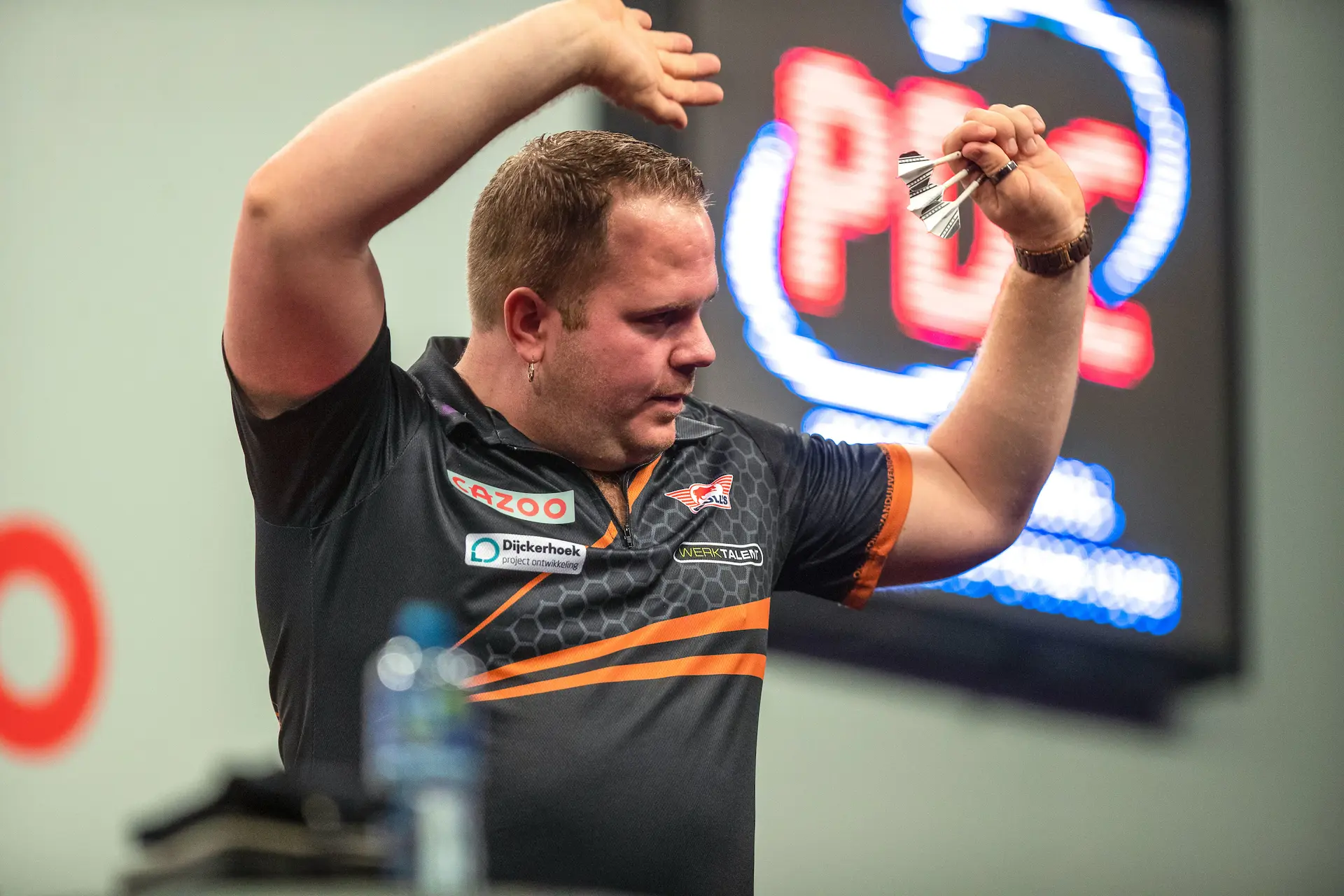
The 2024 World Championship summarised this, crashing out in the second round to Boris Krcmar made many doubt his career and question whether a longer break was needed. Months were spent rebuilding his throw from scratch, and with no events to show for it, the rankings told a brutal story. From earning £279,250 in prize money in 2023, he earned just £159,750 in 2024 as his win percentage fell 12% to 56% in 2024.
Pulling out of results was followed by question marks over why he would bother playing in many; his confidence was shattered. Dirk plays with confidence. The Titan is one of the boldest players on tour, from his walk-on to his hard-hitting scoring that blows away opponents. He came into 2025 a shadow of his former self, but his results started to look up.
ADVERTISEMENT
The rebuild
2025 produced results that 2024 couldn’t dream of. A European Tour finalist and qualifying for the World Matchplay and World Grand Prix, his rebuild seemed to be complete. Not just qualifying for these events, but also a round two in Blackpool and a quarter-final at the World Grand Prix show he wasn’t content with just qualifying; he wanted to get back to his prime. A year-high average of 117.74 against Chris Dobey summarises his rebuild best.
The Aubergenius had recovered, and after rebuilding his throw, he threw one of the highest averages in 2025 alone. However, just because his A game had returned doesn’t mean it was hit regularly. An average of 92.67 against James Hurrell in the World Championships, as well as not averaging above 96.40 in the 2025 majors, shows he still wasn’t the finished article.
Read also
During 2025, Dirk Van Duijvenbode had the 7th highest average on tour, 97.59. Coming out of 2025 without a title or any noticeable result apart from his European tour final is a severe case of injustice. He deserved a title at the least. He was under the radar for many fans because he wasn’t making any noise on tour.
ADVERTISEMENT
High averages without results are a theme that can’t continue for very long, especially when playing the 7th-best darts. Hitting a 180 in 43% of his legs showed his scoring had returned, in fact surpassing his peak of 37.8% in 2022, which saw him hit the third most 180s in the world; the stats depicted a return that the naked eye wouldn’t see. Going into 2026, the picture of the Dutchman wasn’t getting any attention, and he’d started to build some noticeable results.
The Recovery: Quarterly Stats 2025-2026
| Metric | Feb-Aug 25 | Aug-Feb 26 | Feb-May 26 | May-Aug 26 |
| Average | 97.59 | 94.88 | 96.41 | 95.96 |
| Checkout % | 41.24% | 40.03% | 35.37% | 38.01% |
| First Nine | 107.55 | 104.31 | 106.75 | 105.09 |
| Deciding Leg Average | 101.74 | 89.38 | 98.53 | 89.00 |
| 180s per Leg | 0.43 | 0.32 | 0.33 | 0.35 |
| Functional Doubles % | 48.37% | 48.81% | 41.08% | 46.15% |
The stats that said it before Blackpool did
Dirk Van Duijvenbode qualified for the Matchplay handily, £17,000 behind 16th-place qualifier Dave Chisnall. His average dropped to 96.41 going into the tournament, but his results carried greater weight. Reaching a first Players Championship final at Players Championship 15 for the first time in 38 months, he lost to Michael Van Gerwen despite being 5-8 with a respectable 101.86 average. Adding to this, two Players Championship and European Tour quarter-finals meant he started to mix himself back into the top 16, which could explain his average drop. Averaging 97.59 is impressive, but when losing mostly in the first three rounds of competitions, this means that he is averaging high against worse players who put less pressure on your throw. This enabled Dirk to average in the high 90s, but this meant that under pressure from top 32 players, he crumbled, and this meant results didn’t come.
ADVERTISEMENT
Dirk van Duijvenbode's quip to poor questioning of reporter.
However, a competitive average of 96.41 against the best players in the world shapes the perspective. In the World Matchplay, it is the top 16 players against the 16 most in-form players: the best 32 dart players in the world. An average of 96.41 against the top players in darts puts Van Duijvenbode easily into the top 10 best performers in darts going into Blackpool. Beating Michael van Gerwen earlier in the year, Josh Rock, Chris Dobey and Stephen Bunting meant that he was well tested against the players he would eventually face.
Statistically, Dirk’s first nine average going into the Winter Gardens was 106.75, and with a checkout percentage of 35.37%, his game showed two different sides. Such scoring is top 8 quality, and it shows why a Matchplay Semi-final was expected. Dirk, in more areas than not, was playing darts that didn’t translate into his World Number 28 ranking.
For a run to the World Matchplay semi-final, Dirk would have needed a favourable run. In the broader picture, Dirk wasn’t defending prize money after missing out on the World Matchplay in 2024, meaning the shackles were off. He had no pressure to perform, as every pound won would add to his ranking. Dirk didn’t have expectations, meaning the World Matchplay was a blank canvas that allowed for a reset from the last two years of Van Duijvenbode, and back into the Van Duijvenbode of 2022-2023. 2025’s World Matchplay average was 96.88. This means that Dirk’s average going into this tournament was competitive against the average performances.

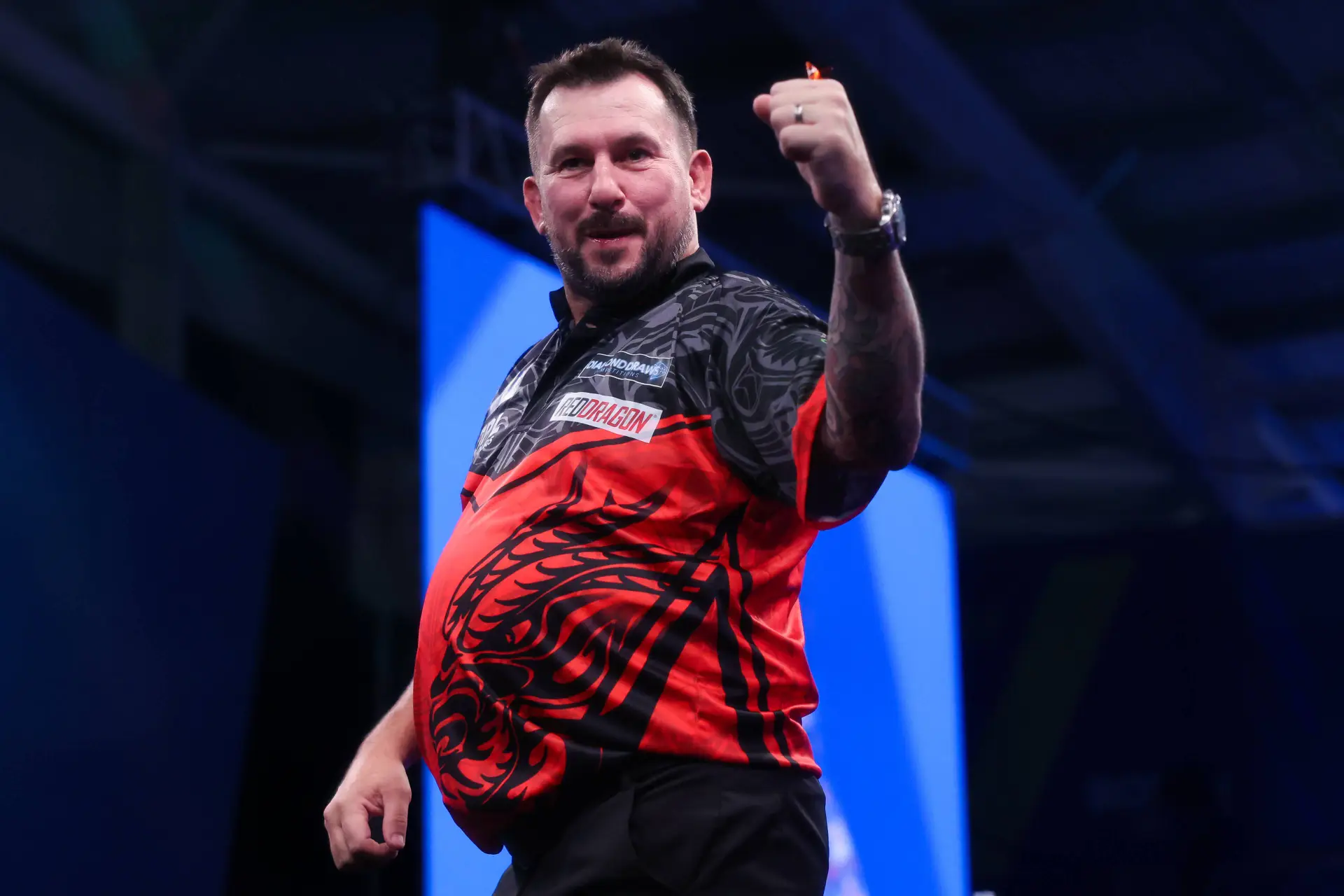
Van Duijvenbode lost to Luke Littler but still achieved in Blackpool.
ADVERTISEMENT
Despite the best result being the quarter-final in 2022, his scoring suits the tournament leg style, and this was seen in his 2026 results. Beating Dobey 13-11 in the first round wasn't pretty, but it didn't need to be. A 24-leg grind that tested his endurance rather than his brilliance, it was the kind of result that 2024 Van Duijvenbode simply couldn't have produced. The Last 16 against Michael Van Gerwen was where the tournament changed. Averaging 95.93 across 26 legs against the world number four, his first nine of 106.75 going into the tournament meant he was generating maximum visits at a rate MVG couldn't sustain over a full match. 14-12 tells you everything about how close it was and how well Van Duijvenbode played to win it.
The quarter-final against Anderson, averaging 101.49, was the clearest evidence yet that this semi-final run wasn't a fluke. Anderson arrived at Blackpool with a deciding leg average of 114.57, the highest of any player in the draw. Van Duijvenbode beat him anyway. A T20 accuracy of 42.4% and T18 accuracy of 42.69%, both top ten percent on tour, produced the scoring platform that Anderson couldn't overcome across 29 legs. Losing 5-17 to Littler in the semis, averaging 92.02, looks damaging on paper.
In reality, Littler was at a level nobody in the draw could have lived with that night and throughout the whole tournament. The scoreline reflects Littler's dominance more than any failing from Van Duijvenbode, who had already gone further than his world ranking of 28 suggested he had any right to.
Dirk van Duijvenbode stuns Michael van Gerwen in Blackpool.
2026 World Matchplay: The Route to the Semi-Final
ADVERTISEMENT
| Round | Opponent | Score | Average |
| Last 32 | Chris Dobey | 13-11 | 92.78 |
| Last 16 | Michael van Gerwen | 14-12 | 95.93 |
| Quarter Final | Gary Anderson | 16-13 | 101.49 |
| Semi Final | Luke Littler | 5-17 | 92.02 |
Van Duijvenbode's semi-final wasn't a story of luck or a favourable draw. It was the logical outcome of a player who had been performing at top eight level for the better part of two years without the results to show for it. His scoring was always there. His checkout percentage, the one weakness that has followed him through every version of his career, corrected just enough at the right moment.
At 22nd in the world coming out of Blackpool, his ranking still doesn't reflect his ability. When the finishing permanently catches up with the scoring, the semi-final is the starting point.

Ben James is a darts writer at DartsNews.com, covering professional darts with a focus on analysis, player storylines, and match context. He contributes articles on tournaments, player performances, and developments across the PDC calendar.
Ben is currently completing his A Levels in History, Sociology, and Business, with predicted grades of A, A, and A. He also completed an Extended Project Qualification (EPQ), awarded an A grade, titled “To what extent do psychological factors and equipment specifications determine performance in competitive darts?”, reflecting a strong interest in the analytical and psychological aspects of the sport.
He has published early work on platforms such as Medium, including articles on Joe Cullen and Niels Zonneveld, and is developing his experience in sports journalism. Ben is also set to attend a PDC event, building first-hand insight into the professional darts environment.
His interest in darts spans player narratives, match dynamics, scoring strategy, and the mathematical and psychological elements of performance. In his writing, he focuses on clear structure, contextual analysis, and accurate reporting.
claps 0visitors 0
Just in

Popular news

Latest comments
- [“The Gentle” then used a sweeping and questionable phrase...] You anglocucks are hilariously finished in every sense of the word.Critical99911-10-2026
- I love Jonny but I disagree. The Grand Slam was always supposed to be "champion of champions" type competition. If the top 16 are guaranteed participation in everything there will be so much less jeopardy involved in qualifying and each major tournament will lose its unique flavour which the PDC has worked hard trying to develop. I enjoy following the qualification races towards the end of the year, and while consistency should have its rewards, the truth is Jonny hasn't reached a major final all year or won a single event on the Pro Tour. Being consistent is one thing, but that alone should have consequences as the sport's elite should not be prepared to accept consistently strong performances, their foremost motivation should be to win and this should be what separates them from the rest, not the consistency of their performances. Jonny is expecting that losing should be enough; it shouldn't be, at least not as far as the Grand Slam is concerned.Deduce635811-10-2026
- Well being honest,it doesn't matter what level you play at, there's always someone who slows it down to suit themselves,and extra swig of water, replacing flights, asking the ref what the score is. It happens wherever. I'm not saying it's professional,but I'm sure we've all seen it beforerick6711-10-2026
- Agree completely. Not sure how a ranking event can have a criteria not based on rankings. And he right on popularity. In the UK second only to football.BandB11-10-2026
- Doesn't matter who's in it,it's boringrick6710-10-2026
- Assuming you qualify as one of the "muppets" in question. Classist too. And since you're so clearly interested in academia, look up "linguistic descriptivism" while you're at it. Oh, and better stay away from the working class sport of darts and maybe offer your insightful analysis to, let's say, croquet instead?Deduce635806-10-2026
- The consequences of being uneducated and grammatically challenged. "To all THOSE muppets not THEM " Everytime I see Arsepinall, I have an image of him wearing a cap, standing behind the counter of a fast food establishment.richieburnettrocks05-10-2026
- I don't understand Littler's reason for playing this tournament.rick6705-10-2026
- James Wade has become James Wide. He has piled on the tonnage considerably, he barely fits in his shirt.richieburnettrocks03-10-2026
- Littler will play whatever tournaments he decides. But does every headline have to start with him? Bristow bought Taylor through,and he followed that with Lewis. I can't see littler doing the same. Let him choose,and lose,he's getting good at that lately!rick6702-10-2026
Loading