"The best wins are the ones you don’t expect": Wesley Plaisier says Gerwyn Price upset 'by far' his biggest career highlight
PDC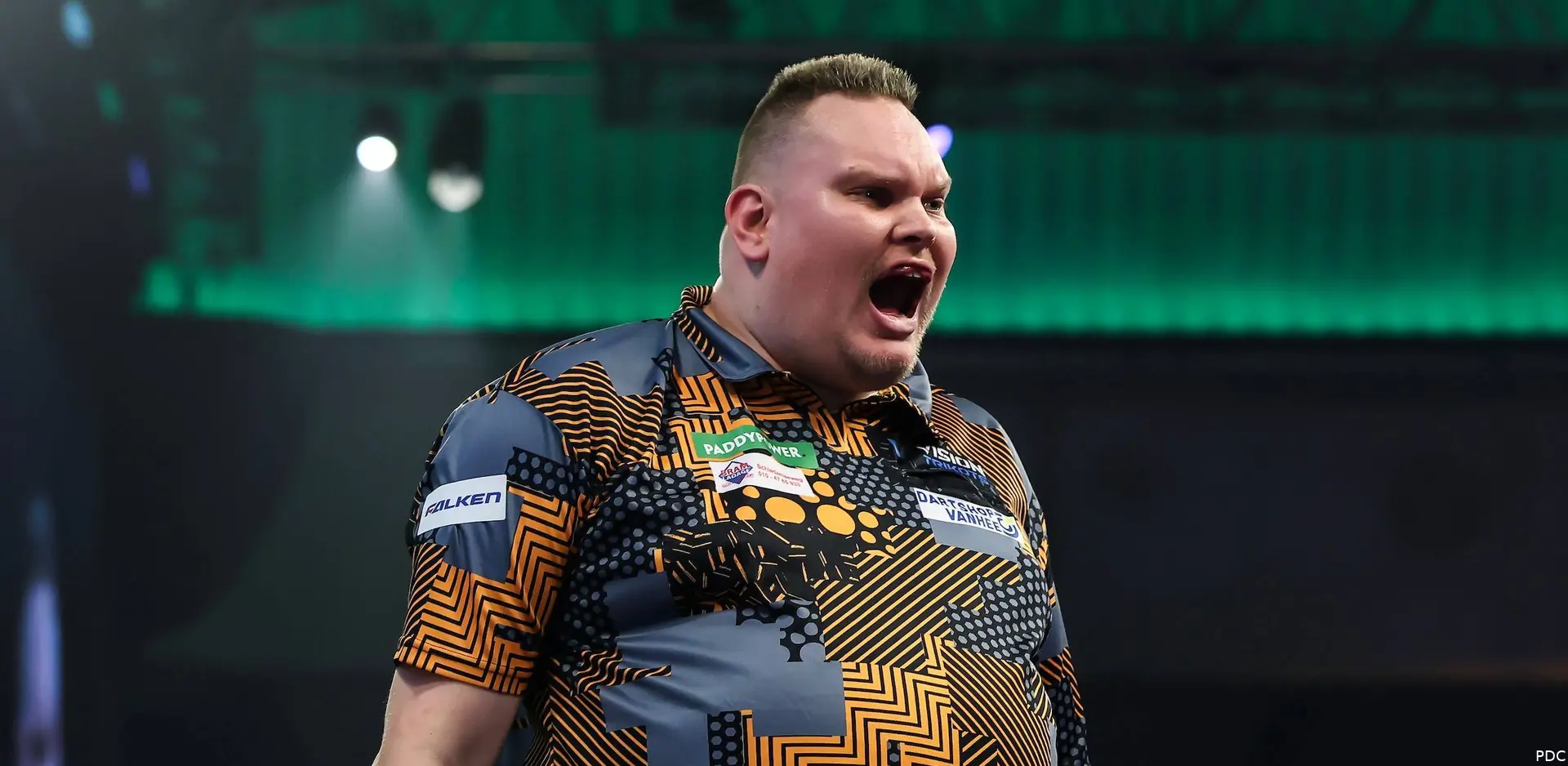
Wesley Plaisier was left almost lost for words after producing one of the biggest shocks of the 2026 PDC World Darts Championship, defeating tournament favourite and former world champion Gerwyn Price in straight sets at Alexandra Palace.
ADVERTISEMENT
Plaisier produced a 94.28 average, two 180's, 56% on the doubles as he dumped out one of the World Championship favourites who would've been buoyed by crowd support but they couldn't will him to even win a set.
“I’m over the moon — that’s the only thing I can say,” Plaisier admitted afterwards including to DartsNews. “To beat not just a former world champion, but also a favourite for this tournament, and in straight sets, that must be a really good feeling.”
The Dutchman had arrived on the World Championship stage hoping simply to be competitive, not to dominate one of the sport’s biggest names. “Like I said to the other people, I couldn’t imagine beating him, especially not 3–0,” he said. “I was hoping I could give him a good match and maybe take one or two sets. I still can’t believe it.”

Nerves in getting over the line and biggest moment of his career
The magnitude of the moment only truly hit home once the match was over. “When I go home, I think I’m going to really enjoy this moment,” he added.
Despite the scoreline, the closing moments were far from comfortable. Standing on the oche with the match there to be won, Plaisier admitted the nerves were overwhelming. “A lot of nerves,” he said. “Especially the first dart on 58 — that was massive. The crowd was a little bit against me, but when you’re playing Gerwyn Price, they want him to stay in. I was shaking.”
ADVERTISEMENT
With Price missing two darts to extend the match, Plaisier held his nerve. “In the end, he missed two darts and I was happy to take it with my first dart in the second visit.”
The win immediately eclipsed everything he has achieved previously in the game including a Players Championship title and two WDF World Masters crowns. “By far, by far,” he said when asked if this was the biggest moment of his career. “The best wins are the ones you don’t expect. Of course, the Players Championship win was something I didn’t expect either, but this is by far my biggest win ever.”
Even his World Masters successes could not compare. “The World Masters title was of course my biggest title before, especially the second one, which was harder than the first,” he explained. “But this win is definitely number one.”
And with Christmas just around the corner, the timing could hardly be better. “Definitely,” he smiled. “I’m going to enjoy it really well, with a good Christmas dinner.”
Plaisier’s composure throughout the match was evident from the opening exchanges, particularly a stunning 130 checkout in the first leg — something he felt played a crucial role.
ADVERTISEMENT
“Yeah, for sure,” he said. “It’s important to take the first leg as soon as possible, and doing it with a 130 helped. That composed me a little bit and calmed me down. Taking the first set was maybe even more important.”
While he was quick to acknowledge that Price was not at his best, Plaisier felt his own timing was the difference. “He didn’t play his best — I’ll be the first one to say that,” he admitted. “But I did the good things at the right moments, and I think that’s the main reason I won this game.”
Not a free pass now for Plaisier
The victory has blown open his section of the draw, but Plaisier is refusing to look too far ahead. “Of course the draw is open, but there are still a lot of good players in it,” he said. “Krzysztof is my next opponent, and he’s always dangerous. I don’t underestimate him at all. I’m just looking match by match.”
That mindset has been central to his approach throughout his career. “You can lose every game,” he explained. “If you don’t hit your doubles, you’re out. It’s always match by match, game by game.”
ADVERTISEMENT
Yet beating Price has undeniably shifted his belief when it comes to facing the sport’s elite — including potential opponents like Luke Littler later in the tournament.
“If you can beat Gerwyn Price, you can beat everybody,” Plaisier said. “Especially this year — he’s been one of the best players on tour, reaching semi-finals at majors. If you can beat him, you can beat anybody.”
One more victory at Alexandra Palace would move Plaisier into the world’s top 64 — a milestone that carries huge significance. “That would be a really big achievement,” he admitted. “It would take a lot of pressure off for next year. Being in the top 64 would be amazing.”

The challenge of the occasion was heightened by a partisan crowd, particularly in the closing stages, but it was something Plaisier had anticipated.
ADVERTISEMENT
“I was prepared for that,” he said. “He’s a big name, and the crowd wants the big names to go deep. The booing was massive at the end, but I kept my head cool when it mattered.”
Despite his pedigree in the WDF — where he was a two-time World Masters champion — Plaisier believes he is still very much finding his feet in the PDC.
“The WDF was a step up for me to the PDC,” he explained. “When I was there, I was one of the best players. Here, I’m just one of the players coming up, trying to get into the top 64. There are so many good players.”
That reality has been reinforced during his time on the Pro Tour. “Every game is really hard,” he said. “There are no easy games.”
This season, in particular, tested him both professionally and personally. “It wasn’t my best year on the Pro Tour,” Plaisier admitted. “Early on, I lost a lot of matches 6–5. Halfway through the year, I had a lot of personal things that didn’t go well.”
ADVERTISEMENT
Biggest goal is to remain on tour
However, a strong second half of the year restored his confidence. “The last half of the year was really good,” he said. “I got a lot of belief in myself, and I’m happy it came out today.”
Looking ahead, his ambitions are clear but measured. “My biggest goal is to get into the top 64 and keep my tour card,” he said. “After that, step by step — top 32, top 60. You never know what can happen in a year.”
For now, though, life remains a balance between darts and his day job. “I still work as a forklift driver,” Plaisier revealed. “My work is really cooperative. If I have to play darts, I can go wherever I want. When I don’t, I go to work like normal.” And practice still fits in around it all. “When I finish work, I go home and practise, or I’m travelling for tournaments.”
ADVERTISEMENT

Samuel GillChief Content Officer
Samuel Gill is the Chief Content Officer (CCO) of DartsNews.com, a role he has held since 2020. He is responsible for editorial governance across the platform, including setting content standards, overseeing accuracy and consistency, and guiding long-term editorial strategy across professional darts coverage. Since joining, he has contributed more than 10,000 articles and editorial pieces, playing a central role in the development and daily operation of the site.
Based in Leicester, Samuel has extensive experience in darts media and has been closely involved in coverage of the professional darts circuit for several years. Within the UK darts community, he is a recognised figure known for his consistent editorial output and ongoing reporting on major tournaments and developments across the PDC calendar.
In his current role, Samuel works closely with editors and writers to ensure content meets clear journalistic standards, with a focus on source verification, editorial consistency, and timely updates when new, confirmed information becomes available.
claps 0visitors 0
Just in


Popular news

Latest comments
- The players who deliberately slow the game down are usually boring and win very little in the way of silverware. Horrible to watch.MrYnyslas197112-10-2026
- [“The Gentle” then used a sweeping and questionable phrase...] You anglocucks are hilariously finished in every sense of the word.Critical99911-10-2026
- I love Jonny but I disagree. The Grand Slam was always supposed to be "champion of champions" type competition. If the top 16 are guaranteed participation in everything there will be so much less jeopardy involved in qualifying and each major tournament will lose its unique flavour which the PDC has worked hard trying to develop. I enjoy following the qualification races towards the end of the year, and while consistency should have its rewards, the truth is Jonny hasn't reached a major final all year or won a single event on the Pro Tour. Being consistent is one thing, but that alone should have consequences as the sport's elite should not be prepared to accept consistently strong performances, their foremost motivation should be to win and this should be what separates them from the rest, not the consistency of their performances. Jonny is expecting that losing should be enough; it shouldn't be, at least not as far as the Grand Slam is concerned.Deduce635811-10-2026
- Well being honest,it doesn't matter what level you play at, there's always someone who slows it down to suit themselves,and extra swig of water, replacing flights, asking the ref what the score is. It happens wherever. I'm not saying it's professional,but I'm sure we've all seen it beforerick6711-10-2026
- Agree completely. Not sure how a ranking event can have a criteria not based on rankings. And he right on popularity. In the UK second only to football.BandB11-10-2026
- Doesn't matter who's in it,it's boringrick6710-10-2026
- Assuming you qualify as one of the "muppets" in question. Classist too. And since you're so clearly interested in academia, look up "linguistic descriptivism" while you're at it. Oh, and better stay away from the working class sport of darts and maybe offer your insightful analysis to, let's say, croquet instead?Deduce635806-10-2026
- The consequences of being uneducated and grammatically challenged. "To all THOSE muppets not THEM " Everytime I see Arsepinall, I have an image of him wearing a cap, standing behind the counter of a fast food establishment.richieburnettrocks05-10-2026
- I don't understand Littler's reason for playing this tournament.rick6705-10-2026
- James Wade has become James Wide. He has piled on the tonnage considerably, he barely fits in his shirt.richieburnettrocks03-10-2026
Loading