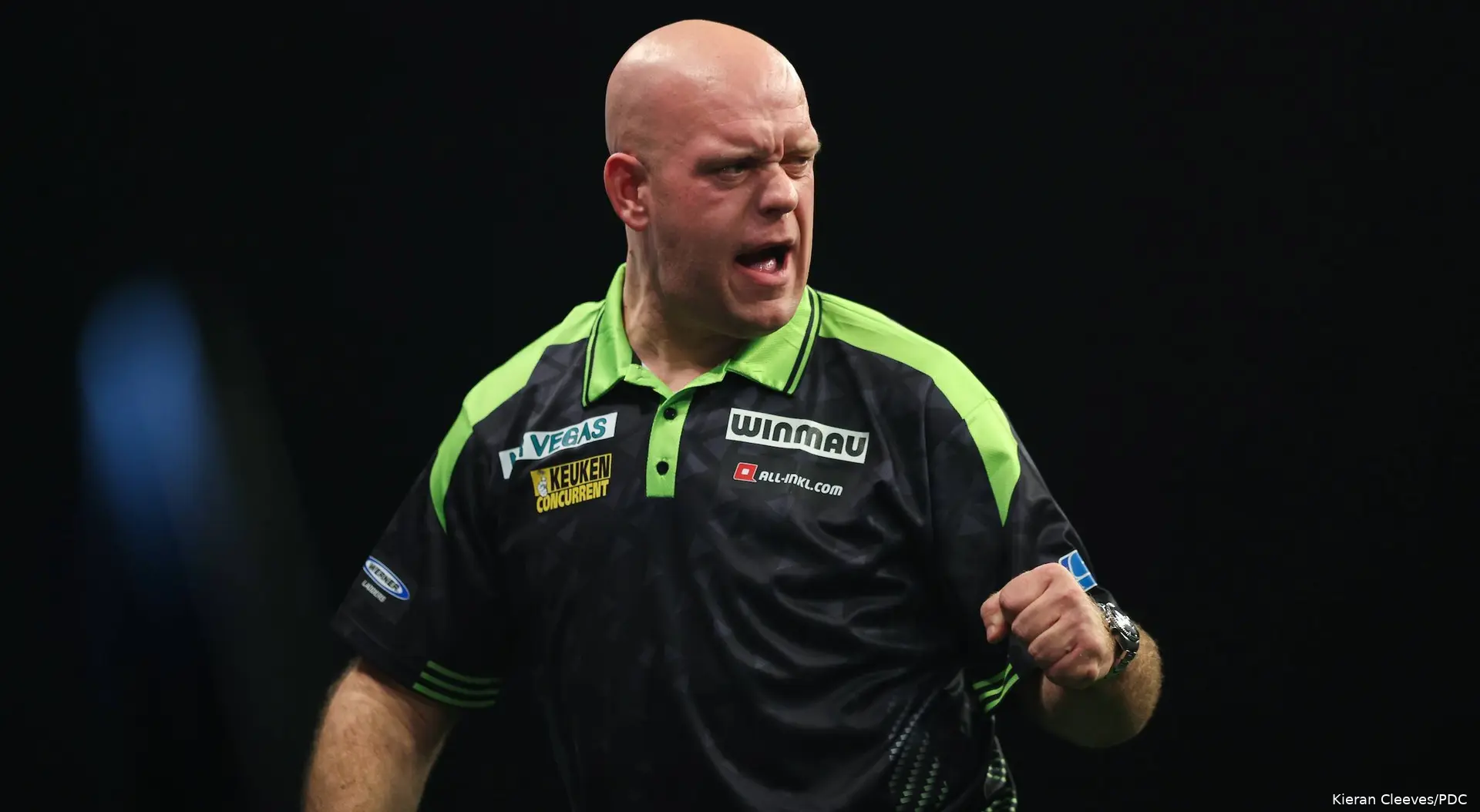
Michael van Gerwen knows what it takes to perform on the biggest stage. On Thursday evening, he begins his nineteenth World Darts Championship at Alexandra Palace, a venue where he became world champion three times and where experience is at least as important as form. In the build-up to his first match against Mitsuhiko Tatsunami, Van Gerwen offered a glimpse into his standard match day, a day that revolves mainly around rest and timing.
ADVERTISEMENT
The Dutchman will step on stage around 10:15 PM for his opener against the Japanese player, but there is hardly any tension or chaos in the hours before. Van Gerwen deliberately keeps his Worlds days empty. “I actually do very little on such a day,” he says on the podcast Darts Draait Door.
That is no coincidence, but a deliberate choice. As a seeded player, Van Gerwen knows weeks in advance that he will play in the evening session. That gives him the freedom to shape his day entirely to his liking. “Apart from that lunch, I lie on my bed and watch Netflix,” he says. Nothing more happens.

Where many athletes pack their match day with rituals and routines, Van Gerwen opts for the opposite. The fewer stimuli, the better. No long walks, no extra practice, no distractions. The body must stay fresh, the mind clear.
That lunch is the only fixed moment he steps outside. After that, he returns to the hotel, where he shuts himself off until it is time to head for Alexandra Palace.
Only four hours before his match does the rhythm change. “Four hours before I have to play, I drive to the venue. It’s a half-hour drive anyway. Beyond that, I want to preserve my rest as much as possible.” He knows the route to Ally Pally by heart. The hill, the car park, the backstage entrance, everything is familiar.

This year Michael van Gerwen is only an outsider for the world title
ADVERTISEMENT
Obligations at the venue
Once there, Van Gerwen cannot escape his status. Interviews come with the territory. “When you come in, there’s a battalion of journalists waiting for pre-match interviews,” he says. He does them without complaint. “I have to do them, but I don’t mind.”
After those obligations, he withdraws again. No rush, no nerves. Van Gerwen knows the real work starts later.
He is also deliberately restrained at the practice board. While some players throw for hours to “get into it,” Van Gerwen guards against that feeling. “I hate that if I’ve been inside for half an hour, I already feel like I’m ready,” he explains.
He sees peaking too early as a risk. Still, he wants to stay active. “I like to keep busy,” he says, “but that’s why I try to rein it in a bit.” The ideal moment to switch on is crystal clear to him. “Three quarters of an hour before a match, ‘it’ has to be there.”
ADVERTISEMENT
That timing is the result of almost twenty years of experience on the World Darts Championship stage. Van Gerwen knows exactly when to step on the gas and when not to. It is a balance learned through trial and error.

Training with a purpose
The real foundation for his Worlds form is of course laid weeks earlier. In the run-up to the tournament, Van Gerwen actively seeks out top-level opposition. He recently played several consecutive days in Finland, where he spent nine days competing in matches against, among others, Luke Littler. “Those are the best training sessions,” he states. “Because you’re really there with a purpose.”
For Van Gerwen, practice without pressure is pointless. Matches force him to stay sharp. “You get paid to give it everything, so you want to deliver.” Pride is also a factor. “You don’t want those others to beat you easily.”
ADVERTISEMENT
That combination of match rhythm and controlled rest should lift him to his best level in the coming weeks. Last year, Van Gerwen unexpectedly reached the final, in which he lost to Littler. This time he feels better prepared.
He is clear about his ambitions. “I’m aiming for at least a final,” Van Gerwen says without hesitation. That confidence is based on his current form. “I’m in a better place than last year. I’m throwing reasonably well.”
At the same time, he remains critical. Perfection does not exist. “Here and there, there’s still some fine-tuning to do,” he admits. But the base is solid. “Beyond that, I feel good.”

Samuel GillChief Content Officer
Samuel Gill is the Chief Content Officer (CCO) of DartsNews.com, a role he has held since 2020. He is responsible for editorial governance across the platform, including setting content standards, overseeing accuracy and consistency, and guiding long-term editorial strategy across professional darts coverage. Since joining, he has contributed more than 10,000 articles and editorial pieces, playing a central role in the development and daily operation of the site.
Based in Leicester, Samuel has extensive experience in darts media and has been closely involved in coverage of the professional darts circuit for several years. Within the UK darts community, he is a recognised figure known for his consistent editorial output and ongoing reporting on major tournaments and developments across the PDC calendar.
In his current role, Samuel works closely with editors and writers to ensure content meets clear journalistic standards, with a focus on source verification, editorial consistency, and timely updates when new, confirmed information becomes available.
claps 0visitors 0
Just in




Popular news

Latest comments
- The players who deliberately slow the game down are usually boring and win very little in the way of silverware. Horrible to watch.MrYnyslas197112-10-2026
- [“The Gentle” then used a sweeping and questionable phrase...] You anglocucks are hilariously finished in every sense of the word.Critical99911-10-2026
- I love Jonny but I disagree. The Grand Slam was always supposed to be "champion of champions" type competition. If the top 16 are guaranteed participation in everything there will be so much less jeopardy involved in qualifying and each major tournament will lose its unique flavour which the PDC has worked hard trying to develop. I enjoy following the qualification races towards the end of the year, and while consistency should have its rewards, the truth is Jonny hasn't reached a major final all year or won a single event on the Pro Tour. Being consistent is one thing, but that alone should have consequences as the sport's elite should not be prepared to accept consistently strong performances, their foremost motivation should be to win and this should be what separates them from the rest, not the consistency of their performances. Jonny is expecting that losing should be enough; it shouldn't be, at least not as far as the Grand Slam is concerned.Deduce635811-10-2026
- Well being honest,it doesn't matter what level you play at, there's always someone who slows it down to suit themselves,and extra swig of water, replacing flights, asking the ref what the score is. It happens wherever. I'm not saying it's professional,but I'm sure we've all seen it beforerick6711-10-2026
- Agree completely. Not sure how a ranking event can have a criteria not based on rankings. And he right on popularity. In the UK second only to football.BandB11-10-2026
- Doesn't matter who's in it,it's boringrick6710-10-2026
- Assuming you qualify as one of the "muppets" in question. Classist too. And since you're so clearly interested in academia, look up "linguistic descriptivism" while you're at it. Oh, and better stay away from the working class sport of darts and maybe offer your insightful analysis to, let's say, croquet instead?Deduce635806-10-2026
- The consequences of being uneducated and grammatically challenged. "To all THOSE muppets not THEM " Everytime I see Arsepinall, I have an image of him wearing a cap, standing behind the counter of a fast food establishment.richieburnettrocks05-10-2026
- I don't understand Littler's reason for playing this tournament.rick6705-10-2026
- James Wade has become James Wide. He has piled on the tonnage considerably, he barely fits in his shirt.richieburnettrocks03-10-2026
Loading