“And if he did, then you should tell Kirk Bevins that he’s a terrible referee” — Drama between Cullen and Suljovic at the PDC World Darts Championship exposes officiating role
PDCMonday, 22 December 2025 at 23:56
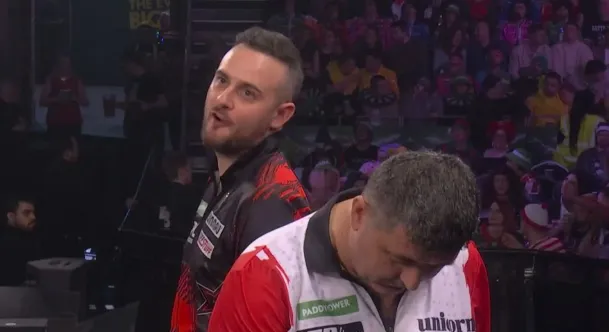
The match between Joe Cullen and Mensur Suljovic at the PDC World Darts Championship sparked plenty of debate. After Cullen’s 3-1 defeat, discussion flared over slow play, irritation on stage, and alleged unsporting conduct. Former pro Vincent van der Voort spoke extensively about it on the podcast Darts Draait Door, pointing chiefly to the role of the organisers and the refereeing.
In sporting terms, the contest did not reach an exceptional level. Suljovic won with an 82 average, while Cullen stalled at 87. According to Van der Voort, the pattern matched what is often seen with Cullen. “Cullen was good in the first round. Today he just didn’t have it,” he said. “He started reasonably well, but he didn’t have the same level as in the first round. That’s a big problem with Cullen: either he’s very good, or his level drops off too much.”
The commotion stemmed mainly from Suljovic’s behavior after winning legs. The Austrian visibly took a long time to retrieve his darts and frequently moved off to the side of the stage. “When Suljović checks out those legs, he tends to walk away from the oche instead of retrieving his darts,” Van der Voort explained. “He makes a half-step forward and then moves to the side. It simply takes a very long time.”
Van der Voort said that behavior in itself does not breach the rules. “There’s nothing that says it isn’t allowed,” he emphasised. “I later read that Cullen considered it cheating, but if you think that, then you have to go to the referee.”
Role of the referee
With that, Van der Voort firmly shifts the focus to the officiating. In his view, Cullen should have done more during the match than express his frustration once. “Then you have to stop the game and say that he’s cheating,” Van der Voort said. “If he does it again after that, then you have to look at what the sanctions are.”

The podcast referenced possible measures, such as warnings or docking a leg, but Van der Voort stressed that this is only possible if someone intervenes. “If Cullen doesn’t agree with it, then he has to ask about it,” he said. “What are you going to do now? This has never really been resolved.”
He pointed to earlier examples. “Gary Anderson experienced exactly the same thing against Suljović five or six years ago. I believe that was also at the World Championship, without an audience. He said exactly the same thing.”
Deliberate or just personality?
Van der Voort left open whether Suljovic uses his behavior deliberately to knock opponents out of rhythm. “That’s hard to judge with him,” he said. Vlottes also indicated that he didn’t immediately think it was intentional. “Maybe that guy is just like that,” he said.
Afterward, Suljovic seemed unaware of any wrongdoing and congratulated Cullen exuberantly. That only added to the irritation for some. Van der Voort also nuanced that moment. “That’s the advantage if you can’t speak English, or say that you can’t speak English. You can always say: I don’t understand what’s happening here.”
At the same time, he considered it plausible that Suljovic did realise Cullen was frustrated. “I think he definitely realised that Cullen had had enough,” Van der Voort said. “But he was completely focused on his own game, his own world.”

Wider issue within the PDC
Van der Voort stressed that he himself does not enjoy watching Suljovic’s behavior either. “I find it annoying too,” he admitted. “But I don’t think he actually did anything wrong. And if he did, then you should tell Kirk Bevins that he’s a terrible referee, because then he hasn’t done his job properly.”
According to Van der Voort, the debate points to a larger issue within the PDC: rules that exist but are not enforced consistently. “I hear a lot of people complaining,” he said. “Not only about this, but also about walk-ons taking too long. Then the PDC comes out with a weak, watered-down message like: ‘Guys, could you please move along a bit more?’"
Van der Voort believes clear consequences are missing. “Then they say: ‘I’m not doing that.’ Okay. And then nothing happens. In that case, you just have to take action.”
He drew a comparison with other on-stage rules. “That zone you’re not allowed to stand in isn’t there for nothing,” he said. “Michael van Gerwen often stands halfway over it. Nothing is ever done about it. That means those rules are pointless.”
claps 2visitors 2
Just in


Popular news
Latest comments
- I'm afraid the physique of Mr littler is not that of an elite sportsman. Remember when he was on kebabs and burgers,and proudly announced it? He's still a great player thoughrick6726-03-2026
- Yeah it was exciting when it started back around 05. Now its just a punish every week. Take it up to 12 players, and bottom 2 drop out after everyone has played once. No need for finals etc every week. At that stage make it first to 7 instead of 6 to take up the timeslot.Cameron.W14-03-2026
- Honestly,who cares? This league should be scrapped. It's just a money spinner for PDC and sky. How on earth can 8 players do this every week,and leave the rest behind? It's a bit shameful really. Anyone can win against anyone,but not every week. Scrap itrick6712-03-2026
- depends on the tournament, easier to tune out at minehead where the acoustics aren't very good and half the crowd are pensioners. "keir starmer's a w*****" is their only good chant though, they should censor the rest and keep that one.colt09-03-2026
- I watched all of the UK open and didn't hear it. Does anyone actually listen to, or hear the crowd noise? I just tune it out as it gets quite annoying. If I have to hear "if you love the darts stand up" one more flippin' time.... Clearly everyone there loves the darts, they paid for tickets. Why they should stand up is beyond me (half of them are so bladdered they'd fall straight back down anyway) hahaha
 DartsEnvy09-03-2026
 - I can't answer why, only the PDC can. I do watch most of them on PDC TV - I have it on in the background when working from home haha. There can be some great moments in them like Beau's recent 9 darter etc. As for their significance, they all contribute to the players rankings with the winners of each day getting 15K, so they are important to their rankings as well as their overall earnings. Win 4 in a year and there's a nice 60K (runner up also gets 10K per day). Also I've seen so many interviews where players say they really enjoy it, because its "pure darts" without the spectacle and they can just get on with it. As per the original reply above, with the stage format playing in front of a bunch of booing drunkards, it's a nice change of pace and can aid concentration. So I can perfectly understand why the players like it so much - it's a good earner, not quite as late nights and very quiet / pure.DartsEnvy09-03-2026
- Would love if podcast was available on youtube. Dont have spotify.kangacheckoutz03-03-2026
- ah ok, that helps put it in context, cheersMrMarkWatsonnonotthatone28-02-2026
- Any IDeaS.....richieburnettrocks28-02-2026
- I deserve it I am the greatest I am the people's champion I believe I will win the Premier League because I believe I am the best because honestly I am the people's champion and I honestly made the fans come tonight because I am honestly the greatest and I, I, I, I, I, I, I, Oh shut up you pathetic pandering hideously ugly fat waste of space! Fatty Bunting should be more sincere and humbly accept he needed that instead of I this and I that.richieburnettrocks28-02-2026
Loading
