"If I'd known a weekend could cost me a grand I wouldn't have come": Gerwyn Price looks back on accidental PDC move that changed his life
PDCThursday, 12 February 2026 at 10:19
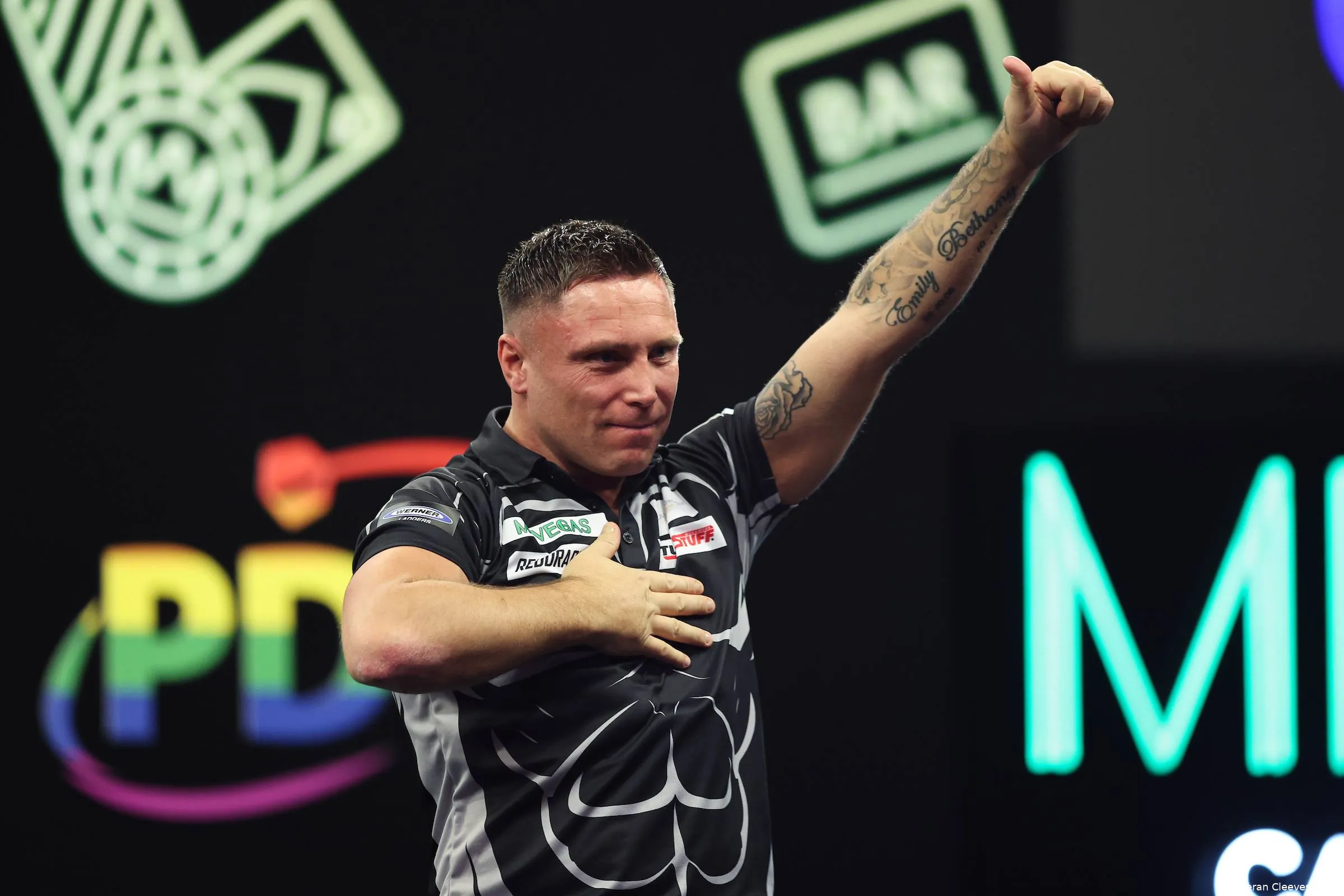
In the podcast Tops & Tales by PDC referee Huw Ware, Gerwyn Price reflects candidly on his entry into the professional ranks, his development as both a player and a person, and the life he has built away from darts.
The Welshman, former rugby professional, world champion, and a fixture at the top of the Order of Merit speaks in a strikingly matter-of-fact way about money, fame, and ambition.
When Price won his Tour Card, he was virtually unknown in the darts world. He did not come through the BDO or WDF system, but stepped straight into the PDC as an outsider. His entry into Q School, he explains, was never part of a master plan.
“I only went there because Barrie Bates was twisting my arm, messaging me and enticing me to go for like two years, and I eventually went,” Price says. “I had no expectations of myself at all. I was just there to support Barrie and Jon Worsley, have a weekend away and just try my luck.”
Out of everyone in the group, Price was the only one to come away with a Tour Card. At the time, he did not fully understand the financial reality of life on tour.
“If I’d known at the time that we had to pay to enter Pro Tours—which was a hundred quid plus a fiver for markers—and pay to enter the European Tours, so a weekend with the hotel could cost me a grand, if I knew that I wouldn’t have come,” he admits. “But looking back, I’m glad I didn’t know.”
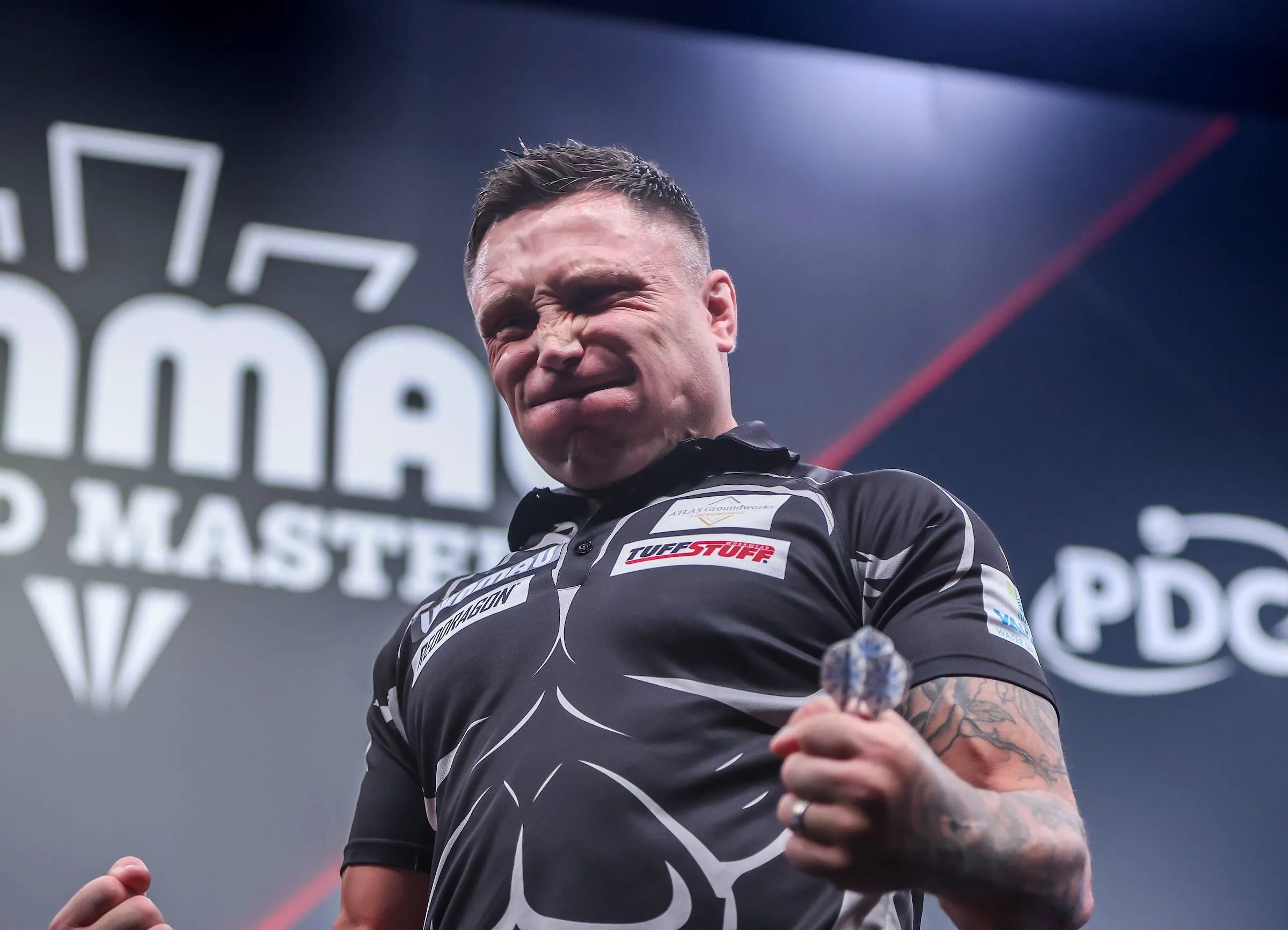
The first time Price met Barrie Bates was in the George pub in Aberbargoed. He had only been playing darts for around six months and was still focused on rugby.
“I used to go around all the local tournaments—£300, £400, £500 for the winner—and I used to win the majority of them,” he recalls. “I’d only just picked up a set of darts and I was still playing rugby.”
When the two faced each other across the oche, Price won comfortably.
“I played Barry and smashed him up in the George,” he laughs. “And he was like, ‘Why don’t you f*** off back to rugby?’”
Despite that introduction, the pair got on from that day. Bates continued to push him towards Q School, but Price initially resisted.
“He kept saying, ‘You’ve got to come to Q School,’ and I was like, ‘I’m a rugby player—no, it’s not for me.’”
County darts and Tony O’Shea
Price’s progression into higher-level darts happened gradually, through Friday night leagues and Super League on Wednesdays. County darts, however, proved difficult to balance with his rugby commitments. “You had to play in the B team to get into the A team, and the B team played on a Saturday,” he explains. “I played rugby every Saturday, so I said I wasn’t bothered.”
Then, late in the season, Gwent needed a result. “They just chucked me straight into the A team,” Price says. “I played on the Sunday and I won with about an 84 average against Tony O’Shea. That’s the only county game I ever played, and I’ve never played there again.”
Asked whether he felt nerves that day, Price is characteristically blunt. “To be honest with you, my memory is shocking, so I can’t even remember how I felt,” he says. “But I don’t think I would’ve been nervous. It was just another game day.”
There is, however, one stage of a tournament that still brings tension. “Only in first-round games,” he explains. “If anyone’s going to beat me, it’s the first round. I’m not nervous, just a bit more anxious about getting through it. Once I’ve done that, I feel at ease.”
Unusually, Price prefers being scheduled early rather than late. “I’d rather play the first match of the tournament than the last match,” he says. “I prefer seven o’clock rather than half ten. At least you know exactly what time you’re on. Later on, you don’t know how the games before you are going to go.”
Over time, his approach to life on tour has changed significantly. “At the beginning, when I first started playing, you might go to Barnsley or somewhere and have a night out,” he says. “But now I’m in bed early, I’m up in the gym, and I’m just… boring.”
That routine, he insists, is personal rather than prescriptive. “For me it works, but everybody’s different,” Price says. “I can’t say to somebody you need to go to the gym. It’s like greyhound racing—some dogs need walking every day, others can run straight off the bed and perform their best.”
At 40, he admits age has played its part. “I used to love getting home and having a night out,” he says. “Now I’m just sitting at home, doing nothing.”

The quiet man in the room
Despite his animated presence on stage, Price describes himself as naturally introverted away from it.“If there’s 30 people in the room, I’m probably the last one you’re going to hear,” he says. “I’ll be sat at the back.”
That was also the case during his rugby career. “If we had video analysis, I’d prefer to be at the back of the room because I hated being asked questions,” he explains.
Media life in the PDC initially felt alien. “I didn’t really know what to do,” Price admits. “I don’t mind it anymore. I’m used to it, but I’d still rather be left alone than be the centre of attention.”
A constant presence behind the scenes has been his partner, Bethan. The two met when Price was 17 and working at Markham Rugby Club. “I used to clean up, mop the floors, do all the glasses,” he says. “That’s where I met her.”
Her support, he believes, has been vital. “Without that support, it’s definitely a lot harder,” Price says. “Every time I’m away, it’s constant support. There’s never any, ‘I don’t want you to be away this week.’”
He sees first-hand how damaging the opposite can be. “There are players who’ve probably lost their tour card because they haven’t had that backing,” he says. “And there are players who, when they lose, instead of getting support, they get grief—and that’s no good.”
When Bethan travels with him, the results often follow. “Every time she comes with me, Pete’s like, ‘You’re winning this weekend,’” Price smiles. “She’s a good omen. Every time she comes away with me, I seem to play a lot better.”
Away from darts, Price keeps himself busy with business ventures, including darts academies, a fish and chip shop, and, most recently, a farm. “With a fresh shop, it’s hard work especially when you don’t know what you’re doing at the beginning,” he says. “Now we know what we’re doing, but it’s still hard work. The hardest part is when I’m away and something goes wrong.”
Despite the workload, the appeal of privacy remains strong. “I’ve always wanted just a bit of a smallholding, something out of the way a little bit,” he says. “If your business is next to your house, you get people knocking on your door and walking up your drive.”
Another ten years for sure
As for retirement, it is not on the immediate horizon. “I’ve just signed with Red Dragon for the next ten years,” Price confirms. “I’m with them until I’m 50, so I’m definitely playing for another ten years.”
That does not necessarily mean a full professional schedule forever. “I’ll never, ever put the darts down completely,” he says. “I might give up Pro Tours or Europeans one day and just try to stay in the top 16 and play TV events as long as possible.”
The World Championship’s £1 million top prize is historic, but Price remains unmoved by the figure. “It is a lot of money, but it wouldn’t change anything about me,” he says. “It would just go into the pot. I wouldn’t go and buy something for a million pounds. My life wouldn’t change.”
He believes the same is true for most of the elite. “It wouldn’t change Luke’s life. It wouldn’t change Michael’s life,” Price says. “It’s a good bonus, but it doesn’t change who you are.”
claps 119visitors 19
Just in

Popular news

Latest comments
- Well,he doesn't want to play in Germany,and now he's letting things get to him. I appreciate he's a fantastic player,he's won loads,but perhaps he should perhaps learn to grow up a bit and realise whoever you are,you can't win every single match.rick6703-04-2026
- I'm afraid the physique of Mr littler is not that of an elite sportsman. Remember when he was on kebabs and burgers,and proudly announced it? He's still a great player thoughrick6726-03-2026
- Yeah it was exciting when it started back around 05. Now its just a punish every week. Take it up to 12 players, and bottom 2 drop out after everyone has played once. No need for finals etc every week. At that stage make it first to 7 instead of 6 to take up the timeslot.Cameron.W14-03-2026
- Honestly,who cares? This league should be scrapped. It's just a money spinner for PDC and sky. How on earth can 8 players do this every week,and leave the rest behind? It's a bit shameful really. Anyone can win against anyone,but not every week. Scrap itrick6712-03-2026
- depends on the tournament, easier to tune out at minehead where the acoustics aren't very good and half the crowd are pensioners. "keir starmer's a w*****" is their only good chant though, they should censor the rest and keep that one.colt09-03-2026
- I watched all of the UK open and didn't hear it. Does anyone actually listen to, or hear the crowd noise? I just tune it out as it gets quite annoying. If I have to hear "if you love the darts stand up" one more flippin' time.... Clearly everyone there loves the darts, they paid for tickets. Why they should stand up is beyond me (half of them are so bladdered they'd fall straight back down anyway) hahaha
 DartsEnvy09-03-2026
 - I can't answer why, only the PDC can. I do watch most of them on PDC TV - I have it on in the background when working from home haha. There can be some great moments in them like Beau's recent 9 darter etc. As for their significance, they all contribute to the players rankings with the winners of each day getting 15K, so they are important to their rankings as well as their overall earnings. Win 4 in a year and there's a nice 60K (runner up also gets 10K per day). Also I've seen so many interviews where players say they really enjoy it, because its "pure darts" without the spectacle and they can just get on with it. As per the original reply above, with the stage format playing in front of a bunch of booing drunkards, it's a nice change of pace and can aid concentration. So I can perfectly understand why the players like it so much - it's a good earner, not quite as late nights and very quiet / pure.DartsEnvy09-03-2026
- Would love if podcast was available on youtube. Dont have spotify.kangacheckoutz03-03-2026
- ah ok, that helps put it in context, cheersMrMarkWatsonnonotthatone28-02-2026
- Any IDeaS.....richieburnettrocks28-02-2026
Loading