PREVIEW World Cup of Darts – Germany: Between searching for form, dartitis and question marks – Schindler and Pietreczko battling doubts
PDC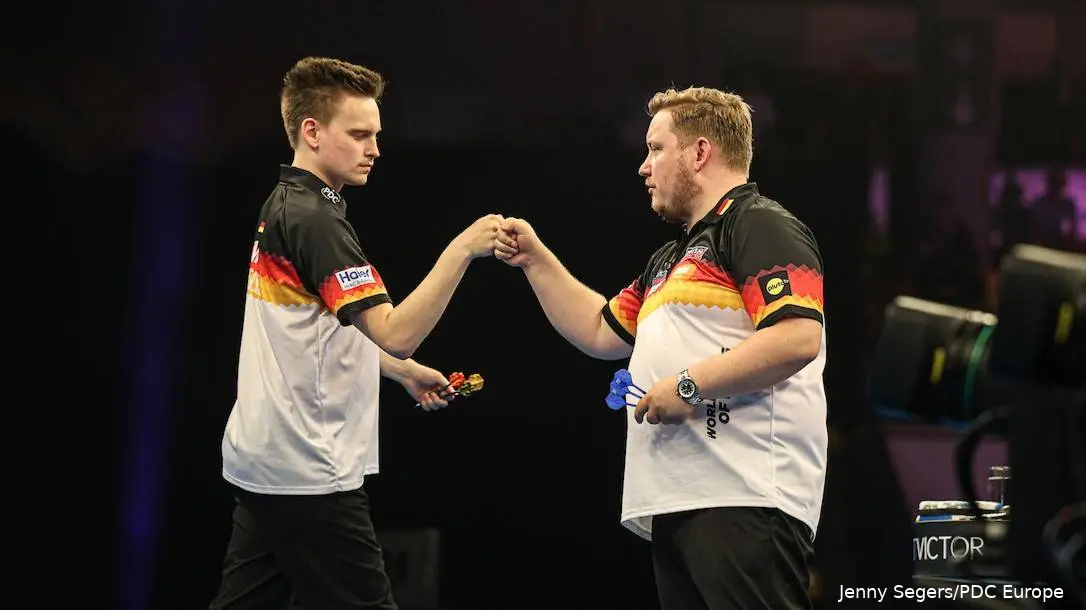
Not even a year has passed since Martin Schindler and Ricardo Pietreczko produced one of the biggest shocks in recent World Cup history. “Pikachu” took out 62, landing the first match dart on double 16, beer cups flew across Frankfurt’s Eissporthalle, and people hugged each other in sheer joy. An atmosphere you rarely encounter even in darts.
ADVERTISEMENT
It was the next milestone for a sporting giant that has been striving for years to live up to its role in darts as well. Barely twelve months later, little remains of that euphoria – even though Team Germany returns to the scene of one of its greatest triumphs with an unchanged lineup. In this preview, we examine why last year’s semi-finalists are currently surrounded by more question marks and doubts than momentum and optimism.
Last year’s semi-finalists return
With the same personnel, Team Germany returns to the heart of Europe this year. Last year, Schindler and Pietreczko cruised through the group phase with commanding 4-2 and 4-0 wins over Portugal and Singapore. In the knockouts, as mentioned at the outset, they sensationally beat the title favourites from England 8-4, before the German duo also edged Australia in a nerve-jangling decider to punch their semi-final ticket.

The upset against England turned Schindler and Pietreczko into German darts heroes – now the duo returns to the site of that triumph
With that, Schindler and Pietreczko matched Germany’s best World Cup result. Team Germany first reached the semi-finals in 2020, when Max Hopp and Gabriel Clemens surprisingly ended the long-running Netherlands hoodoo and advanced to the last four for the first time with a 2-1 win over their neighbours. Gabriel Clemens repeated the feat in 2023 alongside Martin Schindler, when the duo beat England 8-3 in the quarterfinals.
Team Germany results at the World Cup of Darts
ADVERTISEMENT
| Year | Team | Result |
| 2010 | Jyhan Artut and Andree Welge | Second round |
| 2012 | Jyhan Artut and Bernd Roith | Last 16 |
| 2013 | Jyhan Artut and Andree Welge | Quarterfinals |
| 2014 | Jyhan Artut and Andree Welge | First round |
| 2015 | Jyhan Artut and Max Hopp | Quarterfinals |
| 2016 | Max Hopp and Jyhan Artut | First round |
| 2017 | Max Hopp and Martin Schindler | Quarterfinals |
| 2018 | Max Hopp and Martin Schindler | Quarterfinals |
| 2019 | Max Hopp and Martin Schindler | Last 16 |
| 2020 | Max Hopp and Gabriel Clemens | Semifinals |
| 2021 | Gabriel Clemens and Max Hopp | Quarterfinals |
| 2022 | Gabriel Clemens and Martin Schindler | Quarterfinals |
| 2023 | Gabriel Clemens and Martin Schindler | Semifinals |
| 2024 | Martin Schindler and Gabriel Clemens | Last 16 |
| 2025 | Martin Schindler and Ricardo Pietreczko | Semifinals |
Martin Schindler: “Capitano” searching for consistency
Although recent headlines have focused mainly on Ricardo Pietreczko’s slide in form, that tells only part of the story. Germany’s number one, Martin Schindler, who travels to Frankfurt as team captain for the third time this year, has also too rarely hit his top level in 2026.
After the first five months of the PDC season, “The Wall” holds a 49 percent win rate. A look at the past four years underlines that it is not only Pietreczko battling his game right now: in 2025 Schindler’s win rate was 64 percent, in 2024 it was 60 percent, in 2023 it was 56 percent, and in 2022 it was a strong 63 percent. Of course, Germany’s number one still has almost seven months to correct course. Even so, the numbers paint the picture of a disappointing season so far.

Martin Schindler heads to Frankfurt as Germany’s number one – but “The Wall” has only been able to access his best level in phases this season
ADVERTISEMENT
A major part of this story lies in the start of the season. In sport, you often hear how crucial a strong start to a match, an event, or a season can be – and in Schindler’s case, looking back, it must be called a false start. In his first Players Championship match of the year, Schindler made the wrong kind of headlines: with a 65 average, the three-time European Tour champion lost 6-0 to Maik Kuivenhoven.
In an interview with DartsNews a few weeks later at the German Darts Grand Prix in Munich, Schindler addressed the much-discussed display: “At the first Players Championship I realised I wasn’t myself at all. I could twist and turn it however I wanted – I just wasn’t in control. I think only the body was functioning, and my head felt like it was two meters to the side.”
Nach seinem zweiten European-Tour-Erfolg des Jahres habe ich Martin Schindler auf seinen komplizierten Saisonstart samt 65er-Average angesprochen.
— Nic Gayer (@nicnacmedia) April 6, 2026
The Wall sprach offen und reflektiert über ein "beschissenes Spiel" und eine "blöde" Karrierephase ⬇️#dartzn @DartsNews_DE pic.twitter.com/EYzaqRd4rC
What at first glance looked like an unusual lapse, which in a sport of fine margins is rare but not unheard of, actually turned into a dip in form over the following weeks and months. Schindler’s best result of the season so far remains a strong semi-final run at Players Championship 15. The fact that “The Wall” sits only 53rd in this year’s Players Championship Order of Merit after 20 events underlines the lack of consistency in his game.
Even on his personal playground of recent years, the European Tour, Schindler has yet to match the levels of previous seasons. In 2024 and 2025, “The Wall” crowned himself a three-time champion on the very tour where he worked as a steward at the age of 17. He also finished the 2024 European Tour season ranked first on the associated Order of Merit and traveled to the European Championship in Dortmund as the top seed.
ADVERTISEMENT
This year, after eight events, the ledger shows two quarter-final appearances. Schindler has also exited in the first round three times already. For comparison: across the entire 2024 and 2025 seasons combined, he was knocked out at the start of a European Tour event only four times.
So is it pure doom and gloom ahead of the 2026 World Cup of Darts? Of course not. When Martin Schindler opened his floor season with a 65 average, fans and pundits were already debating a far-reaching crisis, possible injury issues, or even existential dartitis concerns. Schindler has managed to disperse those dark clouds in recent months.
Even if the world number 19 is unlikely to be satisfied with his season so far, he has repeatedly flashed world-class with quarter- and semi-final runs and averages of 113.79, 108.78, and 105.90. And who knows: perhaps the special intensity of Frankfurt’s Eissporthalle will give him exactly the wings he needs for a strong second half of the year.
Ricardo Pietreczko: The arm of the nation
ADVERTISEMENT
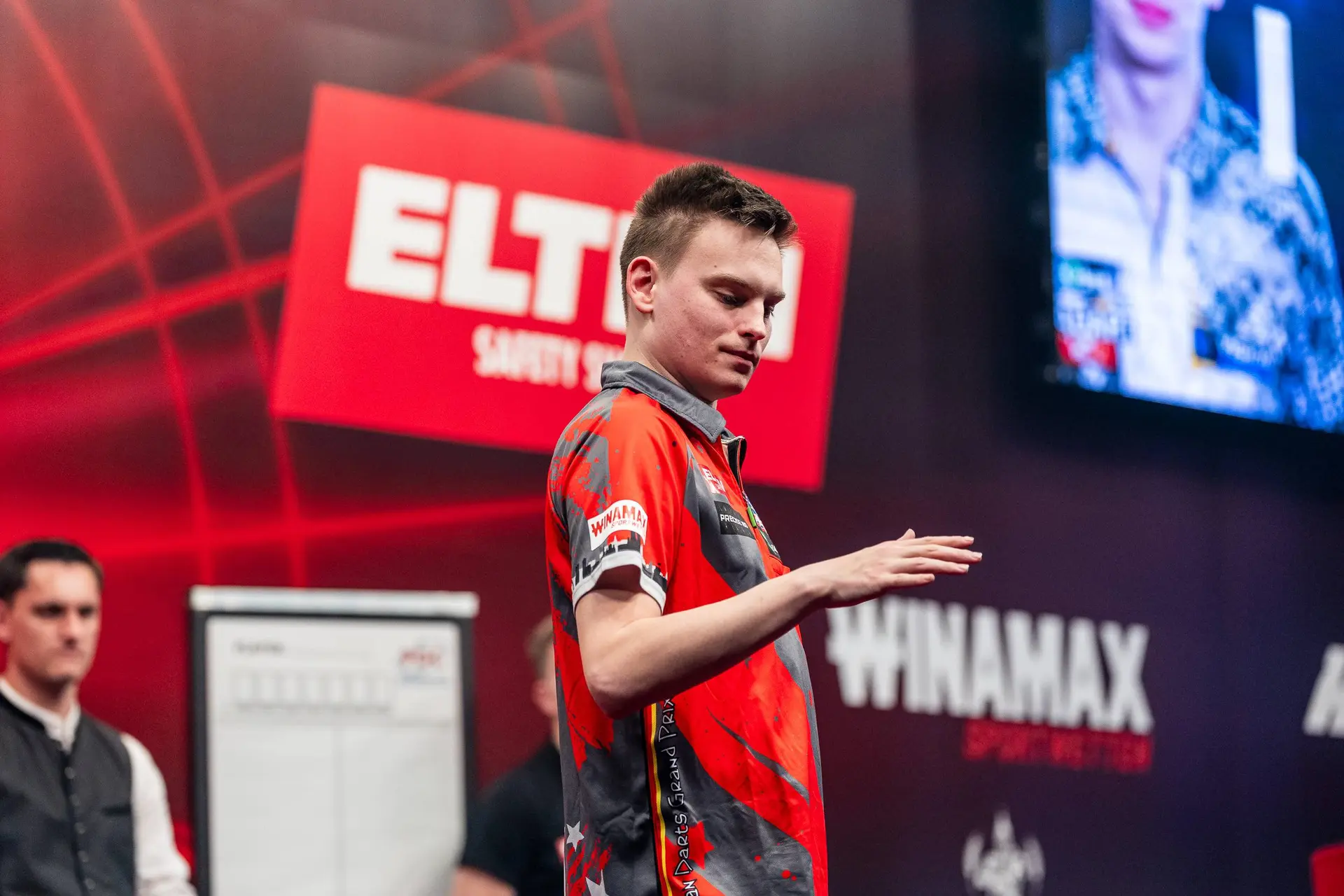
Let’s turn to one of the most discussed topics around this year’s World Cup of Darts: Ricardo Pietreczko and his battle with dartitis. After an impressive season finish with a quarter-final run at the European Championship and reaching the third round at the World Darts Championship at Ally Pally, Pietreczko suddenly faced the biggest sporting crisis of his PDC career in early April.
At the German Darts Grand Prix in Munich, Pietreczko initially scraped past Ian White into the second round with a 79 average and, in his duel with Nathan Aspinall, showed clear signs for the first time of an issue with his throw. Aspinall, one of the sport’s most prominent cases of successfully overcoming dartitis, even offered the German his help in the on-stage interview after the match.
And Aspinall would be proved right. What at first looked like a hitch in the throw developed over the following weeks into a sporting emergency. Pietreczko’s throwing technique seemed to collapse like a house of cards—and with it his entire game. At Players Championship 14, “Pikachu” abandoned his first-round match against Jeffrey de Zwaan after only two legs, averaging under 60. At Players Championship 15 and 16, he did not get beyond a 76 and 66 average in two first-round defeats. The dartitis that has already destroyed numerous careers in darts had now caught up with Germany’s number two.

Dartitis is presenting Ricardo Pietreczko with the biggest sporting challenge of his PDC career—but “Pikachu” has no intention of giving up
Accordingly, the debate around Pietreczko—especially with a view to his upcoming start for Team Germany at the 2026 World Cup of Darts—gathered pace. Fans and experts asked whether Pietreczko should voluntarily relinquish his spot to increase the German team’s, and Martin Schindler’s, chances of success. The current German number three, Niko Springer, was repeatedly put forward as the logical replacement.
ADVERTISEMENT
Captain Schindler also spoke on the European Tour in Graz on the DartsNews microphone about a possible withdrawal by his teammate:
“I’ll be honest: that’s in Ricardo’s hands. If he says he feels up to it and trusts himself and his game, then I trust him too. But if he’s equally honest and says he won’t do it, then I respect that—and I genuinely think that would be a very, very good and mature decision.”
But Pietreczko held a firm line throughout. In mid-May, he confirmed in a Twitch chat that he would play the World Cup of Darts unless something “worse” intervened. At the International Darts Open in Riesa, the 31-year-old also made it clear that he would definitely be fit for the start of the World Cup.
The tournament in Riesa in some ways marked Pietreczko’s sporting resurrection. Above all, the speed with which the 31-year-old managed to restore his competitiveness is remarkable. At the International Darts Open, Pietreczko delivered a memorable display: the German unveiled a fundamentally reworked throwing action, with an initial movement reminiscent of the 2010 World Cup champion, Co Stompé.
Pietreczko looked noticeably more assured and liberated on stage and, with wins over Maik Kuivenhoven and Danny Noppert, reached the final day of a European Tour event for the first time this season. He underlined that progress last week by reaching the board final at Players Championship 20.
ADVERTISEMENT
The fact that Pietreczko radically changed his throwing action within a few weeks and, in the middle of that process, made the final day of a European Tour event shows how deeply he lives for darts—and how well he understands his own game. As external pressure mounted and the days until the World Cup in Frankfurt ticked down inexorably, Pietreczko worked on his sporting comeback.
Keeping a cool head under pressure is among the traits that epitomise Pietreczko’s PDC career to date. The 31-year-old has long been regarded as the country’s best big-game player. And that is precisely why it would fit the narrative if “Pikachu” used the stage in Frankfurt to silence many of his critics.
Read also
Conclusion
At first glance, Team Germany does appear to be far removed from the euphoria that swept through Frankfurt’s Eissporthalle twelve months ago heading into the 2026 World Cup of Darts. Martin Schindler is still searching for the consistency of previous years, while Ricardo Pietreczko has battled through the biggest sporting crisis of his career in recent weeks. The doubts surrounding the German team therefore do not come out of nowhere.
ADVERTISEMENT
And yet it would be negligent to reduce Schindler and Pietreczko solely to their struggles in recent months. The team captain has already flashed his world-class level several times this season, while Pietreczko has impressively demonstrated the extent of his resilience. Above all, the German duo showed last year that they can raise their game on the sport’s biggest team stage.
Perhaps that is exactly where the biggest opportunity lies. Rarely has the expectation around Team Germany before a World Cup of Darts been as restrained as it is this year. In recent weeks, the discussions have revolved less around possible success and more around dips in form, doubts, and personnel alternatives. The pressure to deliver at all costs is therefore likely to be lower than twelve months ago. Schindler and Pietreczko are not traveling to Frankfurt as great standard-bearers, but as a team whose potential many currently find hard to gauge. And that could prove to be an advantage in the coming days.

Lucas MichaelDarts Journalist
Lucas Michael is a darts journalist and reporter based in Cambridge, UK, and has been part of the DartsNews team since 2025. He covers professional darts through reports, analysis, round-ups, and live coverage, with a focus on clear context and accurate reporting across the PDC calendar.
A key part of his work is liveblogging major tournaments throughout the year, providing real-time updates, match coverage, and contextual reporting across the professional circuit. He also reports regularly from events on site and has covered the PDC World Darts Championship from the venue, delivering first-hand insight throughout the tournament.
Within the newsroom, Lucas works closely with the editorial team and supports coverage alongside Chief Content Officer Samuel Gill and reporter Kieran Wood.
Lucas holds a BA (Hons) in Sports Journalism. In his work, he places strong emphasis on careful sourcing, editorial accuracy, and updating content promptly when new, verified information becomes available.
claps 1visitors 1
Just in

Popular news
Latest comments
- I agree,I can't believe the lack of coverage of this sad loss. Always enjoyed watching him,but I guess now it's all about littler,well it seems that way. Darts has sadly lost a good manrick6717-10-2026
- In the absence of a report regarding the death of Stefan Lord, I'll assist. An excellent player in the late 70s and early 80s, he actually won the now defunct 3rd place match at two World Championships and a couple of the News of the World Championships. A fabulous player and easily the best Swedish player ever. Rest peacefully Stefan.richieburnettrocks16-10-2026
- Joking aside, it is the second most watched sport on sky (more than golf, F1 etc) behind football only, and in participation is second to only football and swimming. It doesn't get the attention or sponsorship of "bigger" sports because it's not as sexy, but it's right up there.BandB13-10-2026
- i love darts but you can't seriously believe it's the second most popular sport in the uk. even top five is pushing it. it may be the fastest growing, though.colt13-10-2026
- I'm a big Clayton fan, but he's got this completely wrong. Qualification criteria exists for a reason - so just as failing to make the top 32/64 for the Euro championships/PT Finals means you miss out, so does not lifting a title for this one.26sForFun12-10-2026
- The players who deliberately slow the game down are usually boring and win very little in the way of silverware. Horrible to watch.MrYnyslas197112-10-2026
- [“The Gentle” then used a sweeping and questionable phrase...] You anglocucks are hilariously finished in every sense of the word.Critical99911-10-2026
- I love Jonny but I disagree. The Grand Slam was always supposed to be "champion of champions" type competition. If the top 16 are guaranteed participation in everything there will be so much less jeopardy involved in qualifying and each major tournament will lose its unique flavour which the PDC has worked hard trying to develop. I enjoy following the qualification races towards the end of the year, and while consistency should have its rewards, the truth is Jonny hasn't reached a major final all year or won a single event on the Pro Tour. Being consistent is one thing, but that alone should have consequences as the sport's elite should not be prepared to accept consistently strong performances, their foremost motivation should be to win and this should be what separates them from the rest, not the consistency of their performances. Jonny is expecting that losing should be enough; it shouldn't be, at least not as far as the Grand Slam is concerned.Deduce635811-10-2026
- Well being honest,it doesn't matter what level you play at, there's always someone who slows it down to suit themselves,and extra swig of water, replacing flights, asking the ref what the score is. It happens wherever. I'm not saying it's professional,but I'm sure we've all seen it beforerick6711-10-2026
- Agree completely. Not sure how a ranking event can have a criteria not based on rankings. And he right on popularity. In the UK second only to football.BandB11-10-2026
Loading