BACK IN THE DAY WITH: Rod Harrington - From ‘Prince of Style’ to two-time World Matchplay champion and figurehead of the PDC
PDC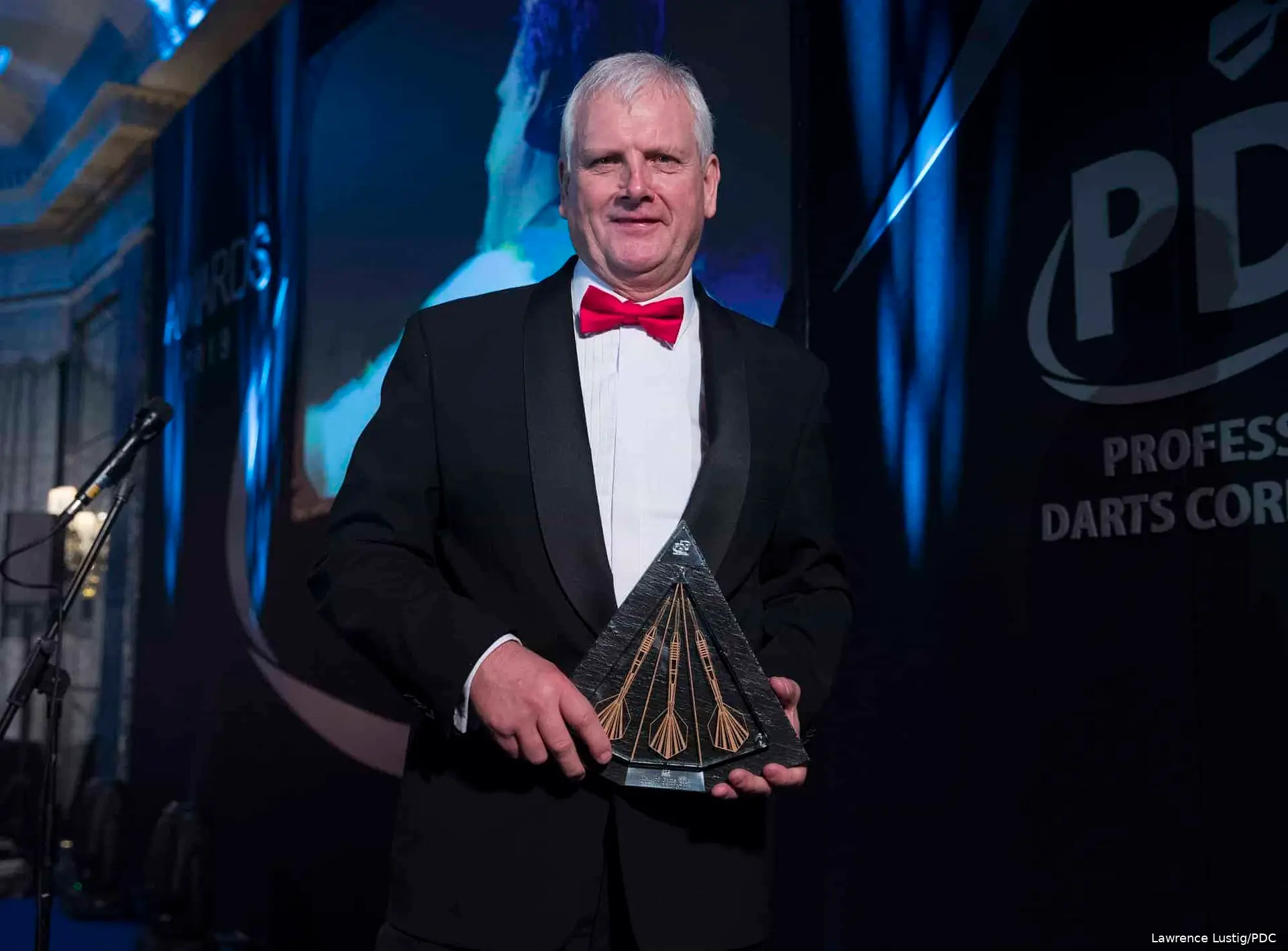
In this series, we regularly take a trip back in the day with a particular darts player. Today, we turn our attention to Rod Harrington. The Englishman was one of the most recognisable players from the early years of modern professional darts.
ADVERTISEMENT
He combined class on stage with a distinctive appearance and became a player who enjoyed considerable success in both the BDO and, later, the PDC. Known by his nickname, ‘The Prince of Style’, Harrington would typically arrive at the oche smartly dressed, often wearing a suit and waistcoat, while also holding his own against the biggest names of his generation.
Successful years with the BDO
Rod Harrington was born in Boreham on 30 December 1957 and began his career at a time when professional darts was still entirely dominated by the BDO. The major split between the BDO and the organisation that would later become the PDC had yet to take place, meaning Harrington achieved his first successes within the BDO structure.
In the early 1990s, the Englishman emerged as one of the leading players on the international circuit. He collected several Open titles, demonstrating that he was among the very best not only on the biggest stages but also at regular tournaments.

Rod Harrington on stage.
Harrington won the Belgian Open in 1991 and 1992 and also claimed the Denmark Open title twice. In addition, he won the French Open in 1991 and 1993 and the Swedish Open in 1991. That year, in particular, established his reputation as a player to be reckoned with.
The absolute highlight came at the 1991 Winmau World Masters. Harrington faced Phil Taylor in the final. The young Taylor already had a world title to his name, but he was still a long way from becoming the untouchable champion he would later prove to be. Harrington managed to defeat Taylor and claim one of the most prestigious titles on the BDO circuit.
ADVERTISEMENT
The victory was particularly significant because Taylor would go on to lose very few major finals throughout his subsequent career. Harrington therefore beat him at a time when ‘The Power’ was already among the world's elite, but was still at the beginning of his historic journey.
First World Championship appearance
A year later, Harrington made his debut at the BDO World Championship. He did not have to wait long to produce an impressive performance, reaching the quarter-finals before eventually being eliminated by Mike Gregory.
Gregory would later reach the World Championship final, meaning Harrington lost in 1992 to a player who would ultimately come within one step of winning the world title.
Expectations were even higher for Harrington a year later. He was the fourth seed at the 1993 BDO World Championship and was considered one of the leading contenders. However, the tournament ended in disappointment as he lost 3–2 to Wayne Weening in the first round.
ADVERTISEMENT
It would prove to be one of his final appearances at a BDO World Championship. Before long, the world of darts would undergo a dramatic transformation.
The great split
In the early 1990s, a power struggle within the world of darts continued to intensify. A large number of leading players broke away from the BDO and joined the World Darts Council, the organisation that would later become known as the Professional Darts Corporation (PDC). Harrington made the switch as well.
The split triggered years of conflict within the sport and changed darts forever. From 1994 onwards, the new organisation staged its own World Championship, and Harrington competed in each of its first ten editions.
He made an immediate impression at the inaugural PDC World Championship, reaching the quarter-finals. However, his real breakthrough came a year later.
ADVERTISEMENT
Harrington reaches the World Championship final
At the 1995 PDC World Championship, Harrington emerged as one of the tournament's leading figures. The Englishman reached the final, where he once again came up against his old rival Phil Taylor.
The match represented more than just a battle for the world title. A few years earlier, Harrington had beaten Taylor in the World Masters final. Now, however, Taylor was on the verge of a period in which he would dominate the world of darts for years to come. Harrington could not match him in the final, with Taylor winning 6–2 to claim his third world title.
Despite the defeat, reaching the final was a major confirmation of Harrington's standing in the sport. He had adapted quickly to the new PDC environment and was among the first generation of players to make a successful transition to the new organisation.
His World Championship performances remained impressive in the years that followed. Harrington reached the quarter-finals again in 1997, before making the semi-finals for the second time a year later, where he once more faced Taylor. Taylor would go on to win that championship as well.
ADVERTISEMENT
In 2001, Harrington reached the last four of the World Championship for the third time in his career. On this occasion, his opponent was John Part. Harrington lost to the Canadian, who would subsequently reach the final. Remarkably, the World Championship was never the tournament in which Harrington celebrated his greatest PDC triumphs. That distinction belonged to the World Matchplay.
Two consecutive World Matchplay titles
In 1998, Harrington enjoyed one of the finest years of his career. At the World Matchplay in Blackpool, he became the player who managed to break Phil Taylor's dominance at the prestigious tournament.
He faced Ronnie Baxter in the final. Harrington came out on top and was crowned champion. The final is particularly remembered for a spectacular 125 checkout from Harrington, which he completed via treble 15, double 20 and double 20. It was a finish that perfectly reflected the Englishman's character: stylish, daring and technically accomplished.
The victory earned him his first World Matchplay title, but Harrington was not finished. A year later, he returned to Blackpool to defend his crown. This time, he faced Peter Manley in the final. While many players struggle to win a major tournament for a second consecutive year, Harrington managed to maintain his level and defeated Manley to become World Matchplay champion for the second year running.
ADVERTISEMENT
In doing so, Harrington made history. For a long time, he and Phil Taylor were the only players to successfully defend a PDC major title. Raymond van Barneveld finally ended that run in 2007 by winning the UK Open for a second consecutive time.
The two Matchplay titles represented the sporting pinnacle of Harrington's PDC career. They also firmly cemented his reputation as one of the finest players of his generation.
Also came close to winning the World Grand Prix
Harrington demonstrated during the same period that he belonged among the elite on other major stages, too. At the inaugural World Grand Prix in 1998, he reached the final.
Waiting for him once again was Phil Taylor. Just as in the 1995 World Championship final, Taylor came out on top. Harrington had to settle for the runner-up position, but reaching the final of the first-ever World Grand Prix once again underlined how important he was to the PDC during that era.
ADVERTISEMENT
Harrington also made his mark at the World Pairs Championship. Partnering Richie Burnett, he reached the final in 1997. There, they were beaten by the Dutch pairing of Raymond van Barneveld and Roland Scholten.
Harrington was therefore among the players who helped shape a period in which the international darts scene increasingly developed into the sport we recognise today.
Injuries lead to a decline
However, Harrington's career also had a difficult side. During the first half of 2001, he underwent no fewer than three knee operations. These physical problems had a significant impact on his performances. After spending years among the world's elite, his level began to decline following the surgeries.
His problems came at an unfortunate time. Harrington had still managed to reach the World Championship semi-finals in 2001, but a clear downturn followed. He started the 2002 World Championship as the third seed, yet by the following year he had fallen outside the world's top 16.
ADVERTISEMENT
His decline had begun. At the 2003 World Championship, Harrington lost to Alan Warriner-Little in the first round. It would ultimately prove to be his final appearance at the tournament.
Nevertheless, Harrington did not immediately bring the curtain down on his career. He continued trying to qualify for major British tournaments for several more years. His final attempt to reach the World Championship came ahead of the 2007 event, when he lost in the first qualifying round. He subsequently decided to bring his professional playing career to a definitive end.
Rod Harrington's World Championship record
| Year | Organisation | Result | Opponent | Score |
| 1992 | BDO | Quarter-final | Mike Gregory | 3–4 |
| 1993 | BDO | First round | Wayne Weening | 2–3 |
| 1994 | PDC | Quarter-final | Peter Evison | 1–4 |
| 1995 | PDC | Final | Phil Taylor | 2–6 |
| 1996 | PDC | Group stage | Nigel Justice / Larry Butler | 3–0 / 2–3 |
| 1997 | PDC | Quarter-final | Dennis Priestley | 2–5 |
| 1998 | PDC | Semi-final | Phil Taylor | 2–5 |
| 1999 | PDC | Second round | Shayne Burgess | 1–3 |
| 2000 | PDC | First round | John Lowe | 2–3 |
| 2001 | PDC | Semi-final | John Part | 5–6 |
| 2002 | PDC | Second round | Dennis Priestley | 3–6 |
| 2003 | PDC | Second round | Alan Warriner-Little | 2–4 |
From player to director and commentator
The end of his playing career did not mean the end of Harrington's involvement in darts. He became a director within the PDC, remaining closely connected to the organisation he had helped build during his playing days. He also became a well-known analyst and commentator for Sky Sports.
His experience as a player from the first generation of the PDC made him particularly well suited to the role. Harrington had experienced first-hand how professional darts evolved from a sport dominated by the BDO into a global professional game with the PDC as its leading organisation.
His distinctive style remained evident in his commentary work, too. The man who had been known as ‘The Prince of Style’ as a player had taken on a new role, sharing his knowledge and experience with a new generation of darts players.
At one stage, Harrington also managed Colin Lloyd, who went on to become world number one. This allowed him to remain involved in the development of elite players behind the scenes.
In 2022, his time with Sky Sports and the PDC eventually came to an end. It marked the closing of a chapter that had begun more than three decades earlier.
Son Ryan follows in his footsteps
In 2015, the Harrington name reappeared in professional darts. This time, it was not father Rod picking up the darts, but his son Ryan. The younger Harrington made an immediate impression at the UK Open, reaching the last 64 in both 2015 and 2016.
His development received a significant boost in early 2018. In January of that year, Ryan Harrington secured a PDC Tour Card at Q-School, earning himself a place on the PDC Pro Tour for the following two seasons.

Ryan Harrington in action.
A few months later, he returned to the UK Open for his third appearance at the tournament. As with his two previous outings, Harrington's run ended in the last 64.
However, his time on the PDC Pro Tour proved relatively short-lived. At the end of 2019, Ryan Harrington lost his Tour Card, bringing his spell as a PDC professional to an end, at least for the time being. His career ultimately remained in the shadow of his father's achievements.
A special place in darts history
Rod Harrington might not be the first name mentioned when discussing the greatest players of all time. Nevertheless, his influence on professional darts should not be underestimated.
He belonged to the generation that made the transition from the BDO to the new PDC and subsequently managed to establish himself among the very best in the new environment. His victory over Phil Taylor in the 1991 World Masters final remains one of the most memorable chapters of his career.
His two consecutive World Matchplay titles, however, arguably represent his greatest legacy as a player. Harrington won the prestigious tournament in 1998 and 1999 and remained, for many years, the only player alongside Taylor to successfully defend a PDC major title.
His three World Championship semi-final appearances and one final also demonstrate just how consistently he performed during his best years. Ultimately, the one achievement missing from his trophy cabinet was a world title.
His career also illustrates just how unforgiving professional darts can be. After years at the top, serious knee problems set him back, and his ranking and performances quickly deteriorated. Nevertheless, he continued trying to qualify for the biggest tournaments until 2007.
That determination was consistent with the image Harrington projected throughout his career. He was a player with style, but also one who competed at the highest level for many years.
His nickname, ‘The Prince of Style’, was therefore about more than his distinctive clothing. Harrington had a personality and presence of his own and was one of the players who helped shape the professional image of the PDC during the 1990s.
His induction into the PDC Hall of Fame in 2019 ultimately provided official recognition of his importance to the sport. Harrington was among the players who experienced the transition from traditional darts to the modern professional era first-hand and played a significant role in that transformation.
Read also

From his BDO tournament victories in Belgium, Denmark, France and Sweden to the World Masters, from the 1995 World Championship final to his two World Matchplay titles, Rod Harrington built a career that may not always receive the same attention as those of Phil Taylor, Raymond van Barneveld and other icons, but which undoubtedly occupies an important place in darts history.
Perhaps that is the best way to look back on the career of ‘The Prince of Style’: as a player who stood at the top of the sport in two different eras, defeated great champions, competed in major finals and ultimately left his mark on professional darts away from the oche as well.
I stumbled into the world of darts quite by accident back in 2013. For a Journalism School assignment, I had to produce a live sports report and as it happened, the European Tour event in Veldhoven was the only available option. That weekend, I caught the darts bug. The post-match interviews especially appealed to me, as darts players tend to be much more open and approachable than what you usually see with footballers on television.
After a few detours, I joined Dartsnieuws.com in 2017 as editor-in-chief. I don’t have much competitive experience myself, although I once entered a PDC Development Tour weekend just to experience what it’s like from a player’s perspective. I even managed to win a leg against a Tour Card holder and, quite by accident, earned £50 in prize money.
In 2022, I was also involved in the founding of the TOTO Dart Kings, a commercial darts team, where I worked as media manager for three years. Unfortunately, due to new legislation in the Netherlands, that project came to an end in 2025.
Through my work in darts, I’ve been fortunate to travel to some incredible events, from Premier League nights at Ahoy Rotterdam, to several World Championships, and even the US Darts Masters at Madison Square Garden in New York.
Beyond darts, I’m a passionate sports fan in general. You can always wake me up for a game of tennis or padel, and I love following football, tennis, padel, cycling, Formula 1, and ice skating.
claps 1visitors 1
Just in

Popular news
Latest comments
- And why should he listen to you?Deduce635807-11-2026
- Ultimately it is a bye for whoever draws Barney. It will be another stroppy and sulky performance once he goes behind. Barney was excellent but really must completely call it a day now.richieburnettrocks07-11-2026
- I'm disappointed he was not able to secure a spot at the Grand Slam. With Carl Sneyd taking care of Daryl Gurney, he would have had to beat Andy Boulton before facing the winner of Sneyd vs Mensur Suljović for a Grand Slam spot. Unfortunately, after beating Filip Bereza comfortably, he succumbed to Boulton, and the board would ultimately be won by the highly inconsistent Carl Sneyd. Since he could instead have been drawn against the likes of Cristo Reyes, Dirk van Duijvenbode and Stephen Bunting, I think once Gurney was out of the picture he would have been favourite to win his board, and it seems like a massive missed opportunity to put 5 grand on his ranking and seal another major TV appearance ahead of the Worlds. The highs and lows of following Raymond van Barneveld!Deduce635806-11-2026
- Probably i will receive a lot of backlash and hate for this reaction, but well, so be it. I am more than sick and tired of those lies of you Barry Hearn. How dare you defend yourself over the back of Fallon’s son! He has a disability and not an illness, so let me correct that for you! I know because I have the exact same disability. I have tried to reach out to Fallon in the past, and offered her to help her and her son, because I was struggling with the same problems, and I understood the boy. I wanted him to have finally someone who understood him. However she told me that she did not want my help, and I have respected Fallon’s choice. I have never asked Fallon for money. They don’t need money in that case. I only ever wanted the best for Fallon and Rory, but I have to be honest about the situation. Fallon should tell the true story and not be forced to tell lies. I don’t hate Fallon, and I don’t begrudge or envy a single penny that she gets, but this situation/case is just not fair. I hate the lies and the dishonesty and injustice. I don’t want Fallon to be hated because there is an unfair disadvantage created. Don’t proclaim your false lies over the back of Rory! I only stand for integrity and justice. I am precisely the one who always sticks up for Fallon. And you don't, you don't give a damn about them. You were never there for them, and now you only want to save your own position! You are just trying to talk your way out of your own bad behavior at the expense of someone with a disability. And to Fallon, I don’t know if this may ever reach you, and you read it, but I want you to know I love you and I love your son Rory very much, I am sorry how things developed and went. I hope you and Harriet are still friends. I am sorry if I were too persistent to you, or you experienced it that way, but it was never my intention. Please understand I have autism as well. As Barry Hearn would say, I am only just a human being too, and I also make mistakes and misjudge things sometimes. I promise you I did everything out of the deepest love and care for you and Rory. If I were you, I should just keep all the money, only please never be dishonest or tell lies anymore for Barry Hearn, or anyone else. I hope you have the best life, and I wish nothing more than the best for you. I have always loved the two of you. Farewell.Hiddo05-11-2026
- She is a professional. If darts is her income, she is a professional. Same as Adrian Lewis, Martin Adams. A tour card just means someone can play on the PDC tour. You could even make a case that Clayton wasn't a professional (until recently I believe) because he had employment elsewhere.BandB04-11-2026
- She's technically not a professional though as she doesn't hold a pro tour card.mr-pablo04-11-2026
- Such a shame that lakeside has been reduced to this. Fantastic venue,and previously a great tournament. Not any morerick6703-11-2026
- Seems to me that the top 16 players pick and choose whatever they want to play. Good,all the money will get spread out more. They get more money from exhibitions than tournaments so let them all withdrawrick6703-11-2026
- Play all legs and the winners split the pot. Luke gets the lot of he wins them all. If your occupation is darts player you can't enter, regardless of ability.BandB01-11-2026
- I'm quite a jaded person all things considered, but to be honest I found Beat Luke Littler to be pretty entertaining. It certainly wasn't seamless, which is to be expected given the lack of precedence, but I actually think the pacing was pretty good, the production was impressive, and there was a good sense of humour and levity to it. I think it was a very ambitious undertaking but one that, for the most part, paid off. I liked the system with the four pots and I think it added to the drama and intrigue. I enjoyed seeing the diverse range of entrants and learning about their backstories. I think the interactivity was pretty clever and well-integrated. The panel was a little incoherent at times; Lee Mack shone however, and his improvisational skills were appreciated during some more awkward interstitial moments. As far as the darts is concerned, it was a shame that the format didn't allow Littler to get into full flow. You obviously don't want him to steamroll everyone but you want to feel like you're getting the full Littler package rather than seeing him struggling to get out of first gear. I will say that his leg against Jayden Walker was very impressive, but it was mostly downhill from there. The attraction revolves around Littler being this untouchable, indomitable force, yet the format doesn't really allow him to fulfil that characterisation. As for Fallon Sherrock, she was mightily impressive and deserved the victory. It is a testament to her unshakeable character that she was able to bang in a 14-darter under such mind-bending pressure. Everything that has been said about the misleading marketing is valid, though they were clear about their eligibility criteria and were able to offload the responsibility somewhat by bringing the viewers into the decision-making process in real time. What is clear though, is that Fallon played the game according to the rules, and she should not be criticised for that, much less abused. I will admit though that it is a kick in the teeth for those true amateurs who committed time and money to the course, and I would also question those who think pub players would have no chance, given that some of Littler's winning legs were dispatched in 7 visits to the board! The great thing about darts is that it isn't so much that amateurs cannot replicate the feats of brilliance pulled off by professionals of the sport, than it is that they simply cannot replicate the consistency of their output, something that this format almost entirely removes from the equation. It should also be noted that, financially, Fallon certainly stands to benefit much less in relative terms from the paycheque than would your average pub thrower, as I'm sure she nets a fair income from the lucrative exhibition circuit alone. What I do hope is that she might use this as an opportunity to really build up a head of steam heading into the new season, as it seems long overdue that she come through Q-School and really take it to the pros on a week-in week-out basis, but whatever she chooses to do, she has certainly achieved enough already for one if not several lifetimes, so who am I to dictate terms? To conclude though, I will state once again that I found Beat Luke Littler to be a pretty enjoyable evening of entertainment. I do feel for the contestants who never actually had the chance to try their luck against the world #1, although I suppose it comes with the format, but all which inevitably raises the question: will Netflix be tempted to do it all again next year? It's hard to say. Whether it would be financially viable, I can't weigh in there. One point I have been making though, and which I touched on earlier, is that the entire concept relies on a public perception that Littler is more or less unbeatable, and that certainly hasn't been the case of late. If the execs had been trying to pitch the show in recent months while Littler has seemed vulnerable, rather than when he was mopping up almost every major title on the calendar, it would certainly be a tougher sell. We will have to see in about 6 months' time whether Littler can still reliably command perception as a near-unstoppable force in darts, and then we'll have a clearer idea about whether we should expect a second helping. Even as a one-off experiment though, and with all the controversy taken into account, I still don't think they disgraced themselves by any means, and that will probably be my lingering assessment of the event when all is said and done.Deduce635801-11-2026